Tables & Chairs
Do You Need a Chair for Every Guest at a Party?
A seated meal needs one real chair per guest. A mingling party may not. Use the EventRent AZ Seat Promise Check to protect guest comfort, surfaces, and room flow.
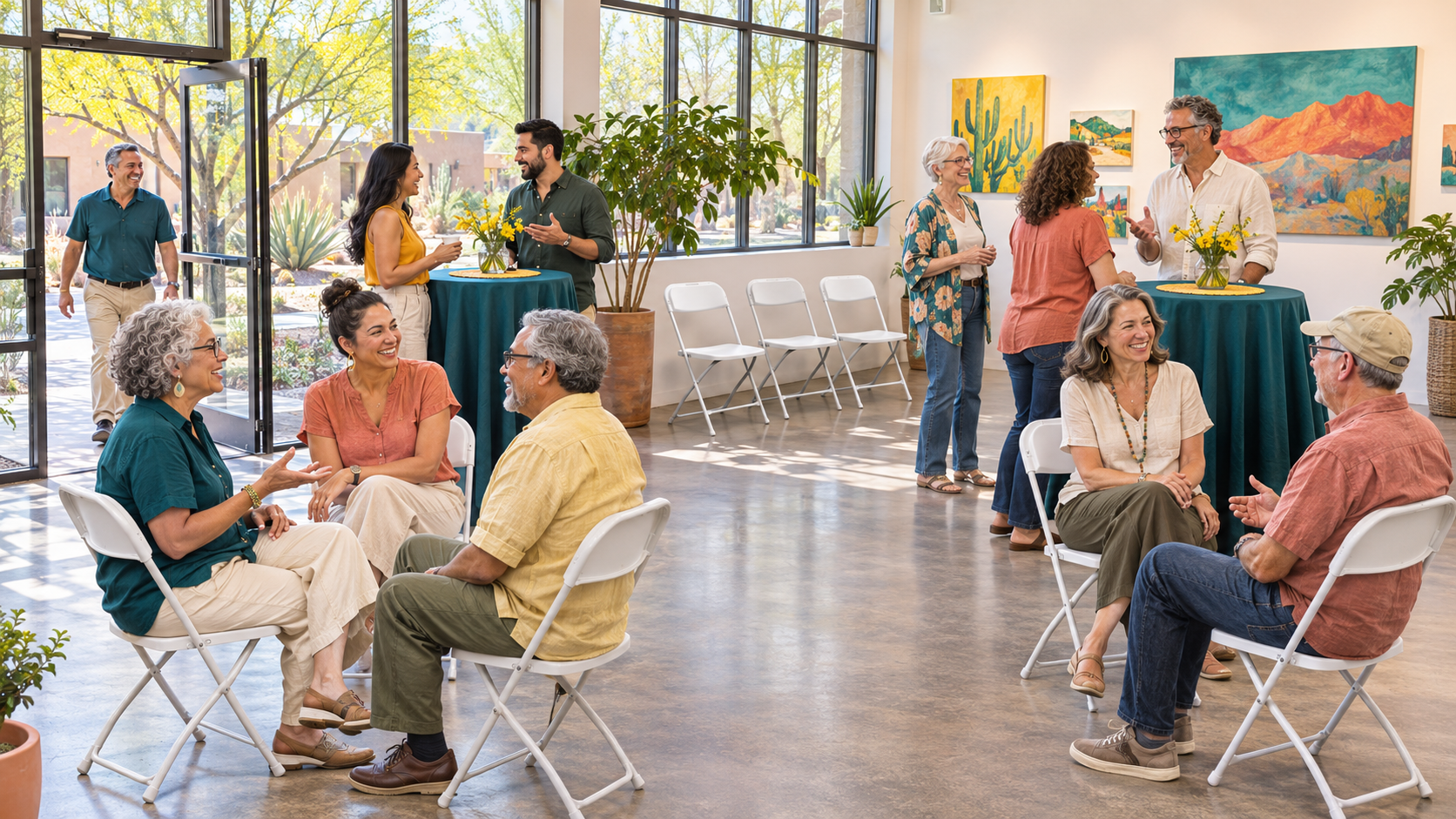
The chairs are lined against the wall, the patio suddenly looks smaller, and you are wondering whether every person on the guest list truly needs one.
Provide one real chair per guest whenever everyone is expected to sit at the same time, especially for a meal, ceremony, presentation, movie, or seated activity. A casual open house or mingling party may not need one chair per invited guest, but it still needs guaranteed seats for anyone who needs or prefers one, enough seating for the busiest sitting moment, and clear places to set food and drinks. Do not begin with a universal percentage. Begin with what your party asks people to do.
Quick answer: make a seat promise before you count chairs
Use the EventRent AZ Seat Promise Check:
- Moment: When will the largest number of guests want or need to sit?
- People: Who needs a stable, easy-to-reach seat guaranteed from arrival?
- Purpose: Does the food, program, or activity only work while seated?
- Surface: Where will standing guests safely set a plate or drink?
- Path: Can every chair be used without blocking the entrance, restroom, food, activity, or exit route?
If the plan is unclear on any one of those questions, the answer is not a smaller chair number. The answer is a clearer party format.
Table of contents
- Know when every guest needs a chair
- Know when flexible seating can work
- Guarantee the right seats before adding extras
- Pair chairs with the surfaces guests need
- Protect room flow from unused furniture
- Compare four common party formats
- Run the 10-minute room walk
Give every guest a chair when the party creates one seated moment
Some event formats answer the question for you. If the host announces dinner, begins a ceremony, turns on a movie, starts a presentation, or hands everyone a project that requires a table, guests reasonably expect a real place to sit.
If everyone is expected to do the same seated thing at the same time, plan one suitable chair for every participant. Include the hosts, helpers, speakers, children, and other people who are easy to leave off the guest count but will use the setup.
A dining chair also needs a dining place. The chair count is incomplete if several guests have nowhere to put a plate, use utensils, or reach the shared table comfortably. The same is true for crafts, games, meetings, and cake decorating. Count the work surface and the chair as one usable place.
This is where the EventRent AZ table-and-chair planning guide becomes useful. Use it after deciding the seat promise to translate the guest count into guest tables, support tables, and a real-space fit check.
Do not treat a sofa arm, retaining wall, cooler, stair, folded table, or decorative stool as a chair. If the party asks someone to sit, give them furniture designed, stable, and suitable for that job.
A mingling party may use fewer chairs, but not fewer decisions
At a short open house, gallery-style gathering, casual networking event, or backyard party built around movement, not every guest will sit at once. Some people will stand by a cocktail table, join a conversation, watch an activity, or move between food and the patio.
That does not justify copying a fixed ratio from another event. A two-hour open house with light bites behaves differently from a four-hour family party with a meal. A group of familiar coworkers behaves differently from a mixed-age neighborhood gathering. A room with supportive bar-height surfaces behaves differently from a bare room where every standing guest holds a plate and drink.
Plan around the peak sitting moment instead. Ask what will make the most people look for a chair at once:
- food is served and guests stop moving;
- cake, gifts, a toast, or announcements begin;
- children start an activity while adults watch;
- the sun, temperature, noise, or event duration changes;
- a new group arrives before an earlier group leaves; or
- guests who were standing simply want a break.
If the answer is “most of the party,” add more chairs. If the answer is one brief optional moment, a flexible mix can work, provided the guaranteed seats stay available.
For a standing-height setup, the EventRent AZ cocktail-table layout guide explains how to create useful landing places without turning them into barriers.
Guarantee seats for people, not categories
A chair plan should not force a guest to explain a private health detail in the middle of the party. Give people a quiet way to share access or comfort needs before the event, then make the solution ordinary and easy to reach.
Your invitation or follow-up can ask:
Is there anything we can do with seating, access, food, or timing to make the event more comfortable for you?
Use the answers privately. Do not label a chair with a diagnosis, announce why it is reserved, or place the only supportive seat away from the group.
Even without a specific request, guarantee a stable chair for any guest you know should not have to compete for one. That may include a person recovering from an injury, someone who uses a mobility aid, a pregnant guest, a caregiver holding or feeding a child, an older relative, or anyone who has already asked for a seat. These are planning examples, not assumptions about what a person can do. Ask when you are unsure.
A guaranteed seat must remain available. A chair buried behind gifts, used for purses, placed in full sun, or isolated beyond the conversation is not really available.
When guests do not know one another, build small open seating clusters rather than one closed circle. The EventRent AZ guide to helping unfamiliar guests connect shows how an open edge and one easy seat can make a conversation more welcoming.
A chair does not solve the plate-and-drink problem
Hosts sometimes remove chairs to create energy, then give standing guests nowhere to put anything down. The result is not lively. It is a room full of people balancing two objects while trying to greet someone.
Match the furniture to the food:
| Food or activity format | Seating promise | Surface promise |
|---|---|---|
| Plated meal or food requiring a knife and fork | One suitable chair per diner | One real dining place per diner |
| Buffet meal eaten over time | Enough seats for the peak meal moment, with guaranteed seats protected | Dining-height or standing-height surfaces for every eating zone |
| Appetizers and drinks | Guaranteed seats plus comfortable flexible seating | Several easy-to-reach landing surfaces outside the entrance and food line |
| Cake, gifts, toast, or short program | Seats for anyone who needs one and for the people featured in the moment | A clear view plus a safe place for plates, gifts, or program materials |
| Seated craft, game, or meeting | One chair per active participant | One usable work place per participant, with supplies outside knee space |
Do not place the only drink surface inside a chair cluster or the only seating inside a food line. Guests should be able to enter, sit, stand, and move on without asking several people to shift.
More chairs can make a party less comfortable
A folding chair uses little space while folded. It uses much more when open, occupied, and pulled away from a table. That real footprint matters more than whether the empty chairs technically fit before guests arrive.
Open every chair you plan to use. Pull it back as a guest would. Sit in the outside chair. Walk behind it with a plate. Test the path from the entrance to seating, food, restroom, activity, and exit.
If the route disappears, reduce furniture, change the table shape, move a cluster, or use a nearby room. Do not solve the problem by squeezing chair backs together and assuming guests will remain still.
Keep unused extras folded and stored only when the venue, rental terms, and item instructions allow it, and only where they cannot fall, block an exit, or invite guests to unfold them in a bad location. For owned or borrowed chairs, inspect the frame, hinges, feet, locks, and seat before setup. The U.S. Consumer Product Safety Commission recall search can help check a known product or manufacturer. Follow the manufacturer's instructions and stop using any damaged, unstable, incomplete, or recalled item.
Compare four common party formats
| Party format | Do you need one chair per guest? | What to protect |
|---|---|---|
| Backyard birthday with a shared meal | Usually yes for the meal window | Dining seats, child and caregiver needs, shade or indoor comfort, and a route that does not cross the activity area |
| Drop-in housewarming or open house | Not automatically | Guaranteed seats, a peak-arrival plan, landing surfaces, and a clearly stated food format |
| HOA or company mixer | Depends on the program and duration | Accessible venue requirements, staff and speaker seating, small conversation clusters, and clear routes |
| Movie night, ceremony, or presentation | Yes for everyone expected to watch, unless another suitable seating type is deliberately provided | Sightlines, surface conditions, comfort, access, power or equipment zones, and safe entry and exit paths |
The phrase “not automatically” does important work. It means the event format allows movement. It does not mean the host can ignore guests who need a chair or rely on a percentage that came from another room and another guest list.
If a consistent basic seat fits the plan, review the current EventRent AZ white folding chair details for a concrete local reference. Confirm current availability, quantity, delivery, pickup, setup, surface suitability, and rental terms directly before making any promise.
Run the EventRent AZ 10-minute room walk
Do this with the actual furniture or taped footprints before the event:
- Enter like a guest. Is the first available seat visible without crossing the food line?
- Find every guaranteed seat. Is each one stable, comfortable, included in the group, and free of bags or supplies?
- Begin the peak moment. Imagine dinner, cake, a toast, a movie, or the busiest arrival. Where does each person naturally go?
- Use the surfaces. Hold a plate and drink. Can you set either down without taking someone else's place?
- Occupy every chair. Pull chairs back and test the paths behind them.
- Move through the whole event. Walk entrance, seating, food, restroom, activity, and exit routes.
- Remove one unnecessary piece. If the room works better and the seat promise still holds, keep it out.
Then count. If exact furniture costs affect the larger plan, place the real current numbers in the free EventRent AZ party budget calculator. The calculator is a planning tool, not a rental quote.
Frequently asked questions
Do I need one chair per guest for a buffet party?
If everyone will eat a full meal during the same window, providing one real seat and eating place per guest is the clearest plan. If food is light and served across a true open-house window, flexible seating may work, but protect guaranteed seats and test the peak meal moment rather than using a fixed percentage.
How many chairs do I need for an open house?
There is no universal ratio that fits every open house. Base the count on the overlap between arrival groups, event duration, food format, guest needs, and the moment most people are likely to sit. If arrival timing is uncertain, leave room to add approved chairs without blocking paths.
Are cocktail tables a replacement for chairs?
No. Cocktail tables give willing standing guests a place for food, drinks, and conversation. They do not replace stable seating for guests who need or prefer it, and they do not turn a seated meal into a comfortable standing event.
Should I keep extra folding chairs nearby?
Only if they can be stored safely, the item and venue rules allow it, and someone knows where an added chair can open without blocking a route. Inspect owned or borrowed chairs before use. Confirm rental handling and storage expectations with the provider.
The right chair count is a promise, not a percentage
Seat everyone when the party asks everyone to sit. For a mingling event, guarantee the seats people need, plan for the busiest sitting moment, add useful landing surfaces, and protect the paths that make the room work.
Once that promise is clear, the chair number becomes easier. You are no longer guessing how many people might sit. You are deciding what every guest should be able to do comfortably when the party is at its fullest.