Birthday Party Planning
How to Plan a Teen Birthday Party That Feels Like Their Party, Not Yours
Give the teen real ownership while the parent protects the budget, timing, transportation, supervision, and room. Use the Teen-Parent-Room Party Agreement to build a night that feels age-appropriate without overplanning it.
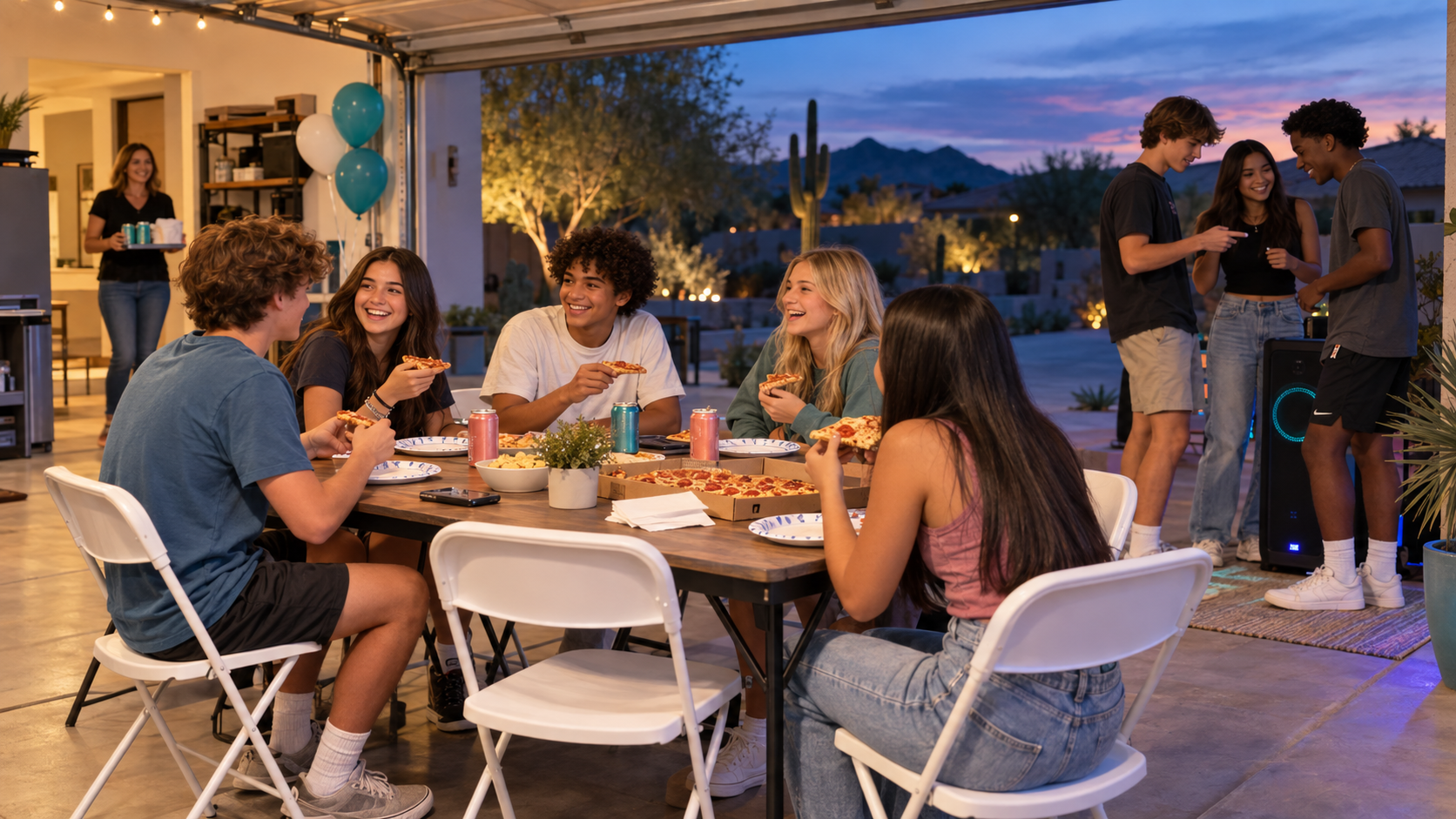
The fastest way to make a teenager nervous about a birthday party is to plan every minute before asking what they want. The fastest way to make a parent nervous is to hand over the whole night with no guest list, ending time, or plan for the house.
The better answer is shared ownership: let the teen lead the vibe, guest experience, food, music, and main activity. Let the parent protect the budget, location, timing, transportation, supervision, and house rules. Then make the room support both.
Quick answer
Start with one short planning conversation. Ask your teen to choose the feeling, the people, and one reason friends will want to come. The parent then sets the non-negotiables. Build the setup around one main social anchor, easy food, several places to sit, and enough unstructured time for teenagers to talk.
The original EventRent AZ Teen-Parent-Room Party Agreement below makes the handoff visible before anyone starts shopping.
In this guide
- Start with agreement, not a theme
- Use the Teen-Parent-Room Party Agreement
- Compare seven teen party formats
- Build a room that supports the party
- Use a flexible sample flow
- Send an invitation parents and teens understand
- Supervise without becoming the entertainment
- Run the 20-Minute Teen Party Room Check
- Teen birthday party questions
Start With Agreement, Not a Theme
Before you suggest decorations, games, or a schedule, ask four questions:
- Who do you actually want there? A small close-friend night and a larger class party need different rooms, food, energy, and adult support.
- What should the party feel like? Relaxed, funny, active, creative, competitive, dressed-up, or built around a favorite movie or sport are more useful answers than a color palette.
- What is the one thing people will do together? That might be a movie, karaoke, a casual tournament, a make-your-own-food table, a craft, a watch party, or simply pizza and a good playlist.
- What would make this feel embarrassing or childish? This question can save more money than any coupon. Listen before defending an idea.
You do not have to approve every request. The goal is to find the area where teen choice and parent responsibility can both be real.
Set a comfortable ceiling early. If the conversation needs a neutral place to organize food, seating, entertainment, decorations, and a buffer, use the EventRent AZ party budget calculator. Keep the numbers private if your teen does not need every detail, but explain the tradeoffs they are allowed to make.
Use the Teen-Parent-Room Party Agreement
The agreement has three owners. Each owner gets real decisions and a clear finish line.
| Owner | Decisions this owner should lead | Finish line before the party |
|---|---|---|
| Teen leads | Guest list, overall vibe, music, food preferences, main activity, invitation tone, and anything that feels childish or uncomfortable | The party has one clear identity and friends know why they are coming |
| Parent protects | Budget, address, start and end time, transportation, adult presence, guest boundaries, home or venue rules, food and allergy communication, and emergency plan | The adult can explain the boundaries calmly and enforce them consistently |
| Room supports | Arrival point, food and drink placement, conversation seating, main activity, sound level, off-limits areas, restroom route, cooling, and pickup | Guests can arrive, join, eat, sit, move, and leave without needing the host to direct every step |
Do not let one owner quietly absorb all three jobs. A teen who chooses every detail but does not understand the fixed boundaries will feel blindsided. A parent who controls every detail may produce a polished party the guest of honor does not recognize as theirs.
Write the agreement on one page or in a shared note. It is not a contract. It is a way to prevent the same decision from being argued three different times.
Compare Seven Teen Party Formats by the Kind of Night They Create
Large search-result lists make it easy to collect ideas and hard to choose one. Start with the type of social experience your teen wants.
| Party format | Best when the teen wants... | Main setup need | Watch for |
|---|---|---|---|
| Pizza, playlist, and hangout | Plenty of conversation with no formal program | Flexible seating, snack table, music, and one optional game | A room that feels empty because there is no social anchor at arrival |
| Backyard or indoor movie night | A familiar activity that removes pressure to perform | Clear sightlines, comfortable seating, sound, snacks, and a realistic ending | Starting the movie so late that pickup becomes confusing |
| Casual tournament | Friendly competition around one game or console | One clear bracket or rotation, waiting-area seating, and food away from play | Eliminated guests having nothing to do |
| Make-your-own food or dessert night | Something hands-on that naturally starts conversation | An organized ingredient table, seating, cleanup plan, and allergy review | Too many choices or a kitchen bottleneck |
| Creative studio night | Painting, jewelry, decorating, photography, or another shared project | Complete work surfaces, task lighting, supplies, drying or take-home area | A project that needs more instruction than social time allows |
| Sports, awards, or fight-night watch party | A built-in shared focus with room to talk | Visible screen, reliable sound, food, seating, and a plan for breaks | Treating every guest like an equally serious fan |
| Evening patio lounge | Music, photos, snacks, and a more grown-up atmosphere | Comfortable edge seating, cooled indoor access, lighting, and neighbor-aware sound | Decor becoming the whole plan while guests still have nowhere natural to gather |
For a movie format, the Arizona backyard movie-night guide covers seating, snacks, timing, and guest comfort. For any outdoor East Valley format, check the event-hour forecast and preserve an indoor or cooled option rather than assuming the evening will be comfortable.
One format is enough. Add one optional backup for guests who do not want the main activity. A deck of cards, a conversation table, a photo corner, or a second low-pressure game can do more than a packed schedule.
Build a Room That Supports the Party Instead of Policing It
A teen party usually needs three functions, even when everything happens in one room.
Give arrival an easy first move
Guests should see where to put a gift or bag, where food is, and where people are gathering. The first person should not be forced to stand alone in the middle of a decorated room.
Start music before arrival. Put one familiar activity, snack, or conversation point within view. Keep the entrance clear so late guests can join without interrupting the whole party.
Put the main social anchor in the center
The anchor can be a movie, food table, console, craft, game, or shared watch screen. It should be obvious without a speech.
Do not place food where guests must cross the activity repeatedly. Keep cords, bags, coolers, and table legs out of the route between the entrance, seating, food, restroom, and pickup door.
Create more seats than one formal row
Teenagers may sit briefly, stand, move, and return. Use small conversation clusters or edge seating instead of lining every chair toward an empty center. Give guests a place to eat without requiring the whole group to sit for a formal meal.
If the setup needs temporary tables or chairs, first use the table and chair planning guide to separate guest seating from food, cake, gifts, and activity surfaces. Then confirm current options through the EventRent AZ rental inventory. Product availability, quantities, delivery, pickup, and setup details require direct confirmation.
The parent supervision point should have a real purpose, such as refilling drinks or managing food, without becoming a chair in the center of the teen circle.
Use a Flexible Flow With a Clear Beginning and Ending
Teenagers need less visible programming than younger children, but they still benefit from a party that knows what happens next. This two-and-a-half-hour example is an editorial starting point, not a universal rule.
| Time | What happens | Why it works |
|---|---|---|
| 0:00 to 0:20 | Music, food, and easy arrival activity | The first guests have something to do and late arrivals do not miss the main moment |
| 0:20 to 1:15 | Main activity or shared focus | The party gains a reason to be together without filling the entire night |
| 1:15 to 1:45 | Pizza, dessert, cake, or a relaxed food break | Conversation resets and the host can check the room naturally |
| 1:45 to 2:15 | Open hangout, music, photos, or optional backup activity | Teens get the unstructured time they often wanted most |
| 2:15 to 2:30 | Clear last song, final photo, dessert, or pickup window | The ending feels intentional instead of abrupt or endlessly delayed |
Choose the duration from the actual format, ages, transportation plan, venue rules, and your teen's friend group. Put the ending time on the invitation and confirm what happens if a ride is late.
Send an Invitation Parents and Teens Can Both Understand
The message can sound like the teen, but it still needs the details a caregiver may use to make a decision.
Include:
- who is hosting and whose birthday it is;
- exact date, start time, and end time;
- address and the correct entrance;
- the main activity and any clothing or equipment note;
- food that will be served and how to share relevant allergy information;
- drop-off, pickup, parking, and ride expectations;
- the RSVP deadline and a parent contact;
- whether the invitation is limited to the named guest.
Copy-ready example:
Come celebrate [Name]'s birthday with pizza, music, and an outdoor movie on [date] from [start time] to [end time]. We will be at [address], using the [gate or entrance]. Bring [blanket or item] if you would like. Please RSVP to [contact] by [date] and share any food or access information we should know. Pickup begins at [time]. This invitation is for the named guest.
Avoid posting a home party as an open public event. Decide in advance how the host will handle a guest who asks to bring another person.
Supervise Without Becoming the Entertainment
The adult does not need to lead every activity, but the adult still owns the environment.
The American Academy of Pediatrics' parent guide to teen parties recommends planning with the teen, setting a guest list and start and end times, agreeing on rules, providing food and nonalcoholic drinks, and keeping an adult present.
Translate those principles into a calm pre-party conversation:
- Which rooms or outdoor areas are open?
- Are guests allowed to leave and return?
- How will the host respond to alcohol, drugs, vaping, property damage, unsafe behavior, or an uninvited guest?
- Who can a teen quietly approach if they feel uncomfortable or need a ride home?
- How will the adult check in without recording or posting guests without permission?
Lock away alcohol, medications, firearms, and anything else that should not be accessible. Confirm current Arizona law, property rules, venue rules, and household expectations with a qualified human before publication and before the event.
The most respectful supervision is predictable. Tell your teen where the adult will be, what the adult will monitor, and what will trigger intervention. Do not invent a surprise enforcement plan after guests arrive.
Run the 20-Minute Teen Party Room Check
Twenty minutes before the first guest arrives, stop decorating and walk the room as a teenager, a parent, and a late-arriving guest.
- Arrival: Is the correct door or gate obvious, and is there a place for bags and gifts?
- First minute: Is there music, food, or an easy activity already available?
- Seating: Can small groups sit without forming one formal row?
- Food: Can guests get food and drinks without crossing the main activity?
- Sound: Can people talk, and can the adult hear a problem without standing in the center?
- Privacy: Are bedrooms, offices, storage rooms, medication, alcohol, and private information secured?
- Paths: Are exits, restroom routes, cords, coolers, table legs, and pickup areas clear?
- Outdoor comfort: Does the current weather still support the plan, and is the indoor option ready?
- Adult handoff: Does another responsible adult know the rules, key contacts, and what to do if the host is occupied?
- Ending: Is the pickup window clear, and does the party have one natural final cue?
If the room works without the host narrating it, the setup is ready.
Teen Birthday Party Questions
How many activities should a teen birthday party have?
Start with one main social anchor and one optional backup. A movie, shared meal, karaoke setup, tournament, craft, or watch party can carry the night. Too many mandatory activities can make the party feel younger and leave less time for conversation.
How long should a teen birthday party last?
There is no universal length. Choose the timing from the format, ages, transportation, venue or neighborhood rules, and the friend group. The sample in this guide uses two and a half hours because it allows arrival, one main moment, food, open hangout time, and a clear ending, but the host should adjust it.
Should parents stay at a teen birthday party?
A responsible adult should be present and prepared to supervise. The adult can stay nearby with a useful role instead of hovering inside every conversation. Tell the teen where the adult will be and what situations will cause the adult to step in.
What if the guests do not want to play the planned game?
Do not force it. If the party still has food, music, comfortable seating, and a safe place to talk, the anchor has already done its first job by giving guests an easy way to arrive. Let the group move on unless the change creates a safety, property, timing, or transportation problem.
Let the Teen Lead the Feeling While the Parent Protects the Night
A teen birthday does not need forty ideas. It needs a guest of honor who recognizes the party as theirs, friends who know what they are walking into, and an adult who has made the important boundaries clear before the doorbell rings.
Let the teen lead. Let the parent protect. Let the room quietly support both. That is how a birthday can feel more grown-up without asking the adult to stop being responsible.