Holiday and Seasonal Party Planning
Family Christmas Party Games for All Ages: Pick 3, Not 30
Skip the list of 30 games. Use the EventRent AZ 3-Game Christmas Lineup to plan an easy opener, one shared family moment, and a calm closer.
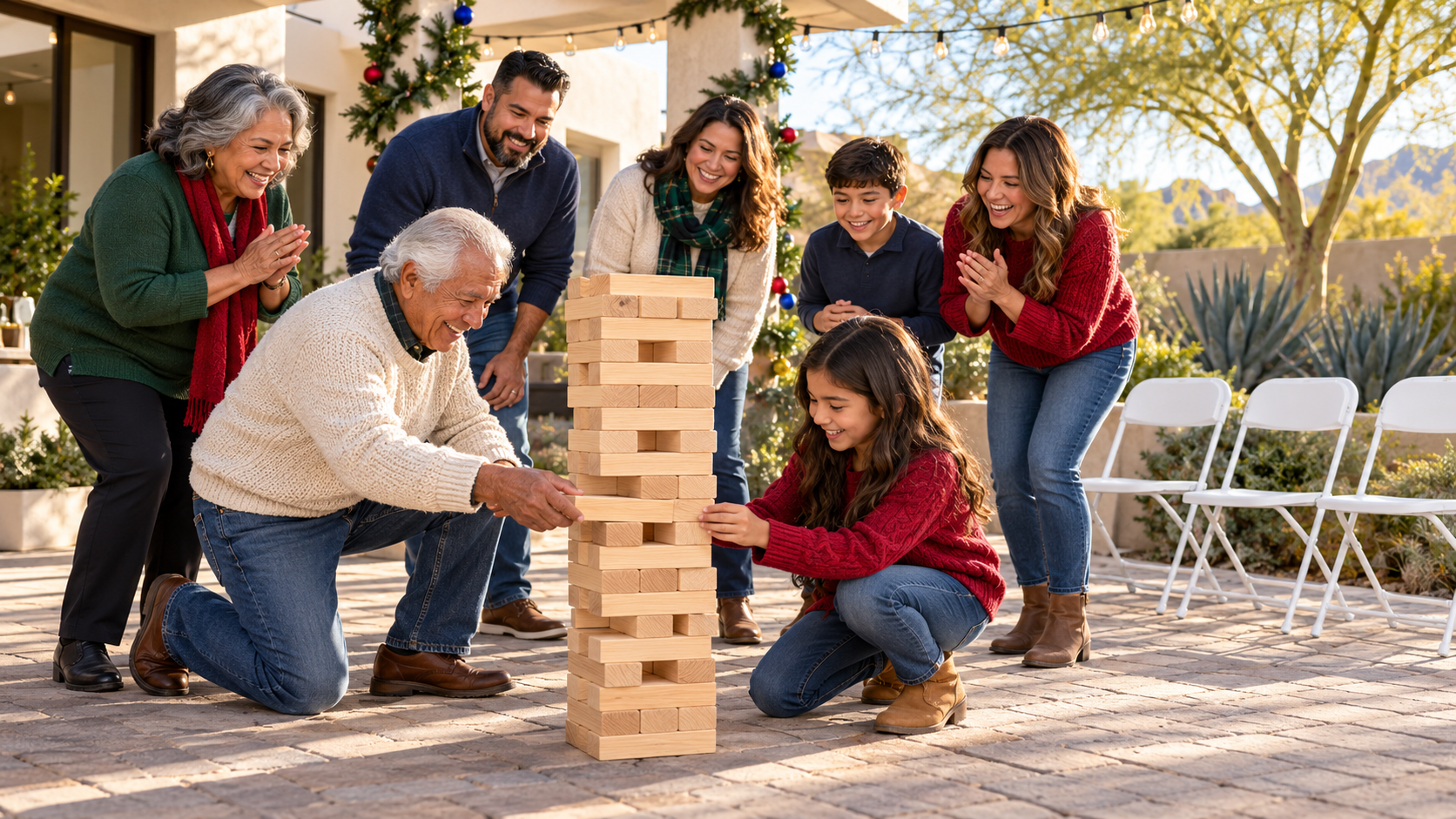
The search for family Christmas party games can make a host feel like the night needs a cruise-director schedule. You save 30 ideas, buy supplies for eight, and still wonder whether Grandpa, the teenagers, and the six-year-old will enjoy the same thing.
They do not need the same game all night. Pick three activities with three different jobs: an easy opener, one short whole-family moment, and a calm closer. Keep each one optional, give people useful ways to watch or help, and stop while everyone is still having fun. That is enough structure to create memories without turning Christmas into a tournament.
Quick answer: Use the EventRent AZ 3-Game Christmas Lineup. Choose one activity people can join as they arrive, one 10-to-15-minute team game that gathers the willing group, and one quiet option that works while people talk or finish dessert. Run every choice through the Everyone Can Join Test before buying supplies.
Table of contents
- Build a three-game Christmas lineup
- Use the Everyone Can Join Test
- Choose one activity for each job
- Build teams around roles, not ages
- Give play, watching, food, and conversation their own space
- Use one shared game inside a relaxed party flow
- Tell guests what kind of party this is
- Run the 15-minute host check
- Family Christmas party game FAQ
Build a three-game Christmas lineup
A family Christmas party does not need constant entertainment. It needs a few easy ways for different people to belong.
The EventRent AZ 3-Game Christmas Lineup gives each activity one job:
| Game job | When it happens | What it should do | Good signs |
|---|---|---|---|
| Easy opener | During arrivals | Give two to four people something simple to begin without a formal start | Rules fit in one sentence, turns are short, and a new guest can join next |
| Shared middle | After most guests arrive | Create one funny or meaningful moment the family experiences together | Mixed teams, several useful roles, a visible ending, and 10 to 15 minutes of play |
| Calm closer | After the shared moment or during dessert | Let conversation continue while willing guests do something light | Seated or low-movement, easy to pause, and no public performance required |
Three is a lineup, not a quota. If your family loves one game and plays it all night, that is a success. If conversation takes over after dinner, skip the closer. The plan exists to remove pressure, not add another checklist Christmas must pass.
This is the main difference between a Christmas party and a full game night. If games are the entire promise of the event, use the EventRent AZ backyard game-night plan for deeper guidance on open play, spectators, food, and re-entry. For a family holiday gathering, games should support the relationships already in the room.
Use the Everyone Can Join Test
Before choosing a game because it looked hilarious online, picture the real guest list.
Ask four questions:
- Can a guest understand the basic action in about a minute? Save complicated strategy for the relatives who already love it.
- Can one turn end before a child, older adult, or conversation-first guest feels trapped? Short rounds make a game easier to try.
- Can someone participate without performing? Reading a clue, keeping time, handing pieces to the next player, taking an approved photo, or cheering for a team can all be real roles.
- Can a guest leave and rejoin without apologizing? A bathroom break, child need, phone call, or quiet minute should not ruin the team.
A game does not need to fit every guest perfectly. It needs a kind boundary. Say who the activity suits, keep it optional, and offer another comfortable place to be.
Penn State's Intergenerational Activities Sourcebook collects activities designed to help younger and older participants communicate, learn about one another, and share an experience. That is a better goal than proving the youngest or fastest person can win.
Choose one activity for each job
You can adapt the lineup to your family's traditions, space, and supplies. These are editorial examples, not universal recommendations.
Easy opener ideas
- Open-play Giant Jenga: Two people can begin, others understand what is happening, and spectators have something to watch. Use one physically stable tower on a level surface with clear space around it. Review the verified EventRent AZ Giant Jenga page only if the activity fits the room and guest list, then confirm current availability, rules, surface needs, delivery, and setup details.
- Holiday would-you-rather cards: Put a few light questions near drinks or appetizers. Guests can answer one and move on. Avoid prompts about money, relationships, politics, religion, health, or family history unless the group has clearly chosen that conversation.
- Picture match: Pair duplicate holiday images or family-approved photos face down on a small table. Keep private or embarrassing images out of the game.
Shared middle ideas
- Family trivia in mixed teams: Use short questions about shared traditions, music, movies, food, or approved family memories. Let one person read, another record, and the group decide together.
- Name that holiday tune: Use humming or a short instrumental clip only when the source and playback are lawful and approved. Keep singing optional.
- One-room clue hunt: Hide a small number of visible clues in the main gathering area instead of sending children through bedrooms, stairs, dark yards, or private spaces.
Calm closer ideas
- Memory prompt bowl: Guests may answer a warm prompt, pass, or write a private response for the host to read later with permission.
- Family photo captions: Show a few approved photos and invite short, kind captions or memory notes. Do not post or share them without consent.
- Tabletop puzzle or cooperative build: Choose something guests can join for two minutes or twenty while conversation continues.
Avoid stacking three activities with the same weakness. Three performance games can exhaust shy guests. Three fast physical games can leave out relatives who would enjoy a team role. Three long seated games can make children feel as though they are waiting for Christmas to resume.
Build teams around roles, not ages
“Kids versus adults” sounds easy, but it often creates uneven teams and makes age the whole joke. Build teams around the work instead.
Use this mixed-age role card:
- Player: takes the physical or verbal turn.
- Reader: reads the clue, question, or next instruction clearly.
- Thinker: helps the team solve or choose.
- Keeper: tracks points, time, or whose turn is next.
- Helper: resets pieces and keeps the play area ready.
- Observer: watches, encourages, and may join later without being called out.
Ask what role a person wants. Do not assign the oldest guest to sit or the youngest guest to run. A grandparent may be the most competitive player in the room, while a child may prefer to keep score.
If hearing is a factor, the National Institute on Aging recommends choosing a quieter place, facing the person, speaking clearly, and trying to keep one person talking at a time. Its guidance for communicating with someone who has hearing loss can help a family think beyond simply turning the music louder.
Give play, watching, food, and conversation their own space
The room tells guests whether watching and talking count. If every chair faces away from the game, observers feel removed. If every seat points toward the activity, conversation disappears.
| Area | Put here | Keep out | Quick check |
|---|---|---|---|
| Play | One game, pieces, rule card, active players, next-turn space | Food, drinks, cords, fragile decor, and the main walking route | Can a full turn happen without bumping furniture or people? |
| Watch | A few comfortable seats or standing places with a clear view | Loose pieces and traffic through the game | Can someone watch and talk without becoming an obstacle? |
| Talk | Small seat groups, lower music, and enough light to see faces | Scorekeeping and speakers aimed at the area | Can guests hear one another without leaving the gathering? |
| Food | Plates, serving pieces, drinks, napkins, and cleanup in a logical order | Active play, gift piles, and the only entrance | Can someone refill a plate without crossing the game? |
In a covered East Valley patio setup, keep one continuous route from the entrance to food, seating, restroom, and exit. Check the actual event hours before choosing indoor or outdoor play. Do not promise the patio in the invitation until the property, weather plan, light, surface, and responsible adults are confirmed.
If guests come from different sides of the family or have not met, use the EventRent AZ first-12-minutes plan for unfamiliar guests. A game can support an introduction, but it cannot replace a warm welcome.
Use one shared game inside a relaxed party flow
The shared game needs a place in the party, not control of the party.
Here is a flexible two-and-a-half-hour example:
| Time | Host move | Guest experience |
|---|---|---|
| 0:00 to 0:30 | Welcome arrivals and keep the opener available | Get a drink, talk, watch, or take a short turn |
| 0:30 to 1:05 | Open food and let the room settle | Eat and connect without pausing for a program |
| 1:05 to 1:20 | Invite the shared middle game | Join a mixed team, choose a role, or watch nearby |
| 1:20 to 2:05 | Return to food, gifts if planned, conversation, and open play | Rejoin a favorite activity or take a quiet seat |
| 2:05 to 2:30 | Offer the calm closer and begin natural goodbyes | Add one memory, finish dessert, or leave without missing a finale |
Announce the shared game simply: “We are doing one 12-minute family round in a few minutes. You can play, keep score, or cheer from the seats.” That sentence says the activity is real, short, and optional.
End before energy drops. One final laugh is better than three extra rounds played because the host already printed the score sheets.
Tell guests what kind of party this is
If games are a main feature, say so. If they are a small option during a family gathering, say that instead.
A clear invitation line can read:
We will have dinner, one short all-ages team game, and plenty of time to visit. Games and holiday sweaters are welcome, never required.
Add the date, start and end time, exact address, parking or gate details, who is invited, meal plan, RSVP method, and any gift-exchange expectations. Use the EventRent AZ party invitation timing guide to work backward from the date without turning a planning range into a rigid etiquette rule.
Keep a gift exchange separate from the game lineup. State the price limit, who participates, whether gifts are funny or useful, and how someone can opt out. No guest should discover at the party that attendance came with an unspoken purchase.
Run the 15-minute host check
Before guests arrive:
- Explain the opener to one person in a minute or less.
- Confirm the shared game ends in 15 minutes or less.
- Prepare at least one non-performing role.
- Remove any prompt that could embarrass or expose a family member.
- Check that active play stays out of the food route.
- Put a few seats where watching still feels social.
- Lower music where the rules and conversation need to be heard.
- Test the surface, lighting, pieces, and full movement of the game.
- Name one helper who can start or stop the activity.
- Decide what happens if the family would rather keep talking.
Then stop adding games. The EventRent AZ stress-free hosting guide can help assign the door, food, or activity job to a named helper so the host gets to enjoy the gathering too.
Family Christmas party game FAQ
How many games should I plan for a family Christmas party?
Plan three different jobs, not a pile of games: an easy opener, one short shared middle, and a calm closer. You may use only one or two if conversation, dinner, or family traditions carry the gathering.
What Christmas party games work for adults and children together?
Choose activities with short instructions, mixed-team roles, brief turns, and a valid observer option. Family trivia, a simple clue hunt, picture matching, Giant Jenga on a suitable surface, and a cooperative tabletop activity can work when adapted to the real group.
What if some relatives do not like games?
Let watching, talking, helping, and passing be normal choices. Put comfortable seats near the action, keep one quieter conversation area, and never call out a guest for declining.
Should we run a Christmas game tournament?
Only if guests are coming because they want one. For a mixed-age family gathering, one short shared round usually creates more connection with less waiting, elimination, and scorekeeping.
Make the game serve the gathering
Your family does not need 30 Christmas games. It needs one easy way in, one moment worth sharing, and one gentle way to keep the conversation going.
Pick three jobs. Use the Everyone Can Join Test. Give every guest a valid role, including observer. Then let the best part happen: the game ends, nobody feels trapped, and the family keeps talking.