HOA and Community Event Planning
How to Plan an HOA Holiday Party Neighbors Actually Want to Join
Skip the oversized activity list. Use the One Door, Three Ways In Plan to make an HOA holiday party easy to understand, join, and enjoy.
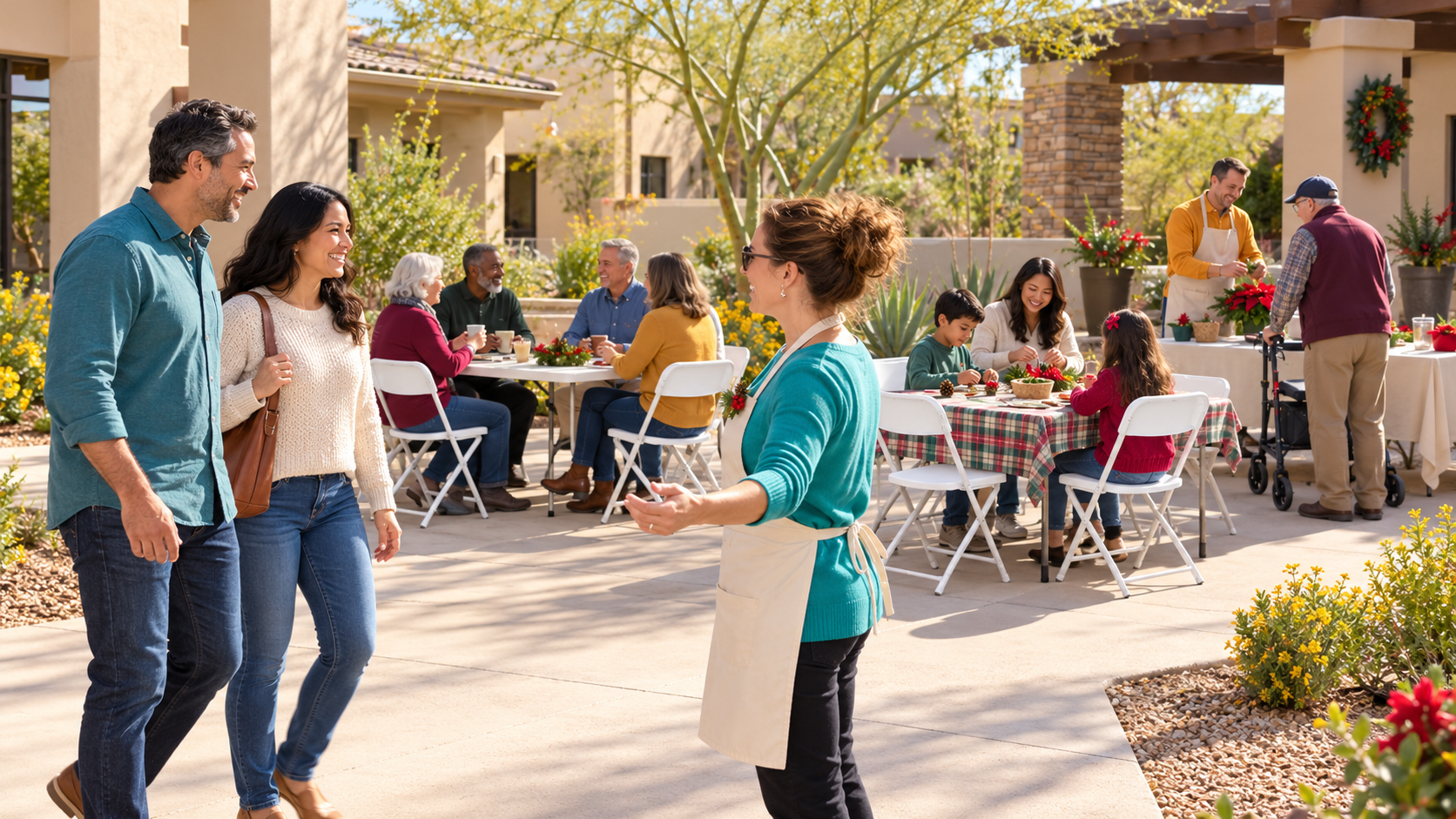
The decorations are up, the food is ready, and the committee is still wondering whether anyone will come. That is the uncomfortable part of an HOA holiday party: a full plan does not automatically feel easy to join.
Start with one clear promise, one obvious welcome, three ways to participate, and one shared moment. Let residents choose whether to Talk, Do, or Help, then give them a specific moment worth staying for. This structure works better than adding another contest or activity because it removes the social guesswork at the door.
Quick answer: Choose a simple 60 to 90 minute format, tell residents exactly what will happen, and design a complete experience for someone who stays only 20 minutes. Confirm property rules, weather backup, accessibility, food, alcohol, vendor, and street-use requirements before announcing details.
Table of contents
- Choose one promise before choosing activities
- Use the One Door, Three Ways In Plan
- Give the event one shared moment
- Write an invitation residents can answer
- Build the layout around arrival and belonging
- Use a simple 90-minute flow
- Run the 15-minute route walk
Choose one promise before choosing activities
An HOA holiday party can become a pile of good ideas with no clear reason to attend. Cocoa, crafts, music, photos, games, desserts, a donation drive, and a contest may all fit the season, but they do not automatically fit together.
Write the event promise in one sentence:
“Residents can stop by for [simple experience], share [one moment], and leave whenever they are ready.”
Examples include meeting a few neighbors over dessert, making one small holiday item, watching one short community program, or completing one service project together. The promise should be specific enough that a resident can picture the visit.
Use this table to choose the format before you choose the extras:
| Format | Clear resident promise | Best participation pattern | Planning load to confirm |
|---|---|---|---|
| Dessert social | Taste a few treats and meet neighbors | Talk plus a short shared toast | Food labels, serving route, seating, cleanup |
| Holiday craft drop-in | Make one item and take it home | Do plus casual conversation | Materials, age fit, table space, supervision |
| Community game night | Join a few low-pressure games | Do plus spectator seating | Game rules, noise, floor space, age mix |
| Outdoor movie gathering | Watch one family-friendly feature together | Shared moment plus relaxed seating | Screening rights, sound, weather, power, sightlines |
| Service social | Complete one useful neighborhood or charity task | Help plus short conversation | Recipient approval, item rules, storage, delivery owner |
Pick the format that can succeed with the smallest complete plan. A short dessert social with a warm welcome is better than a winter festival that depends on ten volunteers who have not committed.
For a broader neighborhood event structure, use the EventRent AZ Arizona neighborhood block-party guide. Keep this holiday plan narrower and easier to explain.
Use the One Door, Three Ways In Plan
Residents do not all want the same party. A new neighbor may want introductions. A child may want an activity immediately. An older resident may want a chair near the action. A volunteer may feel most comfortable when they have a small job.
The One Door, Three Ways In Plan keeps everyone in one event while offering three valid choices.
Talk
Create one conversation area with small seating groups, room for a mobility device, and a host who can make introductions. Avoid placing every chair in rows facing a program that has not started.
Give the host one useful prompt: “How long have you lived in the neighborhood?” That is easier than asking strangers to mingle.
Do
Offer one activity that takes less than ten minutes to understand. It could be a simple craft, a guess-the-number jar, a photo spot, a game, or a small table where residents add a note to a community board.
Participation should be optional. Nobody should have to sing, compete, pose, or reveal personal information to feel included.
Help
Give residents one small contribution path: place a dessert, add an approved donation item, carry a stack of napkins, greet for ten minutes, or help reset a game. The job needs a clear start and finish.
Do not turn the Help path into unpaid staffing that carries the event. The committee still owns setup, safety, supervision, cleanup, and every task that requires training, approval, or accountability.
The three choices should be visible from the welcome point. A resident should not have to cross a crowded room before understanding what is happening.
Give the event one shared moment
A come-and-go party still needs a reason to feel like one community gathering instead of several unrelated stations.
Choose one shared moment and put the exact time in the invitation. It might be:
- a five-minute welcome and volunteer thank-you;
- one group photo with an opt-out path;
- a brief neighborhood lighting countdown;
- a drawing with clearly communicated rules;
- a short performance; or
- the start of a movie.
Keep it short enough that the party does not stop for a speech. The moment should reward attendance, not trap people in place.
If the event includes a public movie screening, music performance, raffle, alcohol, outside vendor, or other regulated activity, confirm the applicable property, licensing, rights, insurance, and local requirements. Do not assume a community event is automatically exempt because residents are not buying tickets.
For an outdoor plan, decide the weather owner and message windows before the invitation goes out. The EventRent AZ three-decision weather plan for HOA events provides a separate framework for go, modify, or move decisions.
Write an invitation residents can answer
“Holiday party in the clubhouse” leaves too much work for the resident. They still need to know whether children are included, whether food is served, whether they can arrive late, what to bring, and whether the event is formal.
Include:
- the event's one-sentence promise;
- date, start time, end time, and shared-moment time;
- exact location and arrival instructions;
- who is invited, including children or guests;
- whether the format is come-and-go;
- what food or drinks are provided;
- what residents may bring and whether it is optional;
- accessibility and accommodation contact;
- weather update method;
- RSVP method and deadline, if a count is needed; and
- one contact for questions.
Use the EventRent AZ party-invitation timeline to choose the send, reply, and reminder dates. Holiday calendars fill quickly, but an early invitation only helps when the details are dependable.
Avoid promising “fun for everyone.” Tell residents what is actually available so they can decide whether it works for them.
Build the layout around arrival and belonging
Start at the parking area or sidewalk and walk the route a resident will use. The arrival point should lead to a human welcome, not a table of forms.
From that welcome, the Talk, Do, and Help choices should be easy to see or explain. Keep the busiest activity away from the only entrance. Put food and drinks where a short line will not block the restroom or the accessible route.
Use ordinary, stable tables with complete tops and safe clearances. Place chairs in small groups near the shared action, with companion seating and open positions that do not require someone to move furniture. Protect a continuous route between arrival, seating, food, activity, restroom, and exit.
The U.S. Department of Justice's 2010 ADA Standards for Accessible Design explain accessible-route and assembly-seating requirements for covered facilities. The standards are a useful reference, but the HOA or venue must confirm which legal, code, and property requirements apply to the specific site and event.
If the event is on a Mesa street, do not announce a closure before checking the current rules. The City of Mesa block-party guidelines distinguish resident block parties from public events and explain the current application and street-closure process. Other East Valley cities have their own procedures.
For a seated snack, craft, or program, calculate furniture from the busiest simultaneous moment, then add support surfaces separately. The EventRent AZ table-and-chair planning guide helps turn the count into a layout that fits.
Use a simple 90-minute flow
A short event can feel complete when every phase has a job.
| Time | Resident experience | Organizer focus |
|---|---|---|
| 0:00 to 0:20 | Arrive, get welcomed, choose Talk, Do, or Help | Greet, orient, watch the entrance and food route |
| 0:20 to 0:50 | Participate at an easy pace | Refill, introduce, keep routes open |
| 0:50 to 1:00 | Join the shared moment | Give a brief welcome and one clear cue |
| 1:00 to 1:20 | Continue, change activity, or visit | Thank residents and begin quiet reset tasks |
| 1:20 to 1:30 | Easy final exit | Give a five-minute close and confirm cleanup roles |
This is a model, not a rule. A movie needs a longer schedule. A service project may need a fixed start. The important part is that the invitation matches the actual rhythm.
Build the working budget around the promise before purchasing decor. The free EventRent AZ party budget calculator can separate food, seating, activities, weather backup, and overlooked supplies while the plan is still editable.
Run the 15-minute route walk
Do this in the real space at the same time of day as the event.
- Arrive: Start where a resident will park or enter. Confirm lighting, address visibility, gate access, and the welcome position.
- Choose: Stand at the welcome and point to Talk, Do, and Help without walking across the room.
- Move: Travel to seating, food, activity, restroom, and exit without squeezing behind occupied chairs or crossing a game.
- Pause: Sit in the quietest chair and check whether the shared moment is still visible or audible.
- Carry: Walk the route with an empty plate or cup and test the narrowest turn.
- Reset: Move a refill or supply bin from storage without cutting through the guest line.
- Close: Turn off the activity and imagine how residents will hear the final cue and leave.
Confirm the board or property approval, governing documents, insurance, vendor requirements, food plan, alcohol decision, child supervision, accessibility, weather backup, electrical load, noise limits, emergency access, cleanup owner, and local permits that apply. Assign a named person to each decision that cannot wait until the event.
Then stop adding. If a new idea does not strengthen the promise, a participation path, or the shared moment, save it for another gathering.
The best HOA holiday party is not the one with the longest activity list. It is the one a resident understands before arriving, can join without performing, and can leave feeling glad they came.
HOA holiday party FAQ
How long should an HOA holiday party last?
For a drop-in dessert social, craft gathering, or small game night, 60 to 90 minutes is a useful starting point. A movie or meal needs longer. Publish an end time and the shared-moment time so residents can plan a short or full visit.
How can an HOA holiday party include adults without children?
Do not build the entire event around children's activities. Offer comfortable conversation seating, one adult-friendly contribution or activity, clear food information, and a shared moment that does not require a child to enjoy it.
Should residents bring food or donations?
Only if the request is optional, specific, and supported by a complete plan. Give food contributors ingredient and serving guidance. Confirm approved items, storage, delivery, and the receiving organization before announcing a donation drive.
Does an HOA need a permit for a holiday party?
It depends on the location, street use, public access, activities, vendors, alcohol, and local rules. A private common-area gathering may differ from a street closure or public event. Confirm HOA governing documents, property approval, city requirements, insurance, and event-specific rules before promotion.