Community event planning
How to Plan an Arizona Neighborhood Block Party People Actually Join
Use the EventRent AZ Easy Way In Test to create a neighborhood gathering where new neighbors, families, teens, and older adults can arrive, participate, and feel welcome.
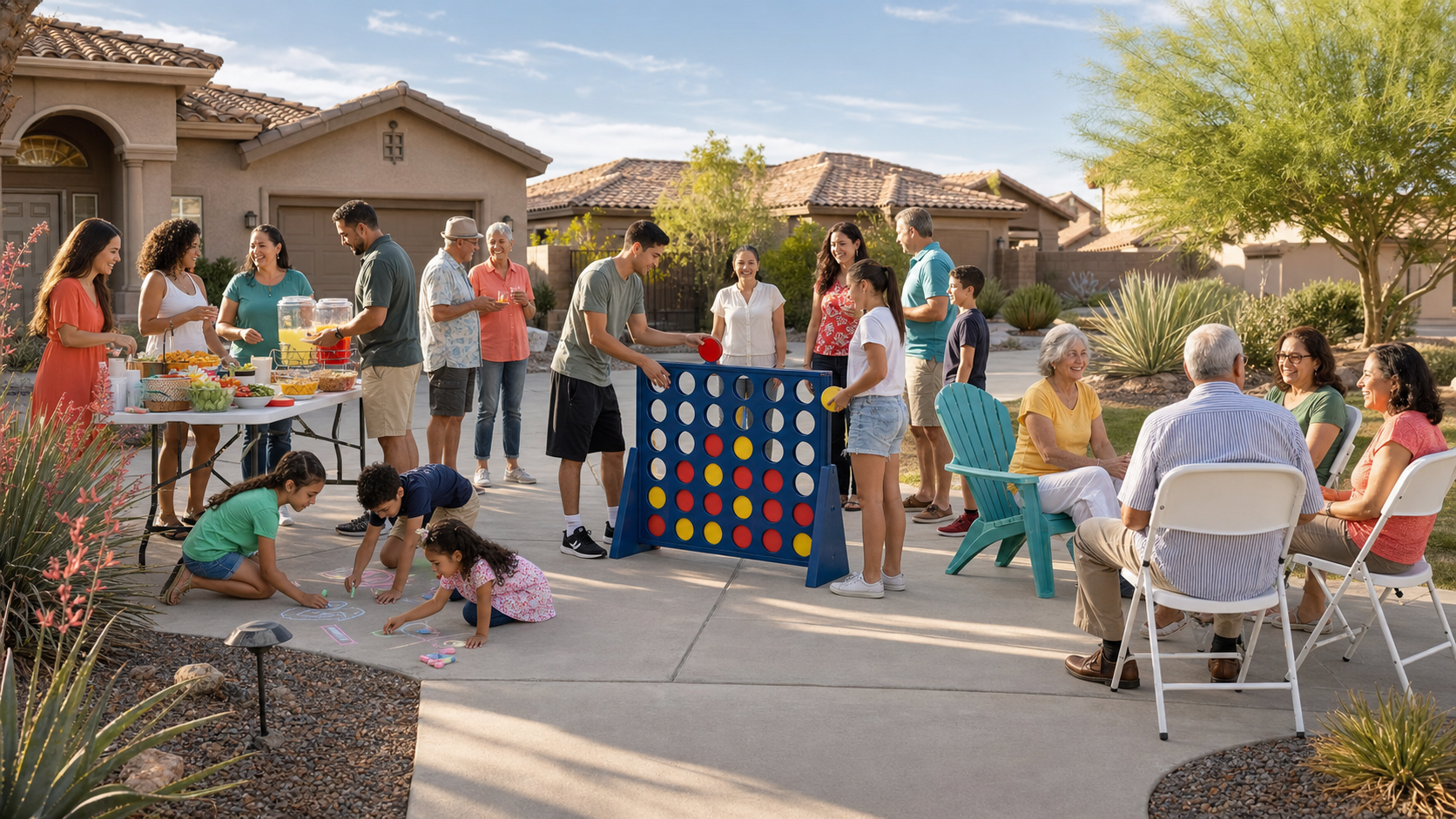
There is a sweet moment at a neighborhood party when the street stops feeling like a row of separate houses. A child joins a game with someone from three doors down. Two adults finally learn each other's names. The new family at the corner stays longer than they expected.
The best neighborhood block party ideas make it easy to arrive, join, and leave without awkwardness. Start with permission, share the work across a few households, and build five easy ways in: a visible welcome, a comfortable seat, a drop-in activity, a small job, and a flexible time window. That plan matters more than a theme or a packed schedule.
Quick answer
Choose a simple location and time, confirm the city or HOA rules, and recruit two or three neighbors before inviting the whole block. Use one food format, one main activity area, comfortable conversation seating, and a clear arrival point. Then walk the setup as if you were a new neighbor arriving alone. If the next move is obvious, the party will feel easier to join.
Define Success as Connection, Not Attendance
A block party does not need every household on the street to count as a success. It needs enough people to create a few new connections without making the organizer feel responsible for everyone's fun.
That changes the plan. You do not need a stage, a strict schedule, or ten separate activities. You need a place where people can pause long enough to talk, an activity that removes the pressure to make conversation immediately, and a host who can introduce people instead of constantly fixing the setup.
A good block party gives neighbors a reason to come outside and an easy excuse to stay for one more conversation.
Set one simple outcome before you plan anything else. Maybe it is helping new residents meet long-time neighbors. Maybe it is giving families a relaxed evening together. Maybe it is finding more volunteers for future community events without turning this party into a meeting.
If an idea does not support that outcome, it is optional.
Confirm Permission Before Promising a Street Party
The word "block party" can describe very different events. One may happen across connected driveways and front yards. Another may use an HOA common area. Another may require a public street to close.
Check the exact location first. Ask:
- Who owns or controls the space?
- Will any public roadway, sidewalk, gate, fire lane, or parking area be blocked?
- Does the event include outside guests, vendors, amplified sound, alcohol, or public advertising?
- Does the HOA, property manager, city, or insurer require approval?
- Who is responsible for setup, access, cleanup, and reopening the space?
For a current local example, the City of Mesa says its neighborhood block parties are intended for residents rather than the general public. A public event with major street restrictions and advertising follows a different special-event process. For a neighborhood street closure, Mesa currently requires at least 70 percent approval from residents on the closed street and asks for the completed application at least four working days before review. Read the official City of Mesa block-party guidelines before making commitments.
Those details apply to Mesa's current process, not every East Valley city or every HOA. Confirm the rules again immediately before publication and before the event. A cul-de-sac, private drive, common lawn, or clubhouse may have a different approval path.
Permission is the first planning step because it decides what kind of party you are actually allowed to promise.
Share Ownership Before the Guest List Grows
The fastest way to make a neighborhood party feel heavy is to let one household become the planner, buyer, greeter, food runner, game leader, and cleanup crew.
Recruit a small host team before the broad invitation goes out. Keep the roles light:
- Neighbor contact: handles the date, invitation, RSVP, and any permission updates.
- Food and supplies: chooses the food format and watches the shared sign-up.
- Space and cleanup: maps the setup, confirms borrowed items, and recruits the closing crew.
These are editorial role suggestions, not a required committee structure. Two people may share all three jobs, or a larger HOA may divide them further.
Make requests small enough that people can say yes quickly. "Can you bring two coolers?" is easier than "Can you help with food?" "Could your household take the final 20-minute cleanup?" is clearer than "We will all pitch in."
Tiny jobs create shared ownership before the party starts. They also give quieter neighbors a natural way to participate.
Build Five Easy Ways Into the Gathering
Imagine a neighbor arriving alone. They know the organizer, but the organizer is helping someone unload food. What can that guest do without waiting to be rescued?
Use the EventRent AZ Easy Way In Test:
If someone arrived alone, knew only one person, and planned to stay for 30 minutes, could they see a place to sit, something easy to do, one person to meet, or one small way to help without asking what happens next?
Build five visible entry points:
- Welcome: One easy-to-find arrival spot and a host who notices people.
- Settle: Chairs that face conversation and activity, not a blank wall.
- Join: A game or table activity that works without a formal start time.
- Contribute: A small job, food item, playlist request, or cleanup task.
- Come and go: A relaxed time window that does not punish late arrivals or early exits.
| Guest situation | What may feel awkward | An easy way in |
|---|---|---|
| New neighbor arriving alone | Walking into a group that already knows one another | A greeter makes one specific introduction and points out the food and activity areas |
| Older adult or guest who wants to sit | Standing near active children while looking for a chair | Stable seating with a view of the gathering and room for conversation |
| Teen who does not want a children's activity | Being assigned to play or supervise younger kids | Music requests, a casual giant game, photo help, or a simple setup role |
| Parent with a young child | Holding a plate while tracking a child across the space | Seating near the child activity area and a clear path to food and drinks |
| Neighbor stopping by briefly | Feeling as if a short visit is not worth coming | An open arrival window and a drop-in activity with no bracket or team commitment |
This is not about scripting every interaction. It is about removing the small obstacles that make people turn around after 15 minutes.
Create a Layout That Helps People Mingle
The event should feel like one gathering, not a food line, a children's corner, and a row of adults who never look at each other.
Start with conversation seating. Use small clusters or gentle arcs instead of one long classroom-style row. Keep a few seats close to the activity area for adults supervising children or taking a break. Leave clear routes between the arrival point, food, seating, activity, and restroom.
If you are unsure how much seating and support-table space the group needs, use the party table-and-chair planning guide to separate guest seating from food, drinks, games, and personal-item tables.
Then place the food where a small line will not block the welcome or the activity. Keep drinks accessible from more than one side if the surface allows it. Put trash and recycling where people can see them, but not beside the clean serving area.
Finally, protect one quieter edge of the party. It does not need a sign or a separate room. Two or three chairs slightly away from the speaker and the busiest game may be enough for an older neighbor, a tired child, or two people having a real conversation.
The layout works when a guest can join the energy, step away from it, and return without crossing a game or squeezing through a food line.
Choose One Clear Food and Budget Plan
A first neighborhood gathering becomes easier when the food has one clear rule.
Choose one of these formats:
- Category potluck: Households claim a main, side, dessert, drink, ice, or paper-goods category.
- Bring-your-own meal plus shared treat: Each household handles its own dinner, while the group shares dessert, cold drinks, or popsicles.
- Simple hosted food with assigned support: The host team provides one main item, and other households claim sides, drinks, serving supplies, and cleanup.
Do not mix three formats on the same invitation. If some people think dinner is provided and others think it is a potluck, the organizer will spend the party explaining.
Set a shared spending ceiling before anyone shops. The five-bucket party budget guide can help the host team separate place, food, setup, experience, and just-in-case costs. For a transparent working estimate, use the EventRent AZ party budget calculator and label each assumption so co-organizers can review it.
Confirm dietary, allergy, food-handling, alcohol, and property rules with the responsible people and venue. Do not make medical or safety promises on a community sign-up sheet.
A clear food rule protects the budget and gives every household a contribution that makes sense.
Use Activities People Can Join Without Instructions
The best block-party activity is not necessarily the most impressive one. It is the one that helps two people interact without needing a microphone, a schedule, or a long explanation.
Good drop-in options may include:
- Sidewalk chalk on an approved, safe surface
- A neighborhood question board with prompts such as favorite local restaurant or best nearby walking route
- One giant game with room for players and observers
- A casual card or puzzle table in the seating area
- Bubbles or simple lawn play for young children
- A playlist request station
- A low-pressure "meet someone from a different part of the block" prompt
For a larger gathering, choose activity types that serve different moods rather than adding more of the same game. The yard-game capacity and variety guide explains how to balance active-player space, rotation, and usable room without crowding the setup.
Keep games out of vehicle access, food lines, doorways, pool edges, grill areas, and primary walking paths. Confirm the surface, lighting, age mix, supervision, and property rules before final placement.
One welcoming activity is more useful than five impressive activities that require the organizer to run them.
Take One Lap Before Guests Arrive
When the setup looks finished, stop decorating and take one slow lap as if you were a guest.
Arrive
- Is the entrance obvious?
- Can a newcomer tell where the gathering begins?
- Is someone ready to notice the first few arrivals?
Settle
- Can an older adult or parent with a child find a stable seat?
- Do the chairs face people and activity?
- Is there a quieter place that still feels included?
Join
- Can a guest understand the main activity by watching for a few seconds?
- Is there room to observe without blocking players?
- Can someone join and leave without disrupting a team or schedule?
Eat and drink
- Is the food rule clear?
- Can a short line form without blocking arrival, seating, or play?
- Are drinks, trash, and cleanup supplies easy to find?
Leave
- Can a neighbor say goodbye without crossing the entire event?
- Is the cleanup crew and borrowed-item plan clear?
- Does someone know who will reopen any controlled space or return required equipment?
If one part of the lap feels awkward, move the furniture, simplify the sign, or assign one small job. Do not add another activity to solve a welcome problem.
The final test is simple: a neighbor should be able to arrive alone, find a next move, and leave feeling glad they came.
A Block Party Works When the Block Feels Smaller
The food will be eaten. The game pieces will go back in their boxes. The chairs will fold, and the street or common area will return to normal.
What remains is that one more person knows the family at the corner. A child has a new friend nearby. An older neighbor has a number to call. The next community gathering starts with fewer strangers.
Confirm the rules, share the work, and build five easy ways in. Then stop planning and let neighbors do the part no checklist can do for them: talk, laugh, and begin to know one another.