Party planning
How Many Yard Games Do You Need for a Party?
Stop guessing from guest count alone. Use the PLAY Check to size yard games by participation, live player capacity, variety, and real yard space.
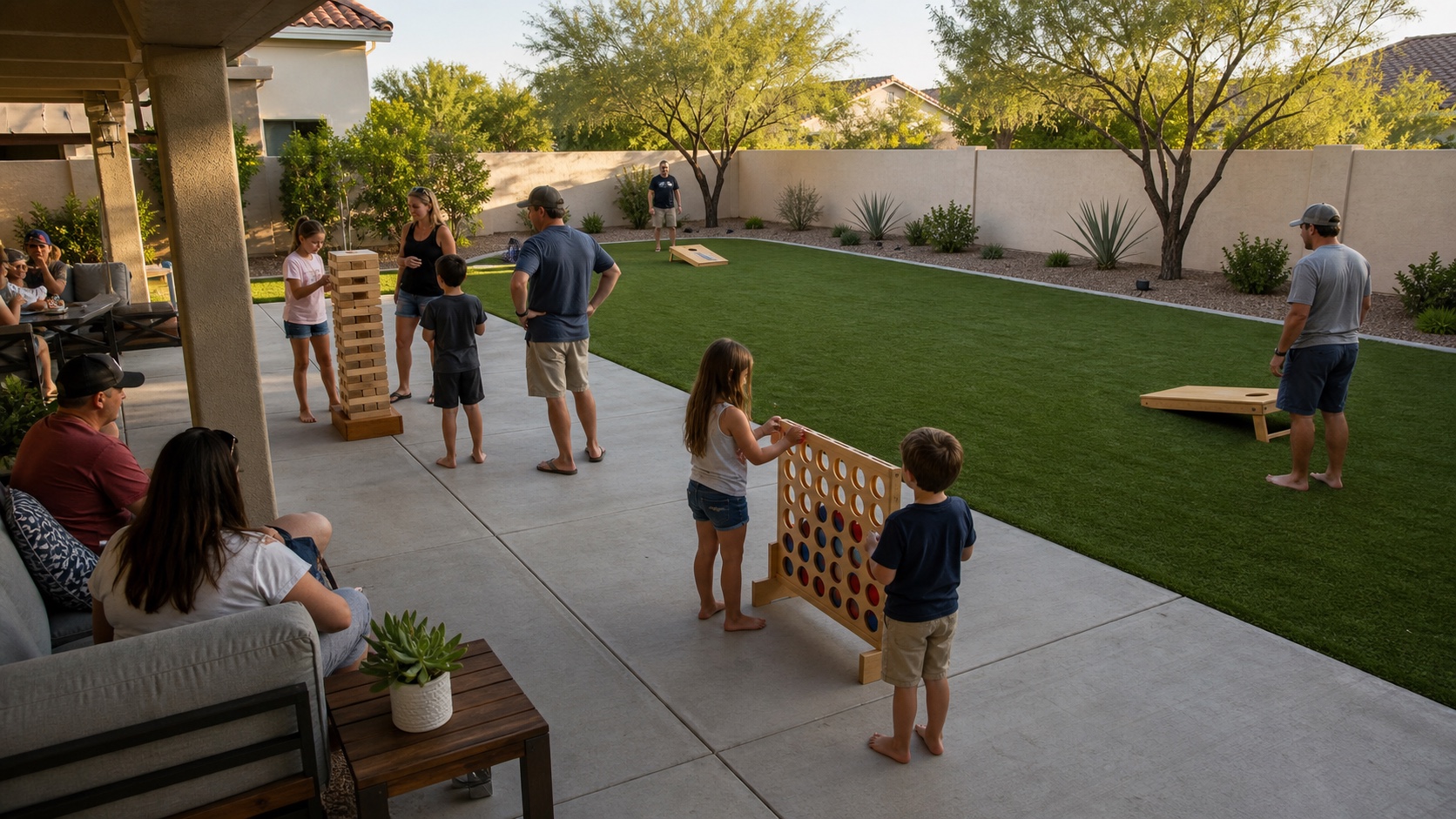
The yard can look ready until the first round begins. Two guests start playing, six wait nearby, and another game sits untouched because nobody knows the rules. The problem is rarely that the host chose “bad” games. The lineup was counted, but its real player capacity was not.
For most casual parties, start by planning enough game stations for about 25% to 40% of guests to play at the same time. Then verify the actual player slots, variety, and space for every station. A game-centered event may need capacity for 50% or more, while a scheduled tournament can rotate nearly everyone through fewer stations.
Quick answer
Do not size yard games from guest count alone. Choose how many guests you expect to play at once, add the verified simultaneous player slots across your lineup, and close any capacity gap. Then check whether every station fits without crossing food, seating, pool, driveway, or walking routes.
EventRent AZ calls this the PLAY Yard Game Capacity Check: Participation target, Live player slots, Activity mix, and Yard fit.
Start With the Number of Guests Who Will Actually Play
A guest list of 40 does not mean 40 people will want a game at the same moment. Some guests will eat, talk, supervise children, arrive late, or watch a round before joining.
Choose one planning scenario before choosing the number of stations:
- Background entertainment: games are optional while food and conversation lead the event. Start with simultaneous capacity for about 25% of guests.
- Shared attraction: games are one of two or three main reasons to gather. Start near 40%.
- Game-forward party: the invitation, theme, or schedule makes play a main event. Start near 60%, or build scheduled rotations.
- Tournament: nearly everyone may participate, but they do not all need to play at once if heats, teams, and wait times are planned.
These percentages are EventRent AZ editorial planning scenarios, not universal participation statistics. Adjust them for age mix, mobility, weather, event length, guest relationships, and what the invitation promises.
| Total guests | 25% background target | 40% shared-attraction target | 60% game-forward target |
|---|---|---|---|
| 20 | 5 active-player slots | 8 slots | 12 slots |
| 30 | 8 slots | 12 slots | 18 slots |
| 40 | 10 slots | 16 slots | 24 slots |
| 50 | 13 slots | 20 slots | 30 slots |
| 60 | 15 slots | 24 slots | 36 slots |
Always round the target up. If the result feels too high for the space or budget, do not hide the difference. Decide whether games should be a smaller part of the event or whether a scheduled rotation would serve guests better.
Use the EventRent AZ PLAY Yard Game Capacity Check
Write four lines for the event before reserving or buying games.
P: Participation target
Multiply the expected guest count by the planning share you selected.
expected guests × chosen participation share = target active players
For 30 guests at a casual backyard birthday, a 40% scenario creates a target of 12 people playing at once. The number is not a promise. It is a visible assumption the host can challenge.
If children are the main players, count the children separately from adults. If the event includes several age groups, consider a range instead of one precise figure.
L: Live player slots
For each selected game, confirm how many people can actively play at once under the rules you plan to use. Count active players, not spectators or people waiting beside the station.
Add those numbers:
station 1 slots + station 2 slots + station 3 slots = live player capacity
Then calculate the gap:
target active players − live player capacity = capacity gap
If the result is zero or negative, the lineup meets the chosen target on paper. If it is positive, add capacity, use team rules only when appropriate, or create scheduled rotations. Do not assume a faster game automatically erases a large gap. A short round helps only when guests understand how to enter the next round.
A: Activity mix
Capacity without variety can still fail. Three nearly identical throwing games may appeal to the same guests while everyone else watches.
Build a mix across three useful dimensions:
- Energy: active movement versus calm, stand-in-place play.
- Learning curve: immediate play versus a station that needs a short explanation.
- Social style: head-to-head, pairs, teams, or cooperative play.
For a mixed-age family party, a quick-turn tossing station, a visual strategy station, and a team-friendly challenge usually create more choice than three stations with the same rhythm. This is an editorial recommendation, not a claim about any specific inventory item.
Y: Yard fit
The final number is whatever safely fits the usable space, not the total square footage on a listing.
Remove seating, food service, grills, pools, gates, steps, landscaping, driveways in use, and primary walking paths from the mental map. Then include the playing area, throwing or movement lane, retrieval space, waiting space, and a buffer from the next station.
If two stations share a retrieval lane or guests must cross one game to reach another, the layout is not finished.
Worked Example: Yard Games for a 40-Guest Family Party
Suppose 40 people are expected at a backyard graduation party. Food and conversation matter, but the host wants games to be a real attraction. The host chooses the 40% shared-attraction scenario.
40 guests × 0.40 = 16 target active players
The host considers four generic stations and checks each game's actual instructions:
| Proposed station | Verified simultaneous player slots | Running capacity |
|---|---|---|
| Quick-turn toss | 4 | 4 |
| Visual strategy game | 2 | 6 |
| Team target game | 4 | 10 |
| Calm precision game | 2 | 12 |
The first draft holds 12 active players. The chosen target is 16, so the capacity gap is four.
The host has three honest choices:
- Add one four-player station if the yard and budget allow it.
- Add a second copy of a popular station if the layout supports two distinct lanes.
- Keep four stations but change the promise: treat games as background entertainment or schedule a short team rotation during one part of the party.
The wrong choice is to claim that four stations are automatically enough because there is one game per ten guests. In this example, the number of stations sounds right while the selected participation target says otherwise.
If the host chooses five stations, that does not mean all five must be rented. Existing family games, simple table activities, and one or two giant yard game options from EventRent AZ can be evaluated with the same worksheet. Confirm availability, instructions, player limits, setup requirements, and surface needs before treating any item as part of the final capacity.
Choose Games by Role, Not Just by Name
Every station should do a job in the lineup.
| Game role | What it contributes | Watch for |
|---|---|---|
| Quick-turn opener | Easy first play and visible movement | A waiting group that blocks the lane |
| Calm strategy | Lower-energy option and one-on-one connection | Long rounds without an easy rotation rule |
| Team challenge | More people active together | Confusing team sizes or scoring |
| Spectator-friendly game | Fun to watch while waiting | Spectators crowding the play area |
| Flexible free-play station | Guests can join without a formal schedule | Missing instructions or pieces |
A good lineup gives guests an easy first yes. At least one station should make sense in a few seconds. Put a concise rule card where a new player can see it, and decide how the next person enters.
Avoid forcing every guest into a tournament. Structured competition can be fun when the invitation prepares people for it, but a casual birthday or reunion usually benefits from a mix of optional play and conversation.
If the party includes young children, older adults, or guests with different mobility needs, confirm surface stability, reach, throwing distance, piece weight, and clear paths with a human reviewer. Do not label a game accessible without checking the actual item and setup.
Use the Five-Minute Tape-and-Walk Test Before Event Day
You do not need design software to catch a bad game layout.
- Mark each station. Use painter's tape, cones, chalk, or removable markers to show the play area and movement lane.
- Add the people. Place the number of chairs, boxes, or helpers that represents active players and a small waiting group.
- Walk the guest routes. Enter from the gate, carry a plate to seating, reach the restroom, move to drinks, and supervise children without crossing a throwing lane.
- Test retrieval. Follow the path of a missed toss or rolling piece. Keep it away from pools, streets, grills, glass, and seated guests.
- Protect the exit. Confirm that no station, waiting group, cord, table, or sign narrows an exit or essential walkway.
If the yard fails the test, reduce the station count before squeezing buffers. Another game does not help if it makes the whole event harder to move through.
Place instructions and scoring supplies at the station, not on the food table. Keep a small bin for loose pieces and choose one person to reset games during the event.
In Arizona, Heat Can Change the Participation Plan
A capacity calculation assumes guests are comfortable enough to play. Direct sun, hot artificial turf or pavers, and a long walk to water can turn a 40% participation plan into several empty stations.
For an East Valley outdoor party, check the forecast and the yard during the actual event hours. The NWS Phoenix Heat Page and HeatRisk guidance provides current local heat-risk context and advises limiting exposure, slowing activity, drinking water, and taking breaks in a cool place.
Move or cancel outdoor play when conditions are not appropriate. A game plan is never more important than guest safety. Keep drinking water easy to reach, provide shade or a cooled indoor break area, and avoid making active competition mandatory.
Wind can also affect tall, light, or throwing-based games. Confirm the manufacturer or provider's setup rules and stop play if a station becomes unstable. Do not improvise anchors, weights, or modifications that the instructions do not allow.
Final Yard Game Planning Checklist
Before event day, confirm:
- Final expected guest count and age mix
- Chosen participation scenario, with the assumption written down
- Target active-player count
- Verified simultaneous player slots for every selected game
- Capacity gap is zero or handled with a clear rotation plan
- Mix includes different energy levels, learning curves, and social styles
- Actual game instructions and all pieces are present
- Each station, movement lane, retrieval area, and waiting space fits
- Food, seating, pools, grills, gates, exits, and walkways stay clear
- Surface, wind, heat, shade, lighting, and indoor backup are reviewed
- Water and cool rest space are easy to reach
- One person knows how to explain, reset, and pause each station
- The entertainment plan fits the total event budget
If the budget is still moving, add games alongside food, seating, supplies, and contingency in the EventRent AZ party budget calculator. Use real quotes when available, and keep a small reserve instead of cutting essentials to preserve an oversized game lineup.
Yard Game Quantity FAQ
How many yard games do I need for 20 guests?
For optional background entertainment, start with capacity for about five people at once. If games are a shared attraction, start near eight active-player slots. The station count depends on how many verified player slots each game provides.
How many yard games do I need for 50 guests?
A 25% background scenario suggests about 13 active-player slots. A 40% shared-attraction scenario suggests 20. Add the actual simultaneous capacity across the lineup, then close the gap or schedule rotations.
Is one yard game for every 8 to 10 guests enough?
It can be a rough shortcut, but it is not a complete plan. A two-player station and a six-player station should not count as equal capacity. Participation, rotation, variety, and usable space matter too.
What if my yard only fits two games?
Keep two well-spaced stations, make their roles different, and set expectations that games are optional. If play is central to the event, use timed rotations, choose another suitable area with permission, or reduce the guest count rather than crowding unsafe lanes.
A Better Number Creates an Easier Party
The goal is not to collect the largest game lineup. It is to give interested guests a clear, comfortable way to join without building lines, blocking paths, or turning the host into a full-time referee.
Choose a participation target, count live player slots, balance the activity mix, and prove the yard fit. When those four parts agree, you have enough games for the party you are actually planning.
Once the game quantity fits the space, use this participation-first backyard game-night plan: Backyard Game Night Ideas Everyone Can Join | EventRent AZ