Party Planning
How to Host a Brunch Party Without Spending the Morning at the Stove
Use the One Hot Thing Brunch Plan to serve a warm at-home brunch without cooking to order or missing the gathering.
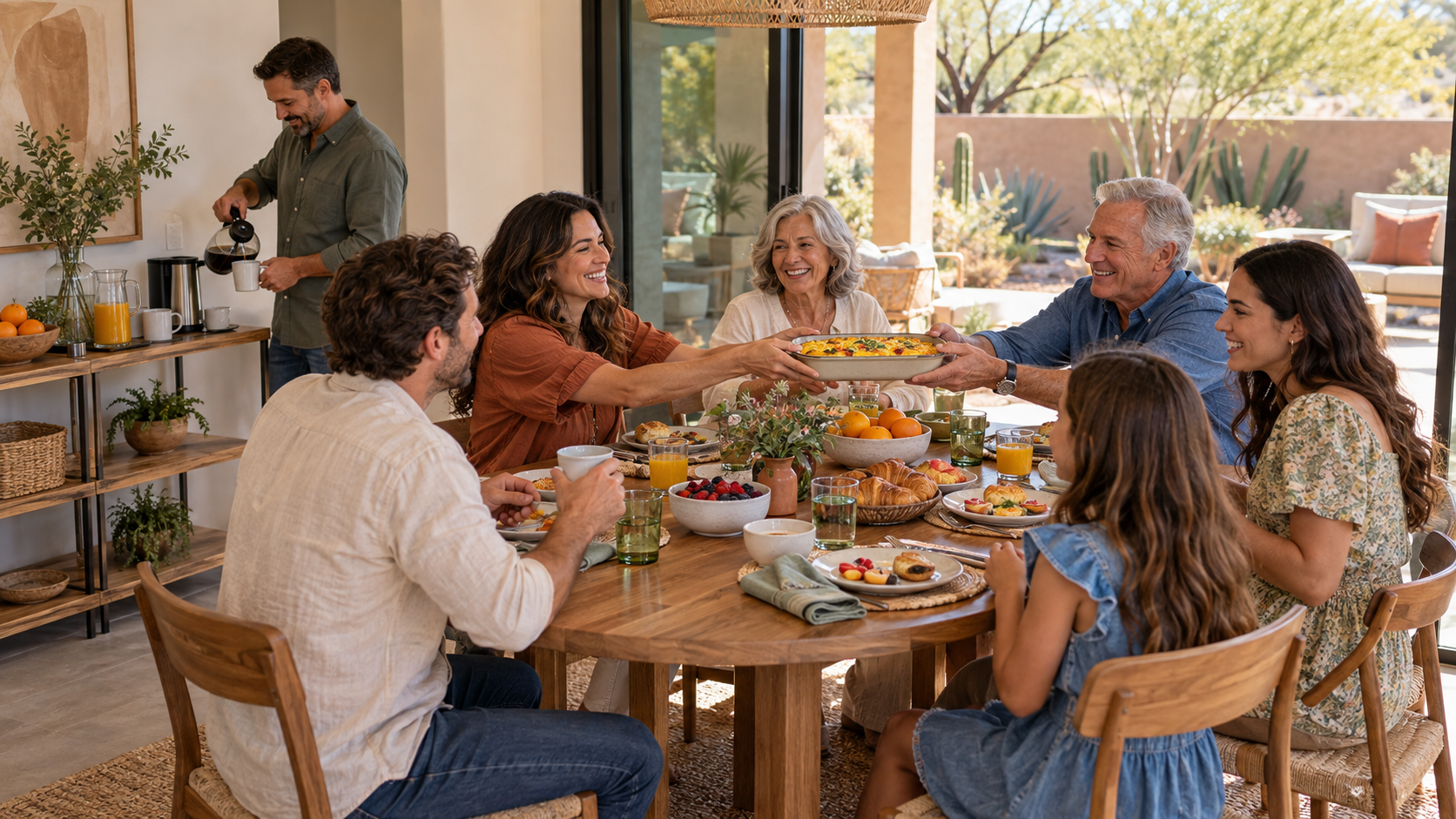
The house is bright, the coffee smells good, and the first guest walks in just as you turn back to the stove. Ten minutes later, everyone is talking at the table except you.
A brunch party works best when the menu is built around one hot thing, everything else can be served cold or at room temperature, drinks are self-serve, and guests have a real place to sit. Make the food easy to finish, not impressive to assemble. Then choose one moment to sit down with everyone and let that be the center of the morning.
Quick answer
Use the One Hot Thing Brunch Plan:
- One hot anchor that can be served all at once, not cooked to order.
- One cold spread of ready-to-eat sides that can wait for guests.
- One first-cup station where coffee, water, and juice make sense without the host.
- One sit-down moment when the host stops working and joins the table.
If the menu requires you to stand at the stove after the first guest arrives, the menu is asking too much of the host.
In this guide
- Choose the brunch format by host workload
- Use the One Hot Thing Brunch Plan
- Build a menu that does not create a kitchen line
- Give the first cup its own station
- Give plates, cups, and people real places to land
- Split preparation between the night before and final hour
- Use a simple two-hour flow
- Brunch party questions
Choose the brunch format by host workload
Brunch can mean coffee and pastries, a buffet, a family-style meal, or a full occasion with gifts and activities. Those are not the same job for the host.
Choose the format before you choose recipes. Start with the feeling you want and the amount of live work you are honestly willing to do.
| Brunch format | Best when you want | Host workload | Protect this detail |
|---|---|---|---|
| Coffee and pastry open house | Flexible arrivals and easy conversation | Low | Enough small surfaces for cups and plates |
| Help-yourself buffet | Choice without formal service | Moderate | A food line that does not block coffee or seating |
| Family-style table | One shared meal and longer conversation | Moderate | Serving dishes that can reach the table together |
| Celebration brunch | A shower, birthday, announcement, or milestone | Moderate to high | A clear time for the special moment, separate from meal setup |
An open-house format forgives staggered arrivals. A family-style meal creates a stronger shared moment but needs a more precise serving time. A celebration brunch may need a gift table, activity, cake, or short toast in addition to the meal.
Pick the version that protects the reason people are coming. Do not plan a plated restaurant experience if the real goal is coffee and an unhurried visit.
If the date is not set yet, the party invitation timing guide can help you work backward from the gathering without sending too early or too late.
Use the One Hot Thing Brunch Plan
Breakfast food can become a trap because many familiar favorites are best one plate at a time. Pancakes, eggs to order, toast, and stovetop potatoes all sound simple until several guests want them together.
The One Hot Thing Brunch Plan changes the question from “What should I serve?” to “What can I finish and leave?”
| Part of the plan | Its job | Useful examples | What to avoid |
|---|---|---|---|
| One hot anchor | Makes the meal feel complete | One baked egg dish, breakfast casserole, warm sandwiches, or another crowd dish you already know | Several made-to-order items competing for the stove |
| One cold spread | Adds choice without live cooking | Fruit, pastries, salad, yogurt toppings, cheese, vegetables, or ready sides | Too many tiny bowls that all need separate utensils and refills |
| One first-cup station | Welcomes guests immediately | Coffee, water, juice, cups, stirrers, napkins, and clearly identified add-ins | Drinks placed inside the food line |
| One sit-down moment | Turns food into a gathering | A welcome, shared first plate, toast, candle, or family photo with consent | A packed program that keeps interrupting conversation |
The “one” in the name is a limit, not a command to serve only four items. You can offer several cold or ready choices. The point is to keep one item, at most, dependent on final hot timing.
Store-bought food is not a hosting failure. A bakery box, cut fruit, or prepared side can be the choice that lets you welcome your aunt, refill your own coffee, and hear the story everyone tells twice.
Build a menu that does not create a kitchen line
Write the menu in the order it will reach the room. For every item, note whether it is made the night before, picked up, reheated, held cold, or placed out just before serving.
If three dishes all need the oven at different temperatures, they are not an easy menu. If every drink needs ice, garnish, and explanation, it is not a self-serve station. If the only table is covered with food, guests have nowhere to set their plates.
Use this edit:
- Keep the dish that matters most.
- Replace one live-cooking item with a baked, purchased, or cold option.
- Remove the item that duplicates another dish's job.
- Put condiments together instead of scattering them across the table.
- Keep backup portions properly stored until they are needed.
For a one-way serving route, use the EventRent AZ buffet setup guide. Put plates first, food in a logical order, and utensils where guests can take them after filling a plate.
Food safety belongs in the menu plan, especially when eggs, dairy, meat, cut fruit, or outdoor serving are involved. Use current FoodSafety.gov guidance for parties and large groups, follow the actual product and venue requirements, and have a responsible adult manage safe holding. Do not set perishable dishes out early merely because the table looks unfinished.
Give the first cup its own station
At brunch, the drink station is part of the welcome. A guest who can pour water or coffee has something to do while the room fills.
Keep the station away from the oven, refrigerator door, and food line. Group the complete task in one place: cups, coffee, water, juice, napkins, stirrers, sweeteners, and clearly identified milk or alternatives. Keep hot appliances and cords positioned according to their instructions and away from children and primary walkways.
If alcohol is served, provide appealing alcohol-free choices and confirm the host's responsibilities, transportation plan, property rules, and appropriate service. The article does not assume alcohol is needed for brunch to feel festive.
The station is ready when a guest can make the first drink without opening a cabinet or asking where anything is.
Give plates, cups, and people real places to land
Brunch is often described as casual, but a full plate and hot drink still need support. Guests do not all need a formal assigned seat. They do need enough stable seats and surfaces to eat without balancing everything on their knees.
Decide whether the meal is mostly seated, mostly roaming, or truly split between both. Then protect:
- comfortable seats for guests who need them;
- table or side-surface access for plates and hot drinks;
- a clear route from drinks to food to seating;
- space around chair backs so people can sit and stand;
- a quieter edge for conversation;
- an indoor fallback when the patio is not comfortable.
For an East Valley indoor-outdoor brunch, do not choose the patio because the invitation says “outdoor.” Choose it only when the actual event-hour conditions, available shade, cooled space, and guest needs support it.
If the furniture plan is still a guess, use the table, chair, and real-space fit guide. The goal is not to fill the room. It is to give everyone a place to eat, talk, and move.
Split preparation between the night before and final hour
The night before should remove decisions. The final hour should protect freshness, safe service, and the welcome.
Finish the night before
- Clear the guest entrance, restroom, seating area, and serving surfaces.
- Set empty platters and serving utensils where they will be used.
- Group coffee supplies, cups, napkins, and labels.
- Prepare only foods that are appropriate to make ahead and store safely.
- Chill drinks and confirm refrigerator, cooler, oven, and outlet space.
- Put decorations in place only after the room works.
- Write a short final-hour list in serving order.
Save for the final hour
- Finish or reheat the one hot anchor according to the recipe and food-safety plan.
- Put out only the food that can be served safely.
- Brew or stage coffee close enough to arrival that it still feels welcoming.
- Add ice and cold items at the appropriate time.
- Open the real guest path and turn on needed lights.
- Put away prep clutter, cleaning supplies, and delivery packaging.
- Sit down for five minutes before the doorbell.
If the budget is changing as you compare homemade, bakery, prepared, and rental choices, use the free EventRent AZ party budget calculator. Spend where a choice removes a real bottleneck, not where it only adds another detail.
Use a simple two-hour flow
Brunch does not need a minute-by-minute program. A loose arc helps food, conversation, and any celebration moment stop competing.
| Window | What guests experience | What the host does |
|---|---|---|
| Arrival | Coffee, water, a light ready bite, and easy conversation | Welcomes people instead of finishing several dishes |
| First shared moment | The hot anchor comes out and the main food opens | Announces food once, fills a plate, and sits down |
| Middle | Eating, talking, and an optional toast, gift, or photo | Protects the meaningful moment and leaves quiet conversation alone |
| Closing stretch | A final coffee, dessert, or natural transition | Stops refilling everything and lets the gathering end gently |
For a casual brunch, guests may linger. That is fine. The schedule exists to make the host available, not to rush the room.
The broader Host-Off-Duty Plan can help assign a drink, door, or dessert job when one specific handoff would keep the host present.
Brunch party questions
What time should a brunch party start?
Choose a start time that gives the host a calm setup window and matches the reason for gathering. Late morning often suits a relaxed meal, but a birthday, shower, young-child schedule, travel time, religious service, venue rule, or outdoor comfort need may point elsewhere. Put both the arrival time and any fixed meal or program time on the invitation.
How many hot dishes should a brunch party have?
One dependable hot anchor is often enough when cold, room-temperature, or ready-to-eat sides complete the meal. Add another hot item only if it can be finished and held without keeping the host at the stove. Menu variety is less valuable when every choice creates a separate live task.
Do brunch guests need assigned seats?
Most casual brunches do not need assigned seats. Every guest should still have access to a stable seat and a surface for a plate and drink. Reserve specific places when a guest's mobility, hearing, family role, or participation in a program makes location important, with that person's input when appropriate.
What can be prepared the night before brunch?
Prepare only items that the recipe, package directions, and current food-safety guidance support making and storing ahead. You can also stage empty serving pieces, group drink supplies, clear the guest path, set nonperishable table items, and write the final-hour order. Keep perishable food properly stored until safe service time.
Host the room, not the stove
A memorable brunch does not need a menu that proves how early you woke up. It needs a warm first cup, food people can enjoy without a traffic jam, a comfortable place to land, and a host who is actually in the room.
Choose one hot thing. Let the cold spread carry more of the meal. Put the drinks where guests understand them. Then fill your own plate and sit down while the coffee is still hot.