Community Event Planning
How to Organize a Chili Cook-Off Without Spending the Party Counting Ballots
Plan a chili cook-off guests can taste, talk about, and vote on without turning the host into the traffic director and ballot counter.
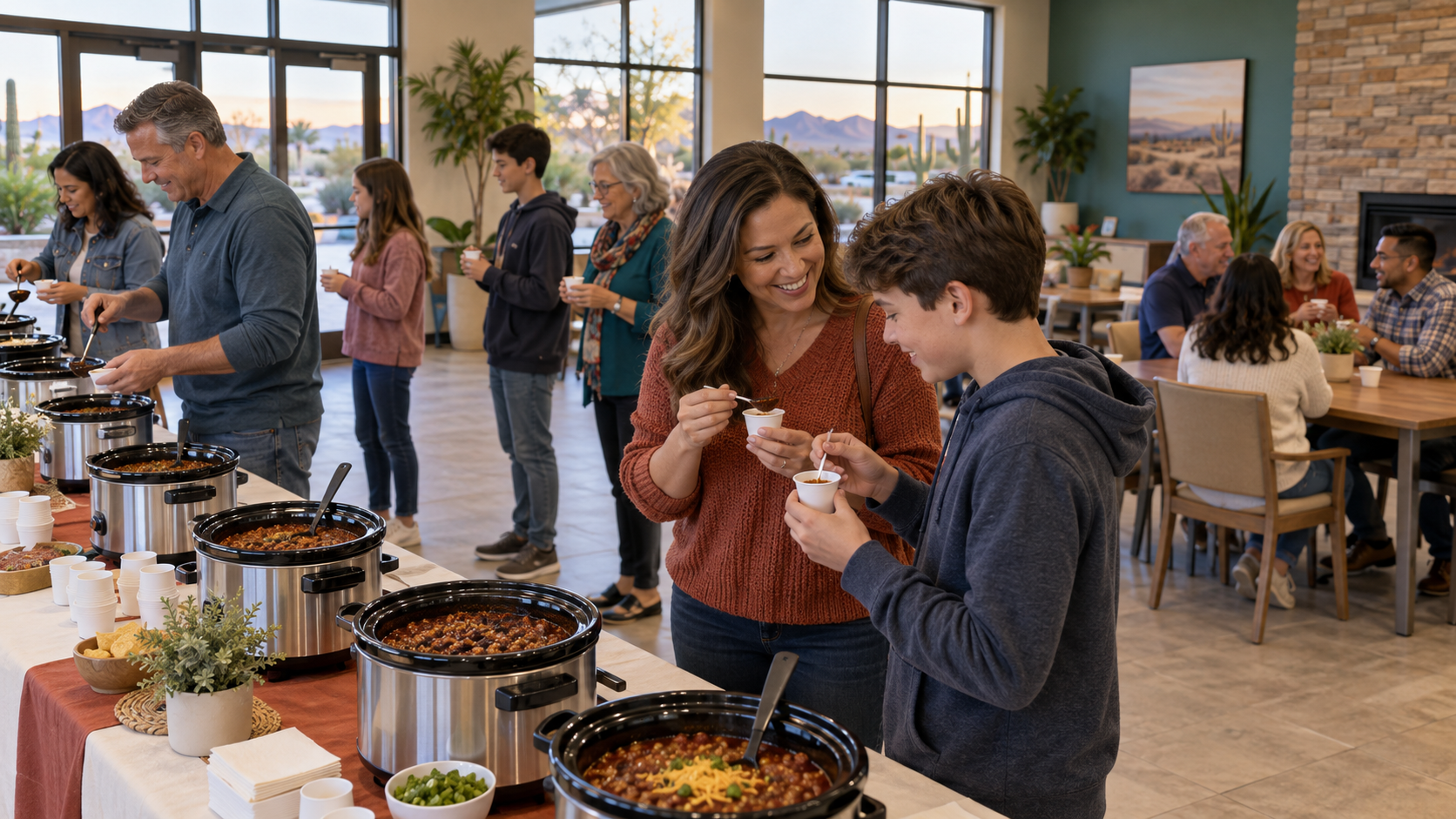
The chili is not usually the hard part. The traffic jam is. One guest is hunting for tasting cups, another is loading toppings before judging, and someone has handed the host a stack of ballots while a slow cooker needs an outlet.
A good chili cook-off needs one clear route, one voting rule, and a few named helpers. Put the pots in tasting order, move toppings and full bowls away from the judging line, collect votes at the end, and give each live problem an owner other than the host. That keeps the competition friendly and leaves room for the actual reason people came: tasting, talking, and defending a favorite recipe.
Quick answer
Use the EventRent AZ Taste, Top, Talk, Vote Route:
- Taste: Guests pick up a sample cup, spoon, water, and ballot before moving past numbered entries.
- Top: Toppings wait after the judging line so each chili gets a fair first taste and the serving table stays clear.
- Talk: Seating and larger bowls live away from the tasting route, giving people room to compare favorites.
- Vote: Ballots or tokens are collected at one obvious station after guests finish the full loop.
Choose the voting format before invitations go out, publish the rules for cooks, and assign separate owners for check-in, food setup, ballots, and closing.
Table of contents
- Choose the kind of cook-off first
- Write rules people can follow
- Build the Taste, Top, Talk, Vote Route
- Choose a fair voting format
- Give the food plan one owner
- Plan the room around the gathering
- Keep the host out of every decision
- Use a simple 90-minute flow
- Run the final walkthrough
- Chili cook-off FAQ
Choose the kind of chili cook-off before inviting cooks
“Chili cook-off” can mean three very different parties. Pick one before anyone starts planning a recipe.
- Casual neighborhood tasting: Friends or residents bring finished chili, everyone tastes, and the crowd chooses a favorite.
- Judged competition: Numbered entries go to a small panel using the same scorecard.
- Fundraiser or public event: Guests may buy admission or tasting rights, and organizers may work with vendors, sponsors, or a beneficiary.
The casual version is the easiest place to start. The judged version needs a clear scoring process and a neutral manager. The public version may trigger requirements that do not apply to a private social gathering.
Write one sentence that names the format:
We are hosting a friendly neighborhood tasting with eight registered home cooks, one People's Choice vote per guest, and no sales or public admission.
That sentence tells you what rules, permissions, supplies, and volunteers the event may need.
Write chili cook-off rules people can read in one minute
Good rules protect the fun. They do not need to read like a legal code.
Tell cooks:
- whether chili arrives fully cooked or is prepared on site;
- the arrival window and serving start;
- whether meat, vegetarian, bean, no-bean, or heat-level categories exist;
- how entries will be numbered or named;
- what the host provides and what each cook brings;
- whether power is available and which equipment is permitted;
- how known ingredients and dietary information will be displayed;
- how voting works, when it closes, and how ties are handled;
- what happens to leftovers, slow cookers, cords, and serving utensils.
Keep the first event smaller than the committee's imagination. The number of entries should come from the approved room, power plan, volunteer coverage, and guest experience, not a universal formula.
If friends are also bringing sides, drinks, or desserts, borrow the contribution handoffs from EventRent AZ's guide to organizing a potluck without managing the buffet. Keep the cook-off rules focused on chili and voting, then let the side-dish plan handle the rest.
Build the EventRent AZ Taste, Top, Talk, Vote Route
The best layout follows the order in which a guest makes decisions.
| Stop | What the guest does | Practical setup | What to avoid |
|---|---|---|---|
| Taste | Picks up a sample cup, spoon, water, napkin, and ballot, then moves past numbered pots | One clear start, entries in order, visible numbers, small samples, water nearby | Toppings, full bowls, chairs, or conversations blocking the tasting line |
| Top | Adds cheese, onions, crackers, or other confirmed toppings after judging | A separate surface beyond the last entry, with ingredient information and dedicated utensils | Putting toppings before the entries or letting one condiment line stop every taster |
| Talk | Sits, gets a drink, returns for a larger serving if the plan allows it, and compares favorites | Chairs and conversation tables outside the serving route | Making the tasting line the only place to stand and talk |
| Vote | Makes one clear choice and turns in the ballot or token | One station after the full loop, pens if needed, announced closing time | Collecting votes beside the first pot or changing the rules after tasting starts |
Taste first, top later. That protects the comparison and removes a common bottleneck. Full servings can follow the official tasting pass if the food plan allows them.
Do not force every guest through the loop at the same speed. Provide a place to pause, offer water, and make voting optional. A cook-off should still work for someone who wants to socialize without tasting every entry.
Choose a voting format that matches the mood
Fair does not have to mean complicated. Decide what “winner” means before the first spoon is served.
| Voting format | Best for | Simple rule | Watch out for |
|---|---|---|---|
| People's Choice | Casual HOA, family, or neighborhood gathering | Each eligible guest gets one ballot or token and chooses one entry | Popular cooks can influence the room if entries are not anonymous |
| Small judging panel | A more structured competition | Three or more neutral judges score the same few criteria | A long scorecard can make warm food and guests wait |
| Two awards | A mixed crowd that wants both fun and structure | Judges choose Best Overall, guests choose People's Choice | Explain that the awards answer different questions |
For a friendly gathering, People's Choice is usually enough. Number the entries, give every guest the same voting opportunity, and decide the tie rule before counting. State whether cooks and children vote and whether a guest may skip entries.
Keep the scorecard short. Flavor, texture, and overall impression may be enough. Do not present personal preference as an objective measure of the “correct” chili.
Give the food plan one qualified owner
A chili cook-off combines food from different cooks, warm holding, utensils, toppings, leftovers, and ingredient questions. That deserves a real plan.
Ask one qualified adult to own the approved food process. That person should confirm how entries arrive, how temperatures are checked and maintained, what serving utensils are used, how ingredients are communicated, and when leftovers leave service.
Use current FoodSafety.gov guidance for parties and large groups and follow the rules of the venue or organization. FoodSafety.gov points planners to USDA, FDA, and CDC resources for group meals and buffets. Do not call a shared table allergen-free or safe for a specific medical need unless a qualified, verified process supports that promise.
A private friends-and-family tasting and a public special event are not the same. If the plan may qualify as a special event where food is sold, sampled, or given away, review current Maricopa County special-event food requirements and ask the responsible authority how they apply to the exact event. Confirm before advertising, collecting money, or promising cooks that homemade food is allowed.
Plan the room around warm food, people, and conversation
Start with the tasting route, then place everything else.
Give the chili line stable rectangular surfaces. Keep cords and heat sources out of guest paths and use only an approved electrical plan. Put toppings after the last entry, drinks on another surface, and ballots where guests finish.
Seating can be casual, but it should be intentional. Keep chairs out of the tasting line and preserve an easy route between food, seating, restrooms, and the exit.
Use the live party table and chair planning guide to separate dining seats from support surfaces and prove the layout in the real room. The goal is not to fill every square foot. It is to let guests taste, sit, and move without the furniture becoming the event.
Set the spending ceiling before decorations and prizes multiply. The EventRent AZ party budget calculator can hold food, drinks, serving supplies, prizes, tables and chairs, cleanup, and contingency in one editable plan.
Keep the host out of every live decision
One organizer can plan the event, but one organizer should not run every station.
Assign these handoffs by name:
- Cook check-in owner: Receives entries, confirms numbers and approved setup, and points personal items toward storage.
- Food-plan owner: Manages the confirmed food-safety process, ingredients, utensils, holding, and leftovers.
- Guest-route owner: Welcomes tasters, explains the route, and notices when a line or table needs help.
- Ballot owner: Explains the rule, guards the closing time, counts with a second person, and applies the tie rule.
- Closing owner: Announces the winner, starts container pickup, and directs cleanup.
At a small event, one person can hold two compatible roles. The host should not hold all five. Name one person who can settle exceptions.
For a larger community program with booths, vendors, performances, or several activities, use the Arizona fall festival planning guide. A chili cook-off can be one good shared moment inside a festival, but it should not quietly inherit the workload of a festival without the matching plan.
Use a simple 90-minute chili cook-off flow
Adapt this editorial starting point to the venue, audience, food plan, and organizer capacity.
| Time | Guest experience | Organizer focus |
|---|---|---|
| 0:00 to 0:15 | Arrive, get water, read the simple rules, and greet neighbors | Keep the entrance open and finish no late setup in the guest path |
| 0:15 to 0:45 | Taste entries in any comfortable rhythm | Refill approved supplies, watch the route, and keep voting instructions consistent |
| 0:45 to 1:05 | Add toppings, choose a fuller serving if offered, sit, and talk | Announce the final voting time once, then let the party breathe |
| 1:05 to 1:15 | Turn in final ballots | Two people count away from the serving line and apply the written tie rule |
| 1:15 to 1:30 | Celebrate winners, thank every cook, and begin container pickup | Keep the announcement short and start the closing handoff |
Do not stretch the event simply because the room is booked longer. A short tasting with a clear ending can feel more complete than an open-ended party that fades while the organizer waits to count votes.
Run the ten-minute empty-room walkthrough
Before cooks arrive, carry an empty slow cooker or similarly sized object through the approved route. Then walk the same path as a guest holding a sample cup, water, ballot, and coat or bag.
Check:
- Can a cook reach check-in without crossing the guest line?
- Does every entry have an approved surface, serving utensil, identifier, and power arrangement if needed?
- Can a guest see where tasting starts and voting ends?
- Are toppings, drinks, seating, and trash outside the tasting bottleneck?
- Can a seated guest move without pulling a chair into the route?
- Does the food-plan owner have the supplies and authority needed for the approved process?
- Can two people count ballots without being interrupted?
- Is there one clear closing announcement and a place for containers to be collected?
If the walk feels crowded before people and food arrive, remove a table, move a station, or shorten the lineup. Do not fix a blocked route with another sign.
Chili cook-off FAQ
How many chili entries should a small cook-off have?
Use the entries that the approved room, electrical plan, food process, serving surfaces, and volunteer team can support without crowding. A shorter lineup can be better than a large field with a long wait.
Should chili cook-off entries be anonymous?
Anonymous numbers can reduce popularity bias. If names and decorations are part of the fun, be honest that the event is a social vote, not a controlled judging exercise.
What should the host provide?
At minimum, clarify who provides sample cups, spoons, napkins, water, ballots, pens or tokens, entry labels, serving surfaces, approved holding equipment, trash supplies, seating, and cleanup materials. Cooks should know exactly what they must bring.
How do you avoid a tie?
You cannot guarantee there will be no tie. Write the tie rule before tasting begins. Options include a neutral judge's choice, a short runoff between tied entries, or shared recognition. The fair choice is the rule everyone knew in advance.
Let the chili start the conversation
The best cook-off is not the one with the longest rule sheet or the fanciest prize. It is the one where cooks know what to bring, guests know how to taste and vote, and the host gets to hear the arguments about beans instead of solving a traffic jam.
Build the route in this order: Taste, Top, Talk, Vote. Then assign the handoffs, walk the room, and let a simple fall idea feel like a real neighborhood tradition.