Community Event Planning
How to Plan an HOA Movie Night That Feels Easy to Join
A movie night should feel simple to residents, not chaotic for volunteers. Use five quiet handoffs, two timelines, and a site rehearsal to plan the whole experience.
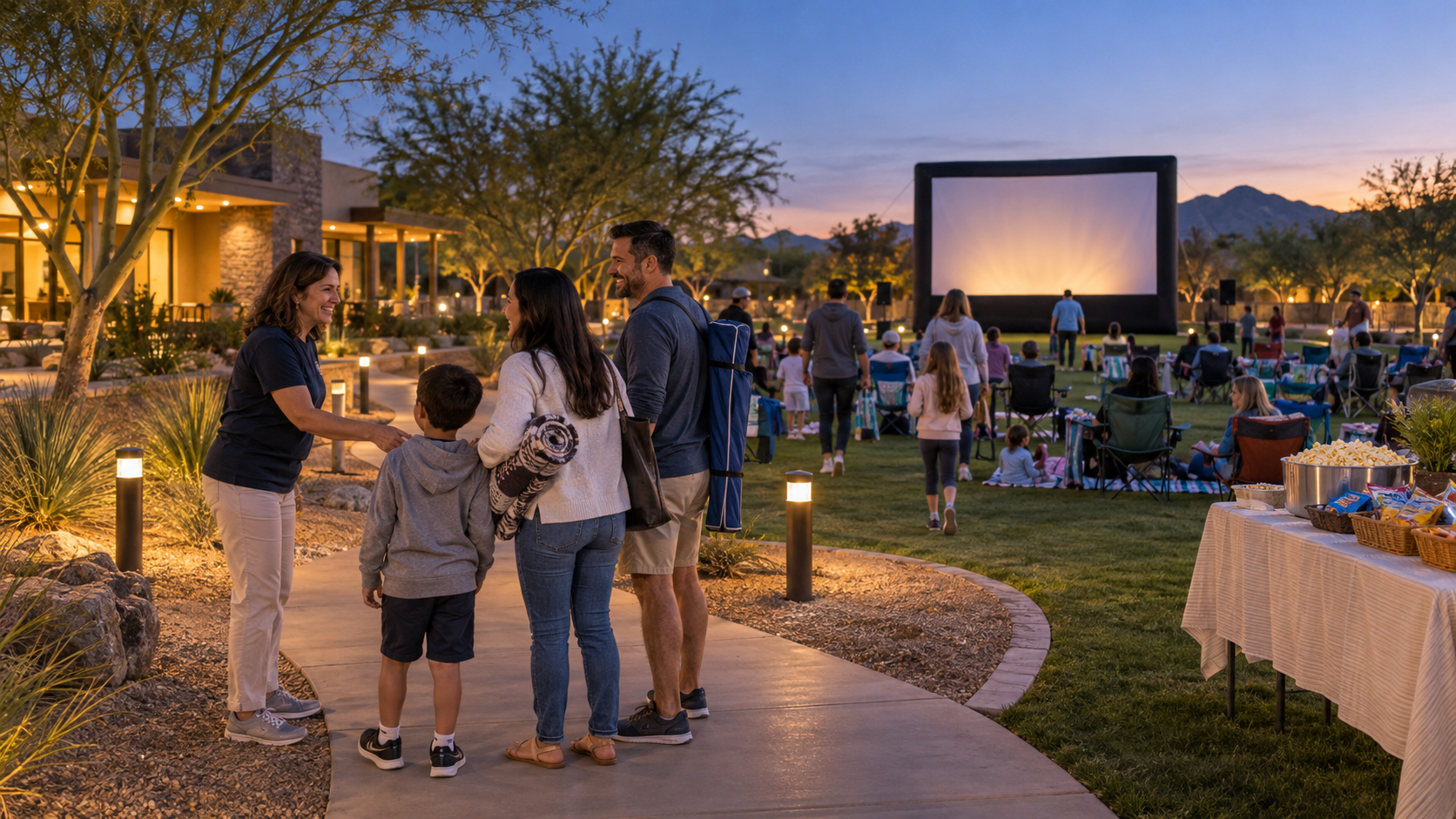
An HOA movie night sounds simple on the flyer: bring a chair, find a patch of lawn, and watch a movie with the neighbors. Behind the scenes, it can become five unfinished jobs sitting in one volunteer's inbox.
The practical answer is to assign five handoffs before promotion begins: rights, site, welcome, show, and close. Give each handoff one owner and one clear definition of done. Then build two timelines, one for what residents experience and one for the quiet work organizers must complete. That keeps the public side relaxed without leaving the important details to chance.
Quick answer: Start with approval and film rights, not the screen. Confirm the audience, common-area rules, site access, power, sound limits, backup decision, and responsible owners. Invite residents with one specific promise, create a clear arrival-to-exit path, test the actual setup, and name the person who can pause or cancel the show. The movie is the shared moment. The plan around it is what makes the night easy to join.
An HOA Movie Night Is Not Just a Bigger Backyard Movie
A private backyard movie and a resident screening in a common area are not the same planning job. Shared property adds approval, access, noise, insurance, vendor, food, and cleanup questions. A screening beyond a family's normal social circle can also fall within the legal meaning of a public performance.
The U.S. Copyright Office explains that copyright owners hold the exclusive right to perform motion pictures publicly. The federal definition includes a place open to the public or a place where a substantial number of people outside a normal family and social circle gathers. Review the U.S. Copyright Office overview of public-performance rights and the federal definition of a public performance with qualified guidance.
Do not assume that buying a disc, renting a title, or having a household streaming subscription grants permission for an HOA screening. Confirm the film, source, audience, and permission path in writing before promotion. This article is a planning guide, not legal advice.
Also confirm the association's approval process. A board, manager, property owner, insurer, city, vendor, or another responsible party may control the final decision.
Assign the Five Quiet Handoffs Before Anyone Designs the Flyer
Residents should see one simple night. Organizers need five clear owners.
| Handoff | Owner confirms | Definition of done |
|---|---|---|
| Rights | Film choice, content source, public-performance permission or documented exemption, and any promotion restrictions | The screening path is approved in writing by the responsible party |
| Site | Property approval, layout, access, power, lighting, sound limits, restroom plan, vendor access, weather decision, and backup location or date | The actual site has been walked and the final plan is shared with every operator |
| Welcome | Audience, resident message, RSVP if needed, arrival point, accommodations contact, and greeter | A resident can decide, arrive, and find the event without hunting for information |
| Show | Screen, projector, sound, playback source, cables, test, start cue, and stop authority | The full system works at the site, and one named person can pause or end the screening |
| Close | Exit lighting, cleanup, waste, equipment release, key or gate return, and incident or learning notes | The common area is returned as required and the team records one useful lesson |
One person may own more than one handoff. The point is to prevent everyone from assuming someone else handled a critical detail.
Choose One Resident Promise and Protect It
Community movie night names the format. It does not explain why a busy resident should come.
Choose one honest promise:
- Bring a chair, meet a few neighbors, and stay for a family movie under the stars.
- Let the kids settle into the movie while adults enjoy an easy evening nearby.
- Walk over after dinner, choose a seat, and leave whenever bedtime wins.
Keep the promise narrow enough to deliver. State who is invited, the caregiver expectation, and the approved movie rating without claiming one choice suits every family.
The EventRent AZ guide to making HOA events easier to join turns that promise into promotion and welcome strategy.
Walk the Site From Arrival to Exit, Not Just Screen to Projector
Stand where residents will enter. Then walk the complete route they will use.
Check:
- the gate, sidewalk, parking, drop-off, and common-area entrance;
- the route to seating, restrooms, water, snacks, and the exit;
- changes in surface, slope, curbs, cords, irrigation, landscape edges, and dark corners;
- nearby homes, pool gates, streets, play areas, sprinklers, and automatic lights;
- where equipment, tables, and waste stations could sit without narrowing the main path;
- where emergency access and normal property operations must remain open;
- what the space feels like after sunset, not only during a daytime walkthrough.
The U.S. Access Board explains that accessible routes connect site arrival points with accessible facilities and elements and generally coincide with circulation paths. Use the current accessible-route guidance as a starting reference, then have a responsible party confirm the applicable requirements and layout.
A screen with a perfect view is still in the wrong place if it blocks the route residents need most.
Build a Two-Clock Run of Show
The resident clock should feel loose. The organizer clock should be exact enough that no critical step happens in front of a waiting crowd.
| Resident experience | Organizer clock |
|---|---|
| Before arrival: A final message makes the location, start window, seating, food, cost, and weather status clear | Site owner confirms access, irrigation, lights, gates, surfaces, power, and the current weather decision |
| Arrival: A visible person or sign shows where the event begins | Welcome owner opens the entry, protects the main path, and directs questions away from the show operator |
| Pre-show: Residents choose seats, talk, eat, or join one low-pressure activity | Show owner completes the real playback test, sound walk, focus, cable check, and final light adjustment |
| Start: A short welcome sets expectations, then the movie begins | One person gives the start cue after picture, sound, rights, and site conditions are confirmed |
| During: Guests can move to a restroom or exit without crossing the image or equipment zone | Owners monitor only their assigned responsibilities and know who can pause the event |
| Close: Exit lighting rises, the route is obvious, and residents know where waste belongs | Close owner manages equipment release, cleanup, key return, and a final property walk |
Avoid turning the pre-show period into a second full event. One snack area, easy activity, or conversation is usually enough.
Plan Picture, Sound, Light, and Power After the Site Test
Do not choose technical details from guest count alone. Viewing depth, ambient light, noise, power, surface, wind, property rules, and access all matter.
At the actual site, confirm:
- The screen has stable, approved placement and required clearance.
- The projector path cannot become a resident walkway.
- Speakers can cover the seating area without creating unnecessary spill toward nearby homes.
- Essential paths, steps, gates, food areas, and exits remain visible without washing out the picture.
- Power and cables follow the equipment provider's instructions and the responsible property's requirements.
- The approved playback source works without relying on a last-minute login or uncertain connection.
- The person operating the show knows the pause, shutdown, and weather procedure.
For family-host setup ideas, use the complete Arizona backyard movie-night guide. Review the movie-night package page for currently listed components and site notes. Confirm availability, service, operation, site fit, pricing, and rights separately.
Arrange Seating, Snacks, and the Pre-Show Hour Around Movement
Use layers instead of one uniform field of chairs.
| Zone | Useful for | Protect |
|---|---|---|
| Front viewing zone | Blankets or other low seating when appropriate for the surface and audience | Screen clearance, child supervision, and a route out that does not cross the image |
| Chair zone | Residents who want back support, an easier transfer, or a defined seat | Sightlines, chair stability, row access, and space requested for mobility devices or companions |
| Conversation edge | Adults or caregivers who want to remain nearby without sitting in the center | Sound, lighting, and a clear connection to the main event |
| Snack and water zone | Food pickup and refills before or during the movie | Separation from equipment, the main entrance, the viewing path, allergens, waste, and property rules |
Keep food and drinks off the arrival path. Confirm food handling, vendor, allergy, waste, and alcohol rules with the responsible parties.
The EventRent AZ party budget calculator can separate venue, food, seating, entertainment, and contingency costs. Use current quotes and approved association numbers.
Send Three Useful Resident Messages Instead of Repeating the Flyer
Each message should do a different job.
First announcement
Neighbors, save [day and date] for [approved event name] at [exact common-area location]. [Who is invited] can arrive from [arrival time] and the movie begins after [verified start condition or time]. [Cost or no-cost statement.] Bring [only confirmed items]. [RSVP instruction or no-RSVP statement.] Questions or accommodation requests can go to [authorized contact and method].
Experience preview
Movie night will be simple: arrive through [entry], choose a spot in [approved seating area], and enjoy [confirmed food or pre-show activity] before the film. The approved title is [film], rated [verified rating]. Children remain with [confirmed caregiver expectation]. Please do not bring [property-specific restrictions].
Final logistics and weather message
Tonight's current plan is [proceed, relocate, postpone, or cancel]. Enter at [specific point] from [time]. The movie begins at [verified time or condition] and the event ends around [time]. Bring [confirmed items]. Parking or walking details: [details]. For a last-minute question, contact [authorized person and method].
Promise only confirmed child care, admission, food, pool, rain-location, or backup-date details. Keep one source of truth across every channel.
Rehearse the Handoffs, Then Close the Common Area Well
Before residents arrive, run one short rehearsal with the five owners.
- Start at the entrance and walk to every guest area.
- Sit in the front, middle, back, and chair-access positions.
- Play real approved content through the actual source and complete a sound walk.
- Turn on the lighting plan and look for new glare or dark routes.
- Confirm the snack, water, restroom, waste, and exit paths.
- Say out loud who decides to pause, relocate, postpone, or cancel.
- Confirm how residents receive a last-minute change.
- Review cleanup, equipment release, gates, keys, and the final property check.
After the event, record what residents used, where friction appeared, and one change for next time. One turnout number is not a verdict on the community.
HOA Movie Night FAQ
Does an HOA need permission to show a movie?
Treat permission as an early confirmation item. The organizer should confirm the film, audience, source, permission, and any exemption with the rights holder or licensor and qualified guidance. Do not assume home-viewing access covers a resident event.
What time should an outdoor HOA movie start?
Set the show time from an on-site picture test, the date, local light, property lighting, and equipment plan. Publish a realistic start and end instead of copying a generic seasonal time.
Should residents bring their own chairs?
They can when the property allows it. State what seating is permitted and provided, preserve approved routes and clearances, and confirm rentals separately.
How early should an HOA start planning a movie night?
Start from the slowest dependency, such as board approval, film rights, site permission, insurance, a vendor, city requirements, or resident notice. Work backward from that confirmed lead time.
Make the Night Simple for Residents, Not Invisible to Organizers
A good HOA movie night can feel wonderfully uncomplicated. Neighbors walk over, find a seat, share a snack, and watch one story together.
That ease is earned early. Settle the rights, approve the site, assign the five handoffs, and run both clocks. Then let the plan support an evening worth doing again.