Holiday and Seasonal Party Planning
How to Set Up a Hot Chocolate Bar Without a Sticky Traffic Jam
A hot chocolate bar should feel cozy, not crowded. Use the Pour, Top, Park Plan to organize the hot drink, toppings, refills, and cleanup.
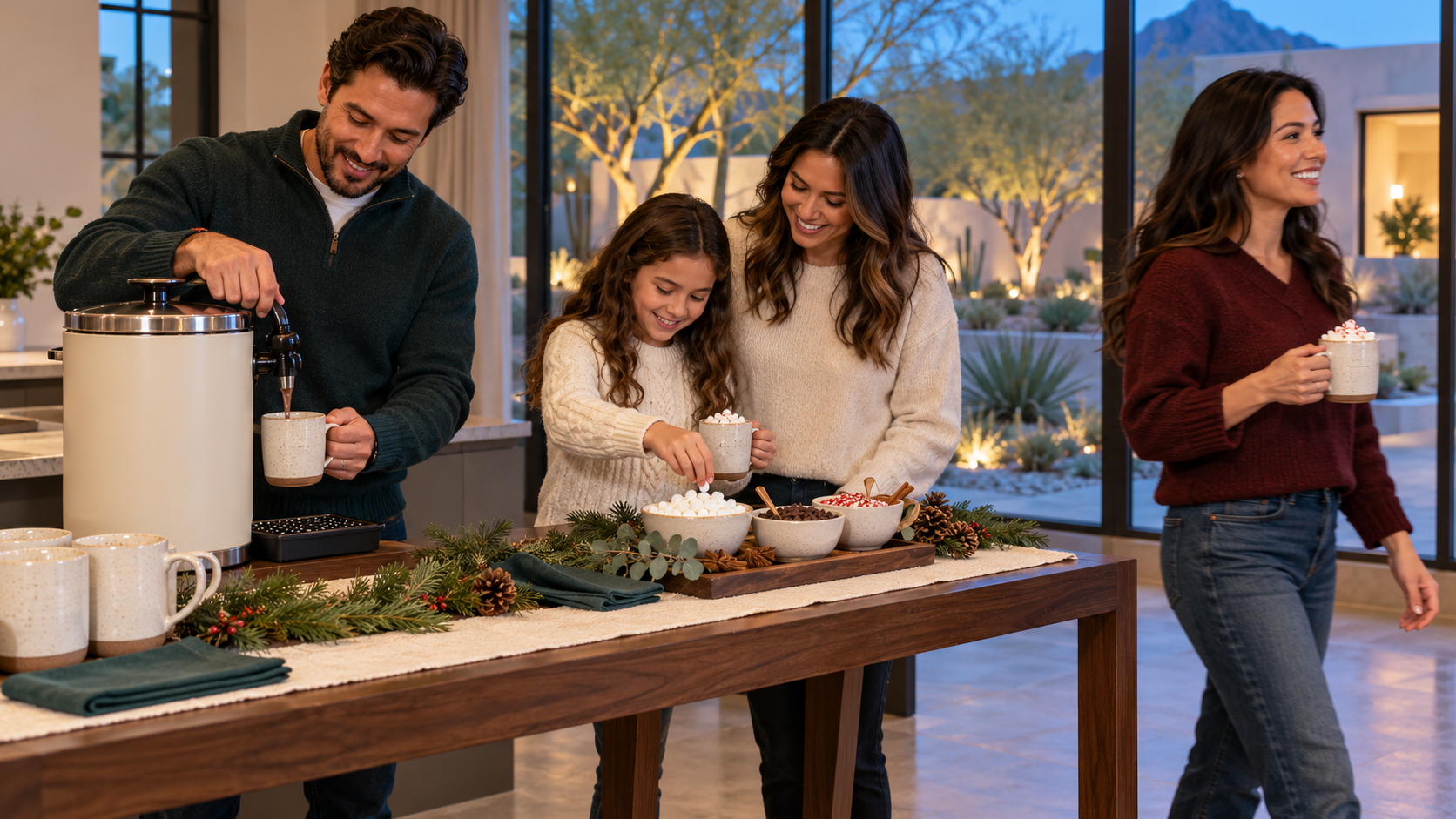
The first mug is charming. The fifth guest is holding a cup under the cocoa while someone reaches across them for marshmallows, a child is waiting beside the hot dispenser, and the host is searching for another spoon.
Set up a hot chocolate bar as three separate steps: Pour, Top, and Park. Keep the hot cocoa at the adult-controlled starting point, put toppings on the next stretch of table, and leave an open finish for stirring, napkins, lids, and walking away. That one-way route prevents most crowding before you buy a single decoration.
Quick answer: Use one dependable cocoa base, three to five toppings, one clean serving tool per item, and a clear refill route behind or beside the guest line. Keep original packages for ingredient checks, test the vessel as directed by its manufacturer, and move decor out of the reach-and-pour zone.
Table of contents
- Start with the Pour, Top, Park Plan
- Build the station in the order hands need it
- Keep the topping menu short enough to feel generous
- Protect children and guests from the predictable risks
- Plan refills, cleanup, and the host's exit before the party
- Hot chocolate bar FAQ
Start with the Pour, Top, Park Plan
A hot chocolate bar has a different rhythm from a food buffet. Every guest begins with an empty mug, pauses at the hottest part of the station, makes several small topping decisions, stirs, and then needs both hands to carry the drink away.
If all of those jobs happen in one square of counter, guests have to wait even when there is plenty of cocoa.
Use the EventRent AZ Pour, Top, Park Plan:
| Step | Put here | What it gives the guest | Keep out of this step |
|---|---|---|---|
| Pour | Mugs, cocoa vessel, ladle or spigot, drip tray, adult helper when needed | One clear place to receive the hot drink | Toppings, napkin piles, children waiting alone, decorative risers |
| Top | Three to five toppings, clean serving tools, simple ingredient information | Room to choose without blocking the hot pour | Backup packages, open drink refills, unrelated desserts |
| Park | Stirrers or spoons, lids if appropriate, napkins, cup sleeves, open exit space | A place to finish the mug and leave the line | Trash, dirty utensils, incoming guests |
| Reset | Backup cocoa, extra mugs, replacement spoons, cleaning cloths, trash access | A host route that does not cross the guest line | Anything guests must search through |
The Reset step belongs to the host, not the guests. Put backups on a nearby counter, cart, or shelf so you can replace an item without reaching through people holding hot drinks.
This follows the same one-way principle as the EventRent AZ guide to setting up a buffet without bottlenecks, but the cocoa bar needs more protected space at the pour and finish.
Build the station in the order hands need it
Start with the surface, not the jars.
Choose a stable, level counter or complete table that does not wobble when someone works a spigot or lifts a lid. Keep the station away from the entrance, the only route to a restroom, active play, and the edge of a patio. If an appliance requires power, follow its instructions and keep the cord and outlet out of guest traffic.
Then arrange the line from left to right or right to left, whichever gives guests a clean exit toward the party:
- Empty mugs: Place handles in an easy direction and avoid stacks that can tip.
- Hot cocoa: Use the vessel exactly as its manufacturer directs. Put a real drip tray or washable mat under the pour point.
- Toppings: Give each item its own spoon or tongs. Leave enough space for a guest to set down the mug while adding something.
- Finish: Provide a sturdy stirrer or spoon, napkins, sleeves, and lids only if they fit the cups safely.
- Exit: Protect an empty stretch of surface and a clear step away from the table.
Keep drinking water somewhere nearby but outside the cocoa line. Guests who only want water should not have to wait behind a topping decision.
For a freestanding party table, include the station in the complete room plan instead of borrowing a dining surface at the last minute. The EventRent AZ table-and-chair planning guide separates dining seats from buffet, drink, dessert, and support surfaces.
Decide whether one table or two surfaces work better
A short counter can still work if the pour stays at one end and the finish stays open. For a larger group, put the cocoa vessel on one protected surface and the toppings on a second surface immediately after it. Do not put the two surfaces across from each other if guests will turn and collide while carrying full mugs.
The setup should be obvious without a sign. If someone enters from the wrong end, use the mug placement, open walking space, and an adult greeting to redirect the flow.
Keep the topping menu short enough to feel generous
More toppings do not automatically make a better bar. Ten open containers create ten spoons, ten ingredient questions, more reaching, and a longer line.
Choose three roles instead:
- One familiar favorite: Mini marshmallows or whipped topping.
- One texture: Crushed cookies, toffee pieces, or chocolate shavings, with ingredients confirmed.
- One special choice: Peppermint pieces, cinnamon, caramel, or another flavor that fits the gathering.
Add one clearly separated alternative only when it answers a real guest need. A dairy-free cocoa base can be useful, but it should have its own identified vessel and serving tools. Do not describe the station as allergen-free unless the ingredients, preparation, surfaces, utensils, and cross-contact controls genuinely support that claim.
Keep decorative items behind the working zone, not between the guest and the mug. Greenery, ornaments, and jars should never force someone to reach over steam, food, or another person's hand.
A hot chocolate bar pairs naturally with a cookie exchange, but it should remain a separate drink stop. The EventRent AZ cookie-exchange plan keeps tasting, trading, and packing cookies away from open cups.
Make the menu readable without turning it into a sign wall
You can use a small card for the cocoa base and each topping, but keep the original packages available for guests who need to inspect the full label. A handwritten card is not a substitute for the manufacturer's ingredient information.
If a guest asks whether something is safe for their allergy, give them the package or recipe and let them decide. Do not guess, and do not promise that two open topping bowls have stayed separate just because they started with different spoons.
Protect children and guests from the predictable risks
The cocoa bar can be family-friendly without making the hot pour self-serve for every age.
Put an adult at the Pour step when children are present or when the vessel is awkward to operate. The child can choose a mug, point to toppings, or decorate at the next step while the adult handles the hot liquid. Keep the station away from running routes and do not place a hot vessel near the edge of the table.
The National Fire Protection Association's scald-prevention guidance emphasizes creating a kid-free zone around places where hot food and drinks are prepared or carried. For a party, that can be a protected pour point with an adult helper and a separate topping area children can reach safely.
Food information deserves the same clarity. Milk, soy, peanuts, tree nuts, wheat, and other ingredients can appear in cocoa mixes, marshmallows, candies, cookies, syrups, and toppings. The FDA explains the nine major allergens and why guests should read the packaged-food label. Save every package until the event is over.
Before guests arrive, confirm:
- the vessel is stable and used as directed;
- the pour point is away from children running or waiting;
- every topping has its own clean utensil;
- packages and recipes are available for ingredient questions;
- alternatives are clearly identified and separated where practical;
- spills can be wiped without sending people through the line; and
- one adult knows who owns the station during the busiest window.
These are planning safeguards, not a substitute for caregiver judgment, medical advice, appliance instructions, venue rules, or professional food-service requirements.
Plan refills, cleanup, and the host's exit before the party
A bar feels self-serve only when the host can refill it without stopping the party.
Prepare the cocoa fully using a method appropriate to the recipe and appliance. If you transfer it to a slow cooker, the USDA notes that a warm or hot setting is for holding food after it is cooked, not for cooking it from the start. Follow the recipe, appliance directions, and the USDA's slow-cooker setting guidance rather than improvising at the event.
Keep one backup set together: extra mugs, napkins, stirrers, clean topping tools, a waste bag, and a cloth for the drip area. Store it on the host's Reset route.
Use small topping containers and refill them from the original packages. This keeps the table lighter, the ingredients easier to identify, and the leftovers simpler to store. Replace a dropped or mixed-up utensil instead of wiping it and returning it to another bowl.
Put trash and cup return beyond the drinking area, not beside the clean mugs. If guests will leave with covered cups, confirm the lids fit before the event. A lid that looks close enough but pops off a warm drink is worse than no lid.
Run the ten-minute host check
Walk the real station with a real mug.
- Pour: Fill the mug to the level you plan to serve. Check the spigot, ladle, drip tray, and vessel stability.
- Top: Set the mug down and use each serving tool with one hand. Remove any jar or decoration that requires reaching across another item.
- Park: Stir, take a napkin, add a sleeve or tested lid, and step away without turning into the next guest.
- Reset: Carry a refill or replacement spoon to the station without crossing the guest route.
- Clean: Wipe a pretend spill and reach the trash without moving the hot vessel.
If the test requires two hands while you are still holding the mug, add open counter space before adding decor. If the host cannot reach the station from the back or side, move the backups. If a child would wait beside the hot pour, separate Pour from Top.
The best hot chocolate bar is not the one with the most jars. It is the one guests understand, caregivers trust, and the host can leave for long enough to drink a cup too.
Hot chocolate bar FAQ
How many toppings should a hot chocolate bar have?
Three to five is usually enough for a home or clubhouse gathering. Choose a familiar favorite, one texture, and one special flavor, then add only the alternatives your actual guests need. A shorter menu keeps the line moving and makes ingredient information easier to manage.
Should the hot chocolate go in a slow cooker?
A slow cooker can be a holding vessel only when the recipe and appliance directions support that use. Prepare the cocoa fully with an appropriate method, then use the slow cooker's setting as directed. Keep the cord and hot vessel out of guest traffic and place an adult at the pour when children are present.
Where should a hot chocolate bar go at a party?
Use a stable, level surface near the gathering but outside the entrance, food line, active play, and main walking route. Protect a clean exit after the toppings and keep the host's refill path separate.
How do you keep a hot chocolate bar from getting messy?
Use a drip tray, small refillable topping containers, one serving tool per item, napkins at the finish, and an open Reset route for the host. Walk one full mug through the station before guests arrive and remove anything that forces a reach or backtrack.