Birthday Planning
How to Plan a Joint Birthday Party That Still Feels Special for Both Kids
One party can celebrate two siblings without making either one feel like the add-on. Use the Two Yeses, Two Moments, One Middle Plan to decide, invite, schedule, and set up the day.
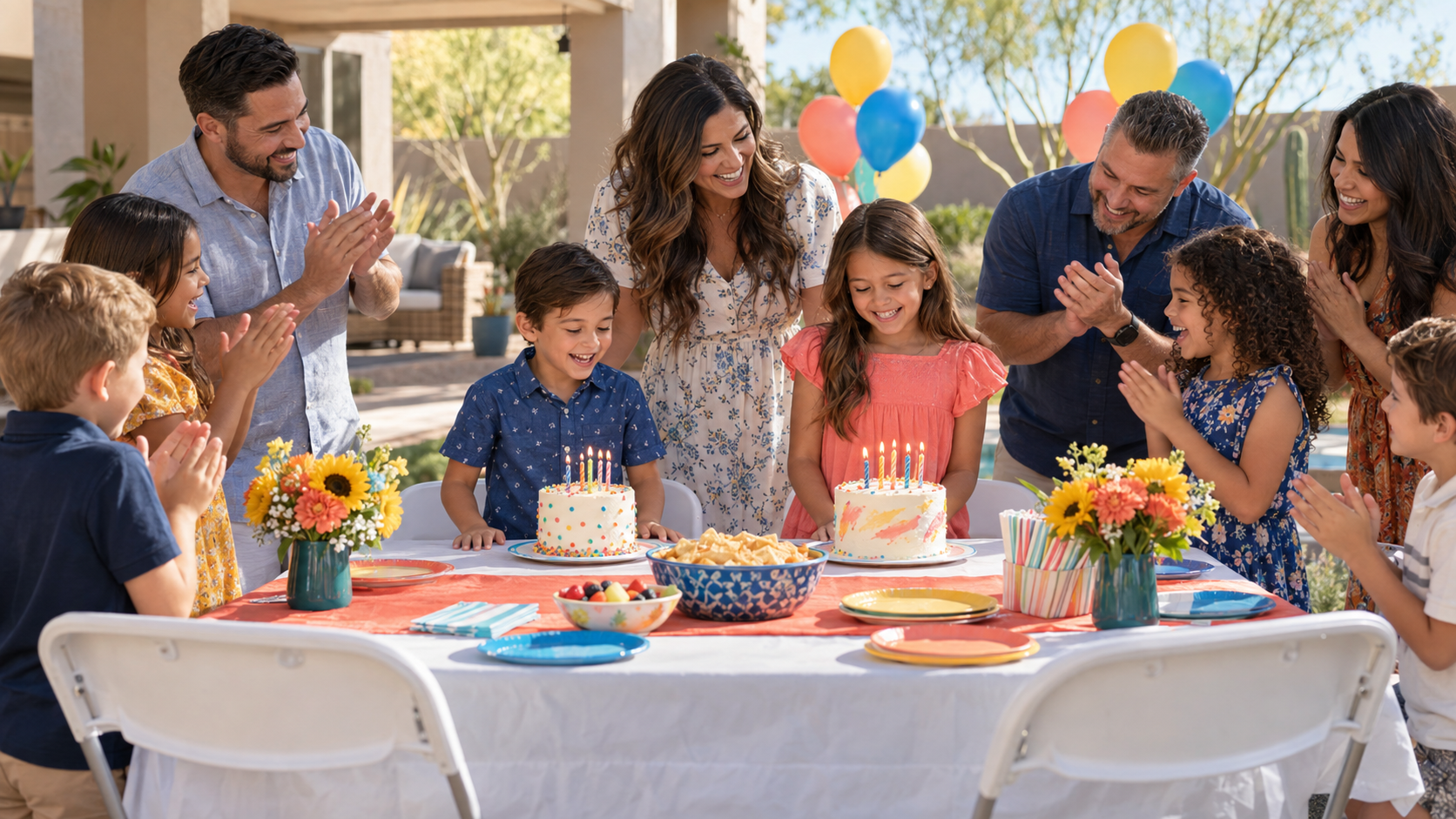
The calendar makes a convincing argument for one party. Two birthdays are close together, the same relatives would drive across town twice, and you can already picture the second round of shopping, setup, and cleanup. Then comes the question that matters more: will both kids feel celebrated, or will one feel folded into the other's day?
The practical answer is to combine only when both children are genuinely on board. Give each child a separate recognition moment, then build most of the party around one shared activity, meal, and guest experience. That saves real work without making either birthday child feel like the convenient add-on.
Quick answer: Use the EventRent AZ Two Yeses, Two Moments, One Middle Plan. Get a private yes from each child. Protect one equally prepared birthday moment for each. Keep the rest of the event centered on something they both enjoy. If you cannot get two real yeses or find a shared middle, choose separate friend celebrations or one joint family gathering plus smaller individual moments.
First Decide Whether One Party Is Actually Kinder
Start with two separate conversations. Ask each child how they feel about sharing the party before you describe the bigger guest list, extra decorations, or money saved. A child who says “fine” while staring at the floor has not given the same answer as a child who immediately starts imagining the day.
The goal is not perfect enthusiasm. The goal is honest agreement without pressure. Children can have mixed feelings and still want the party. They should also know that sharing this year does not create a permanent family rule.
Use this table as a conversation guide, not a verdict.
| A joint party is promising when | Separate celebrations may be kinder when |
|---|---|
| Both children choose it after private conversations | One child agrees mainly to avoid disappointing the parent or sibling |
| Their guest groups can share at least one activity or meal | One guest group would dominate the room, schedule, or activity |
| Each child can name something they are excited to share | Every theme or activity feels like a win for one and a concession for the other |
| The space can support one connected gathering | The setup would become two crowded parties with one entrance |
| The family can protect two equal recognition moments | One child's milestone needs a different pace, setting, or kind of attention |
If the answer is no, the alternative does not have to be two full productions. You might hold one family meal for both children and let each choose a smaller friend outing, sleepover, or favorite-day activity. The useful decision is the one that fits your children, not the one that looks most efficient on paper.
Use the Two Yeses, Two Moments, One Middle Plan
Once both children want to share, make the plan visible.
| Part | Decision to make | What guests should notice |
|---|---|---|
| Two yeses | What is each child excited to share, and what do they want to keep personal? | Both names, interests, and friend groups feel expected |
| Two moments | How will each child be recognized separately? | Each child hears their name, sees their candles or dessert, and gets unhurried attention |
| One middle | What activity, meal, or atmosphere truly works for both? | The party feels connected instead of divided into rival corners |
This plan keeps fairness from becoming a decorating contest. Equal does not require identical colors, cakes, or gifts. It requires equal care.
One child may want the first candle moment because waiting is hard. The other may want to choose the final song. One may love a loud cheer, while the other would prefer a short toast and family photo. Match the form to the child while matching the level of attention.
Build the Guest List Before You Pick the Theme
Two friend groups can double the social complexity faster than they double the fun. Write each child's must-have guest list separately, then look for overlap.
Ask:
- Are the children close enough in age for most guests to enjoy the same core activity?
- Will classmates know whose celebration they are attending?
- Are siblings of invited guests included, optional, or not part of the invitation?
- Will parents stay, drop off, or decide based on the child's age?
- Does the combined group still fit the space with comfortable seating and clear paths?
Do not quietly cut one child's friends to make the numbers look even. A better move may be one shared family party with separate small friend plans.
Once the list is real, set the RSVP deadline from the decisions that need a headcount. The EventRent AZ party invitation timeline can help you work backward from food, seating, and final setup.
Choose One Shared Middle, Not One Forced Theme
A joint party does not need one perfect theme that describes both children. It needs a shared middle that gives both groups an easy way to participate.
That middle might be backyard games, a movie, pizza making, an art table, a simple challenge course, a dance playlist, or a build-your-own dessert. Each child can choose a smaller personal detail around it, such as a color, dessert flavor, table card, playlist pick, or photo prop.
| Situation | Shared middle that can work | Personal detail for each child |
|---|---|---|
| Close ages and overlapping friends | One open game area plus food and cake | Each child chooses a featured game or team color |
| Different ages but compatible interests | Two difficulty levels inside the same activity | Younger and older prompts, goals, or materials |
| Different interests | Neutral shared activity with two small visual accents | Separate dessert colors, mini displays, or photo props |
| One social child and one quieter child | Drop-in stations instead of one performance | One leads a game; the other chooses a craft, playlist, or photo moment |
For young children, the American Academy of Pediatrics' playful birthday guidance recommends structured but flexible activities and short activity windows. That approach helps a mixed-age party because children can enter, leave, and return without waiting for the whole group.
If adults will stay, choose something they can understand from a few feet away and join without taking over. The kids' birthday guide for adult guests has practical ways to give children and grown-ups an easy way into the same celebration.
Write an Invitation That Celebrates Both Children Clearly
Put both names in the same visual position and give each child's age the same prominence. Then answer the questions that become awkward later: Who is invited? May siblings attend? Will adults stay? Is the party shared for the entire time? Is one gift expected for each child?
Use wording like this:
Please join us for one big birthday afternoon celebrating [Child One], turning [age], and [Child Two], turning [age]. We will share games and food, then give each birthday kid their own cake-and-candle moment. [Invited guest] is invited, and [siblings are welcome / please check with us before bringing siblings]. Gifts are optional. If you choose to bring one, a small gift or card for either child is lovely, but your company is what matters most. Please RSVP by [date] and tell us how many adults will stay.
The parent should adjust the gift line to fit the real family expectation. If guests are likely to bring gifts for both children, say so plainly and keep the scale modest. If gifts are not expected, do not hide that message after registry links.
Clarity protects both children. It also keeps guests from arriving with a gift for the classmate they know and only then realizing the party honors two children.
Give Both Kids a Real Birthday Moment
Do not combine the part that tells each child, “Today, we see you.” Each child should hear their own name, have their own candle or dessert moment, and receive a clear pocket of attention.
The moments can sit inside one smooth two-hour party:
| Time | What happens | Fairness cue |
|---|---|---|
| 0:00 to 0:20 | Arrivals and open shared activity | Both names appear at the entrance or welcome table |
| 0:20 to 0:55 | Shared games, stations, or project | Each child gets one first-choice role without controlling everything |
| 0:55 to 1:20 | Food and conversation | Seating mixes both friend groups instead of creating opposing sides |
| 1:20 to 1:30 | Birthday moment for Child One | Name, candles or dessert, photo, and full song or toast |
| 1:30 to 1:40 | Birthday moment for Child Two | The same preparation and unhurried attention in the child's preferred style |
| 1:40 to 2:00 | Favorite shared activity and goodbyes | Each child chooses one closing detail, such as a song or final game |
This schedule is an editorial starting point, not a rule. Age, nap needs, travel, meal timing, and the activity may change it. The birthday party duration guide can help you choose the overall length before you fill the schedule.
Avoid making the second child wait through a long gift-opening session for the first. Open gifts later, open both children's gifts in parallel with dedicated helpers, or skip public opening entirely. The right choice is the one both children understand before guests arrive.
Set Up One Connected Party With the One Middle Map
A split theme can accidentally create two camps. Instead, draw one shared center and place the personal details around it.
Your five zones are:
- Welcome point: Both names, one gift landing spot, and the first easy direction.
- Shared middle: The activity, food, or seating area where the party feels like one gathering.
- Child One detail: A small display, dessert, color, or photo element chosen by the first child.
- Child Two detail: An equally intentional detail chosen by the second child.
- Quiet landing spot: A few seats away from the busiest path for a child or adult who needs a break.
Keep food, drinks, gifts, and the two personal details from blocking doors or splitting the yard down the middle. In an East Valley home, walk the setup at the actual event time. If the patio is uncomfortable, move the shared middle indoors rather than putting one child's area in the less comfortable space.
Before buying duplicate decorations, protect the parts of the budget both children will use. The EventRent AZ party budget calculator can help you set one ceiling, protect the shared priorities, and keep two sets of small purchases from quietly becoming two party budgets.
Run the Final “Would I Want My Name Here?” Check
The day before the party, look at the invitation, room, schedule, and supplies from each child's position.
- Are both names equally visible?
- Does each child recognize at least one choice they made?
- Can every guest tell the party celebrates two people?
- Is each recognition moment equally prepared, even if the style is different?
- Does one child's friend group, age, or personality control the entire shared middle?
- Has each child heard the plan for gifts, candles, photos, and goodbyes?
- Can the host stop managing long enough to notice both children?
Then ask each child one last private question: “Is there anything about tomorrow that still feels unfair or confusing?” You may not be able to grant every request, but you can remove surprises.
One party works when convenience stays in the background and both children stay visible. Get two real yeses, protect two meaningful moments, and create one middle everyone can enjoy. The result can feel bigger and warmer than two separate productions because the day is shared on purpose, not merged by default.
Joint Birthday Party FAQ
Should siblings always have separate cakes?
Not always. The useful standard is separate recognition, not a universal cake rule. Two small cakes, one shared cake with separate candles, or two favorite desserts can all work if each child understands the plan and receives an unhurried moment.
How far apart can sibling birthdays be for a joint party?
There is no universal number. Consider whether both children want the celebration, whether guests can reasonably attend one date, and whether combining still feels connected to each birthday. The children's comfort matters more than an arbitrary calendar cutoff.
What if one child wants a joint party and the other does not?
Do not force the shared friend party. Consider one joint family meal plus separate small friend activities, or let the child who wants a group event have it while the other chooses a different kind of celebration.
How do we handle gifts at a joint birthday party?
Choose the expectation before sending invitations and state it clearly. Options include gifts optional, a modest gift or card for each child, no public opening, or separate gift moments after the party. Avoid letting guests discover the second birthday only when they arrive.