Tables & Chairs
Round vs. Rectangular Tables for a Party: Choose by the Moment, Not the Photo
Round or rectangular? Use the Seat, Serve, Shift Test to choose each party table by its real job, then test the occupied layout before setup day.
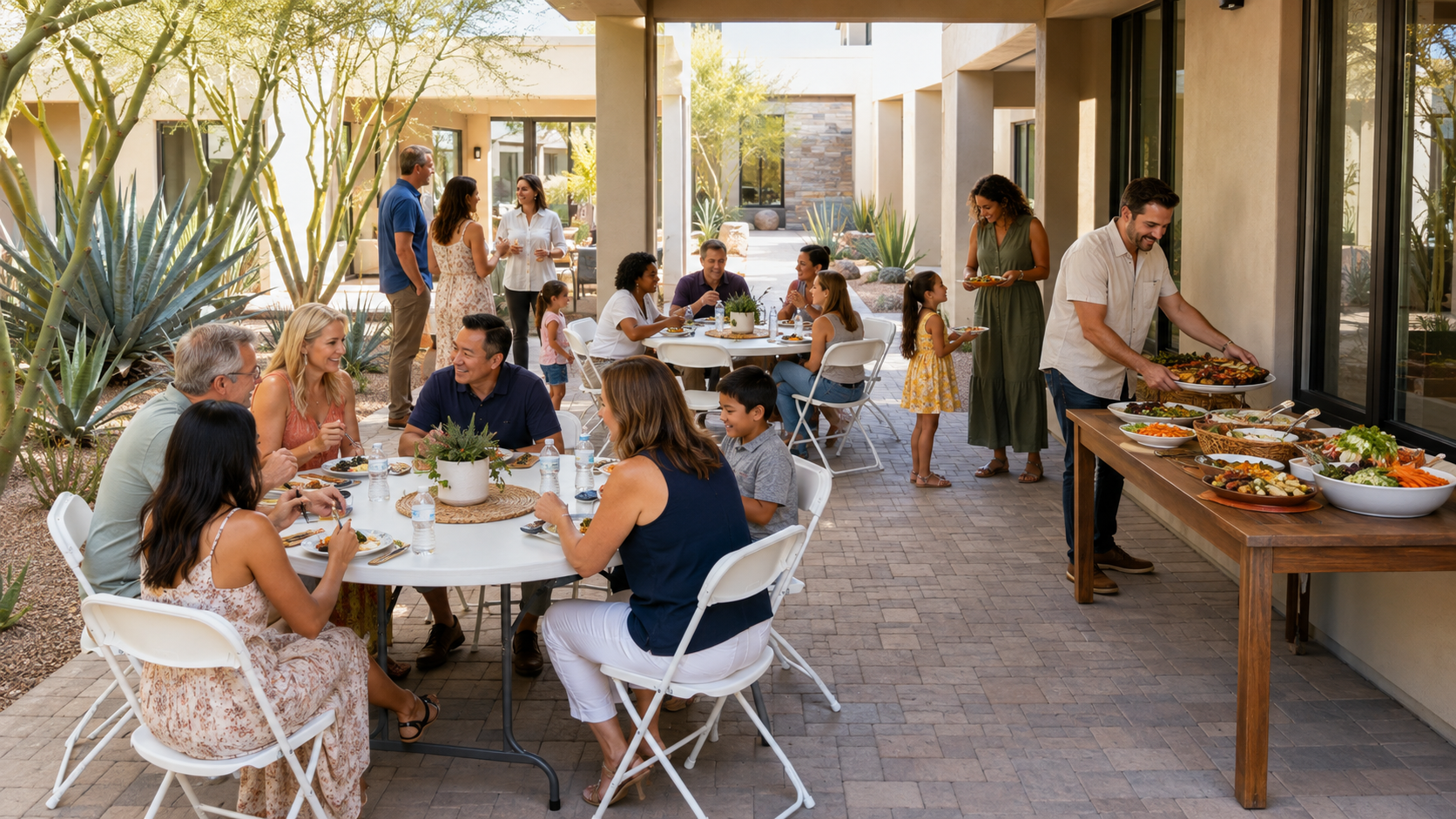
You can make either table shape look beautiful in an empty room. The harder question is what happens after guests arrive, chairs pull out, plates appear, and someone needs to reach the restroom without asking half a table to move.
Choose round tables when seated conversation is the main job and the room gives every chair room to breathe. Choose rectangular tables when you need straight edges, flexible placement, food or activity stations, or an easy way to reconfigure the space. For many parties, the best answer is a mix: rounds for social dining and rectangles for serving, gifts, crafts, or displays.
Quick answer
Start with the job, not the shape. Label every planned table Seat, Serve, or Shift. A Seat table keeps guests comfortable and connected. A Serve table moves food, drinks, gifts, or supplies. A Shift table may change purpose or position during the event. Then choose the shape that performs that job in the measured room.
EventRent AZ's current 60-inch circular table is described as seating 8 to 10 guests, while its 6-foot rectangular table is described as seating 6 to 8. Treat the top of either range as a tighter arrangement and confirm chair width, place settings, decor, end seating, and occupied clearance before finalizing a count.
In this guide
- Use the Seat, Serve, Shift Test
- Choose round tables for shared conversation
- Choose rectangular tables for flexible jobs
- Mix shapes without making the room feel random
- Match table shape to six common events
- Test the occupied layout
Use the Seat, Serve, Shift Test before comparing table shapes
Most table comparisons start with a list of pros and cons. That helps, but it still leaves the host trying to choose one winner for an event with several different needs.
A table should be judged by the job it must perform at the busiest moment. Use the EventRent AZ Seat, Serve, Shift Test:
| Table job | Main question | Shape that often starts strongest | What can change the answer |
|---|---|---|---|
| Seat | Will people eat, talk, watch, or work here? | Round for group conversation, rectangular for directional or compact seating | Room shape, chair width, focal point, guest needs, place settings |
| Serve | Will guests approach, choose something, and move away? | Rectangular | Access from one or two sides, refill path, wall placement, queue direction |
| Shift | Will the table move, join another table, or change jobs? | Rectangular | Staffing, storage space, floor surface, venue rules, timing |
Walk through the event in order. The gift table may begin as a Serve table, then become a place for favors near the end. A craft table may be a Seat table for children but a Shift table before dinner. A family meal may need Seat tables plus separate Serve tables so platters do not crowd place settings.
This is the central decision: do not make one surface carry three jobs simply because it is already in the room. A separate drinks or activity table may protect the guest experience more than adding another dining seat.
Choose round tables when shared conversation is the main event
Round tables naturally turn guests toward a common center. No one occupies an obvious head position, and several people can see one another without looking down a long row.
They are a strong starting choice for:
- showers where conversation matters more than a front-facing program;
- family meals with guests grouped by household, generation, or shared connection;
- receptions with an open room and several social dining groups;
- events where a centered focal point is less important than table-level connection;
- broad patios or community rooms that allow circulation around the full perimeter.
The current EventRent AZ 60-inch circular table is described as seating 8 to 10 guests. For a meal with wider chairs, substantial place settings, or a centerpiece, begin with the more comfortable end of that range and confirm the real setup.
Round does not automatically mean easy. Every chair needs usable space behind it, and the table cannot sit flush against a wall without losing part of its seating logic. A round table can also be a poor fit in a narrow side yard or long room where guests need to face a speaker, screen, couple, or activity.
Choose a round table because the guest group should face inward, not because round has been labeled more elegant. Linens, chairs, lighting, and decor can change the visual tone of either shape.
Choose rectangular tables when the room or the job needs flexibility
Rectangular tables have straight edges that can align with walls, run parallel to a narrow patio, stand alone, or join end to end. That flexibility makes them useful well beyond guest dining.
They are a strong starting choice for:
- buffet, dessert, drink, gift, registration, or favor stations;
- crafts, games, displays, sign-in, or school and community activities;
- long or narrow rooms with a clear front, aisle, or service wall;
- small gatherings where one shared table suits the group;
- layouts that may need to change between arrival, a meal, and an activity.
The current EventRent AZ 6-foot rectangular table is described as seating 6 to 8 guests and as useful for dining, service, gifts, activities, and displays. End seats and a tighter eight-person plan should be checked with the actual chair, tabletop setup, and path behind the guest.
Rectangles have tradeoffs too. One very long run can leave guests talking mostly to the people beside or directly across from them. Rows can feel more like a meeting or cafeteria than a celebration if the room has no social break, focal point, or warm styling. End seats may also project into a walkway that looked clear on paper.
Rectangular is not automatically more space-efficient. The exact dimensions, chair positions, aisle needs, room shape, and usable edges decide whether the full occupied layout fits.
Mix round and rectangular tables without making the room feel random
For many home, HOA, and family events, a mixed plan is the most honest answer because dining and service are different jobs.
A simple mixed layout might use:
- round tables for seated guest conversation;
- one rectangular table along a wall for drinks;
- one rectangular table with a clear beginning and end for buffet service;
- a second rectangular table for gifts, crafts, or an activity away from the food line.
Another event may reverse the emphasis. A company workshop could use rectangular tables facing a presenter, then add one round table in a side area for a quieter break or small-group conversation.
Keep the mix intentional with three visual anchors:
- Use a consistent chair type unless a different chair communicates a real zone.
- Repeat one linen color, runner, centerpiece material, or place-setting cue.
- Align table edges and centers to the room, not to one another at random.
The shapes do not need to match. The reason for each shape needs to be obvious. Guests should be able to read the room: sit here, find food there, leave gifts here, join the activity over there.
If the next question is quantity, use the EventRent AZ table-and-chair planning guide. It separates guest dining from support tables and compares comfortable and tighter starting counts.
Match the table shape to six common party situations
Use these examples as a starting point, then let the measured room and guest needs make the final decision.
| Event situation | Strong starting plan | Why it works | Check before committing |
|---|---|---|---|
| Backyard family dinner | One or more rectangles, or rounds plus a separate serving table | Rectangles can create one shared table; rounds can divide a larger group into easy conversations | Patio width, end seats, shade, door and restroom path |
| Baby or bridal shower | Rounds for guests, rectangle for gifts and food | Guests can talk at the table while service stays separate | View of honoree, gift-opening plan, stroller and mobility space |
| Child's birthday | Rectangles for crafts and food, smaller seating clusters for adults | Surfaces can change jobs while adults still have a place to settle | Adult count, child supervision, spills, activity transition |
| HOA or community meeting | Rectangles facing the program, or rounds for small-group discussion | Shape follows whether guests listen, write, or talk together | Sightlines, sound, exits, late-arrival path |
| Company open house | Rectangular service and display tables with limited social seating | Guests can circulate without turning every surface into dining | Check-in queue, electrical needs, accessible route, staff replenishment path |
| Wedding reception | Rounds, rectangles, or a deliberate mix around the room's fixed moments | The dance floor, couple, food, music, and guest paths should decide | Venue floor plan, service, views, room flip, final guest count |
For a wedding, the table-shape decision belongs inside the full room plan. The EventRent AZ wedding reception layout guide helps place fixed features, guest paths, the dance floor, service areas, and tables around the moments people came to share.
Do not assume every guest at a casual event will stand because children are playing or arrivals are staggered. Count the adults, older relatives, pregnant guests, and anyone who may need a stable seat. Ask guests about access needs instead of guessing.
Test the occupied layout, not the empty furniture
The most useful layout test happens after you imagine every chair occupied.
Use this check before the rental order or final venue approval:
- Mark the outside edge of each table in the real space with painter's tape, cones, or removable markers.
- Put a real chair at the tightest seat and pull it back as a guest would.
- Walk from the entrance to seating, food, drinks, restroom, activity area, and exit while carrying an empty plate.
- Stand where a buffet or drink line will form. Make sure the queue does not close another route.
- Test the table-end seats, corners, doors, gates, pool boundaries, cords, uneven surfaces, and any place two paths cross.
- Repeat the walk during the event's busiest moment, not only at arrival.
- Confirm who may move a Shift table, when it moves, where its contents go, and what guests do during the change.
If the layout works only while every chair is tucked in, it does not work yet. Change the table orientation, remove an end seat, separate dining from service, or choose another shape before narrowing the main path.
Accessibility requirements depend on the site and event. The U.S. Access Board explains that accessible routes connect accessible entrances, spaces, and elements, and that those routes must meet technical requirements. Review its guide to accessible routes, then have the venue and qualified professionals confirm what applies to the property and gathering.
In an East Valley backyard or covered patio, also check the space at the time guests will use it. Sun angle, lighting, doors, fans, landscaping, and the route from parking can change which part of the floor is truly available. Keep the weather discussion proportionate and confirm current conditions close to the event.
Frequently asked questions
Are round tables better for party conversation?
Often, because guests face a shared center and can see more people at the same table. The benefit weakens if the table is overcrowded, the centerpiece is too tall, music is too loud, or guests must keep turning toward a program. Choose round when table-level conversation is a main event job and the room provides enough occupied clearance.
Do rectangular tables fit more guests than round tables?
Not automatically. Capacity depends on the exact table dimensions, chair width, usable edges, place settings, aisle needs, and room shape. EventRent AZ currently describes its 6-foot rectangular table for 6 to 8 guests and its 60-inch circular table for 8 to 10. Compare the occupied layouts, not only the number of seats printed in a chart.
Can I use both round and rectangular tables at the same party?
Yes. A mixed layout often works best when the shapes have different jobs. Use one shape for guest seating and another for food, drinks, gifts, crafts, registration, or displays. Repeat chairs, linens, colors, or centerpiece materials so the room feels connected.
Which table shape is best for a small backyard?
The yard's usable shape decides. A narrow side patio may favor a rectangle aligned with the long edge. A broader square or open area may support a round table with circulation on every side. Tape the table footprint, pull out a real chair, and walk the occupied routes before choosing.
The best table shape is the one guests can use without thinking about it
Round and rectangular tables are not opponents. They are tools for different moments.
Label each table Seat, Serve, or Shift. Choose rounds where facing one another improves the gathering. Choose rectangles where straight edges and flexibility make the room easier to use. Mix them when the event has more than one job, because most parties do.
Then test the layout with chairs pulled out and people in motion. If guests can sit, eat, talk, move, and find what they need without furniture becoming the story, you chose well.