Party Planning
How to Set Up a Party in a Small Backyard Without Making It Feel Crowded
A small yard usually feels crowded at the doorway first. Use this door-first setup plan, three adaptable layouts, and a five-minute walkthrough to make the space easy for guests to use.
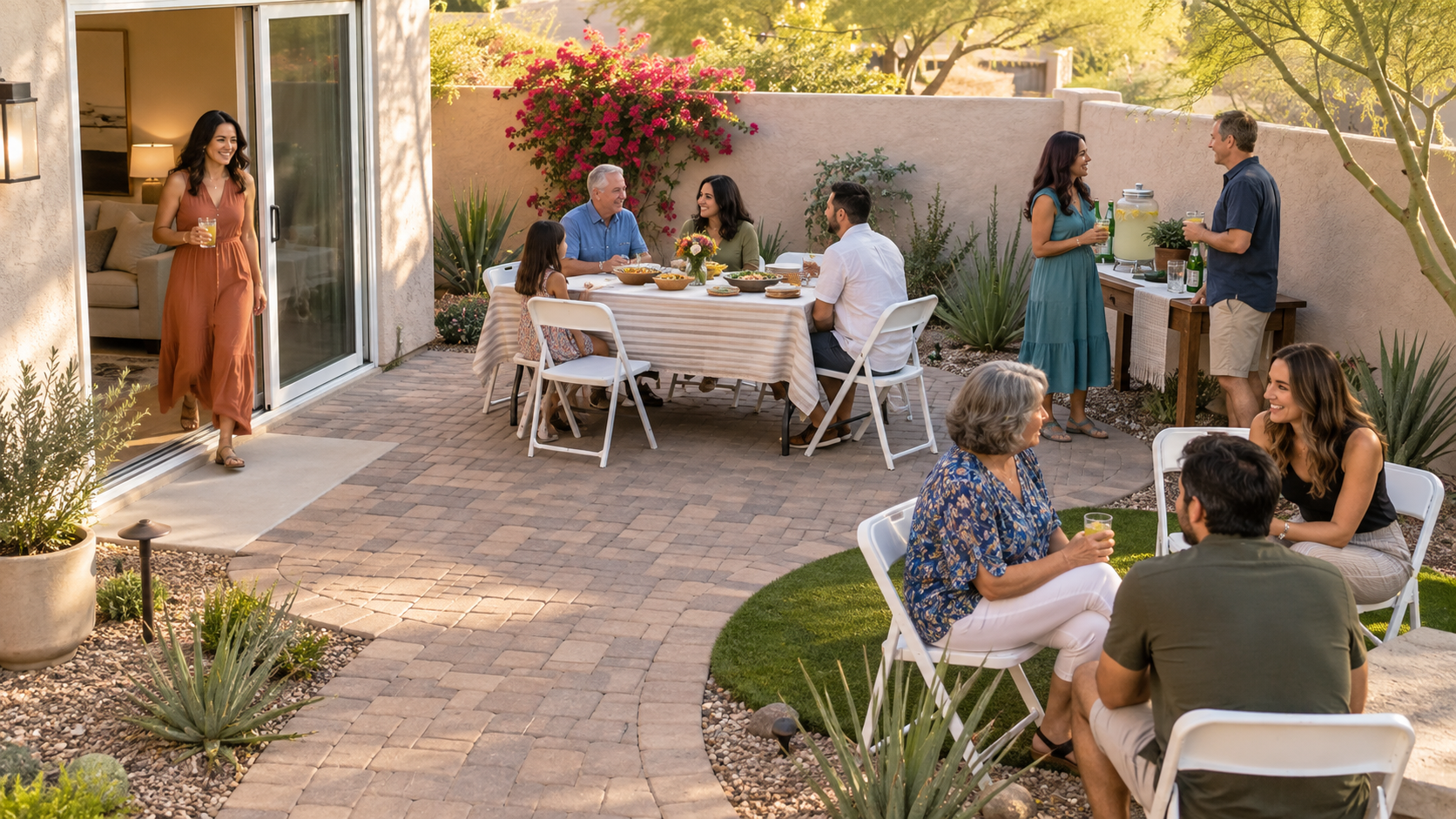
The guest list looked perfectly reasonable until you pictured everyone arriving at the same sliding door, setting down a gift, looking for a drink, and pulling out a chair at once. Suddenly the backyard feels half its actual size.
The best small-backyard party layout starts with the walking path, not the tables. Protect one clear route from the house or gate to the main seating area, move food and drinks off that route, and give the yard one main job. A small space can feel generous when guests immediately understand where to enter, settle, refill, and move next.
Quick answer: Empty the yard of anything that does not serve the party. Walk the route guests will use. Choose one main gathering pattern, then add only the seating and serving surfaces that support it. If a table blocks the route when chairs are pulled out, it does not fit, even if it fits on paper.
Table of contents
- Start with the door
- Give the yard one main job
- Choose one of three small-yard layouts
- Keep, move, or remove what is already there
- Place food and drinks without creating a line
- Build seating around real guest needs
- Do the five-minute empty-yard walkthrough
- Set up in the right order
Start with the door, because that is where a small yard gets crowded first
Stand where guests will enter. It might be a sliding door, a kitchen door, or a side gate. Now picture the first five minutes: someone pauses to say hello, a child runs past, another guest carries a gift, and two people head toward the drinks.
If the entrance opens directly into a chair, buffet line, cooler, or gift pile, the layout will feel cramped before the party has even started. Keep that first landing spot open. Guests need enough room to enter, look around, and choose where to go without being pushed into a line.
Walk from the entrance to four destinations: the main seating, food, drinks, and restroom route. Those paths can overlap, but they should not require guests to squeeze behind occupied chairs or cut through an activity.
For a public or commercial venue, accessibility obligations depend on the site and event. Use the U.S. Access Board guide to accessible routes as a starting reference, then confirm the venue's rules and any applicable local requirements. For a home gathering, ask guests directly what would make arrival, seating, and restroom access comfortable.
Give the small backyard one main job
A large yard can hold dining, games, lounging, serving, and a photo area at the same time. A small yard often works better when it does one thing especially well.
Decide which sentence sounds most like your party:
- Everyone will eat a meal together. Protect dining first.
- People will snack, talk, and move around. Protect conversation and flexible seating first.
- Children will be the most active guests. Protect open activity space and adult sightlines first.
This choice does not ban everything else. It tells you which item gets the best surface and which ideas can move indoors, onto a side patio, or off the plan completely.
A small yard feels crowded when every idea is treated as equally important. It feels intentional when one shared moment has room to happen.
Choose one of three small-backyard party layouts
Use these patterns as starting points, then adapt them to doors, gates, steps, pools, gravel, turf, and the surfaces guests can actually use.
| Party priority | Main yard setup | Put near the house | Move elsewhere | Best for |
|---|---|---|---|---|
| Shared meal | One dining arrangement placed parallel to the longest usable edge, with chair pullback kept off the main route | Food refill point and cleanup supplies | Drinks to a separate corner; gifts indoors | Showers, family dinners, milestone birthdays |
| Mix and mingle | Small seating clusters around the edge with open center space | One compact food station | Extra dining tables, large decor, structured games | Open houses, casual birthdays, neighborhood visits |
| Kids in motion | Open activity area with adult chairs facing it from one side | Drinks, wipes, and simple snacks | Gift opening, cake display, adult coats and bags | Children's birthdays and family gatherings |
Layout 1: The edge-table meal
Place the dining table along the yard's longest practical edge instead of floating it in the center. Keep the working side of the door and the main walk route open. If everyone will eat at once, use the EventRent AZ table-and-chair quantity guide to plan the count, then prove that the chosen arrangement fits when chairs are occupied.
This pattern works when the meal is the main event. It does not work if the table cuts off the gate, pool route, grill, or restroom path.
Layout 2: The open-middle gathering
Keep the center mostly empty. Place chairs in two or three small groups along the perimeter, each with a nearby surface for a cup or plate. Guests can sit, stand, and change conversations without moving a row of furniture.
This is often better than creating a seat at a dining table for every person when the menu is finger food and no seated program is planned. Do not use it as an excuse to overlook older guests, pregnant guests, or anyone who needs a stable, comfortable chair.
Layout 3: The watch-and-play yard
Give children one visible activity area and place adult seating on one side, facing it. Keep food, drinks, and the entrance out of the play route. The goal is not to fill the yard with activities. It is to let children move while adults can talk and still understand what is happening.
Choose one activity that genuinely fits. A game that needs a long lane or wide safety area may belong in a driveway, side yard, or different event plan, not squeezed between chairs.
Keep, move, or remove what is already in the yard
You do not need to empty the entire patio. You do need to make every large item earn its space.
| Existing item | Keep it when... | Move or remove it when... |
|---|---|---|
| Patio dining set | It supports the main meal and leaves the route open | Its shape divides the yard or creates unusable corners |
| Outdoor sofa | It gives several adults comfortable seating without blocking entry | It forces every conversation into a narrow passage |
| Grill | A designated adult will use it and guests can stay clear | It will be cold, unused, or directly beside the serving line |
| Planters and decor | They define an edge without narrowing the path | Guests must turn sideways or children can knock them over |
| Coolers | Guests can reach them without blocking food or the door | Open lids, bending guests, and refill traffic occupy the main route |
| Extra chairs | They are folded nearby for a real need | They are opened in every empty patch before guests arrive |
Removing one bulky piece can improve the party more than adding three clever small-space products. Take a photo before moving anything so the yard is easy to restore afterward.
Put food and drinks where guests can reach them without forming one big line
The kitchen connection matters, but “close to the door” does not mean “in front of the door.” Put the food beside the route from the kitchen, not across it. Leave room for someone to stop and serve a plate while another guest walks past.
Separate drinks when you can. People refill water and ice more often than they rebuild a plate, so one combined station creates repeat traffic around the buffet. The EventRent AZ buffet setup guide explains how to place plates, food, utensils, and exits in an order that keeps the host from managing the line.
In a very tight yard, let the kitchen do more work. Keep backup food, dessert, gifts, coats, and unopened supplies indoors. Bring them out when needed instead of asking the patio to store the entire party.
Build seating around how guests will use it
Start with people, not chair symmetry. Who needs a dependable seat? Who will eat with a plate and utensils? Will everyone sit at once, or will guests arrive and leave throughout the event?
Give the most stable, comfortable positions to guests who need them. Avoid placing a chair where standing up puts someone into the serving line or walking route. Pull every dining chair out before deciding that the table fits.
If the event needs more furniture, review the current EventRent AZ table and chair options only after the layout is clear. A narrow rectangle, a round conversation table, or folding chairs can help, but the right item is the one that supports the plan without taking over the yard. Confirm dimensions, inventory, availability, delivery, pickup, and setup details directly with the business before ordering.
Do the five-minute empty-yard walkthrough
Do this before moving heavy furniture or decorating:
- Open the guest door fully. Mark the space people need to enter and pause.
- Walk to the main gathering spot. Carry an empty plate or small box so the test feels realistic.
- Mark table and chair edges. Use painter's tape, flattened boxes, or household objects. Pull one real chair out at the tightest point.
- Walk the refill loop. Go from seating to drinks, food, trash, and the restroom route.
- Invite one honest helper. Ask where they naturally want to stop and where they have to turn sideways.
If the empty-yard version feels tight, the finished version will not become easier after guests, bags, decorations, coolers, and open chair backs arrive. Remove something now.
Set up the party in the right order
Use this order so pretty details do not lock in a bad plan:
- Clear unused household items, toys, tools, hoses, and fragile decor.
- Mark the entrance and continuous guest route.
- Place the main dining, conversation, or activity area.
- Pull out chairs and walk the route again.
- Add food, drinks, trash, and cleanup supplies beside the route.
- Add only the decor and optional items that still have a safe, useful home.
- Photograph the finished setup and share it with anyone helping before guests arrive.
For a lower-stress hosting plan beyond the layout, use the EventRent AZ guide to enjoying your own party. If the furniture, food, and other event categories need to fit one spending limit, build a starting plan in the free EventRent AZ party budget calculator.
A small backyard does not need to hold the whole party at once
The yard can be the place where people eat while gifts stay inside. It can be the place where children play while adults refill drinks in the kitchen. It can be one warm conversation area instead of four tiny “zones” that nobody can use.
Protect the door, choose the yard's main job, and remove anything that makes guests negotiate the furniture. That is how a small backyard starts feeling like a welcoming party space instead of a storage puzzle.