School and community event planning
9 Arizona Back-to-School Event Ideas Families Will Actually Want to Attend
Compare nine family-focused formats, then use the One-Hour Welcome Test and Welcome, Play, Help layout to make an Arizona school event easy to join.
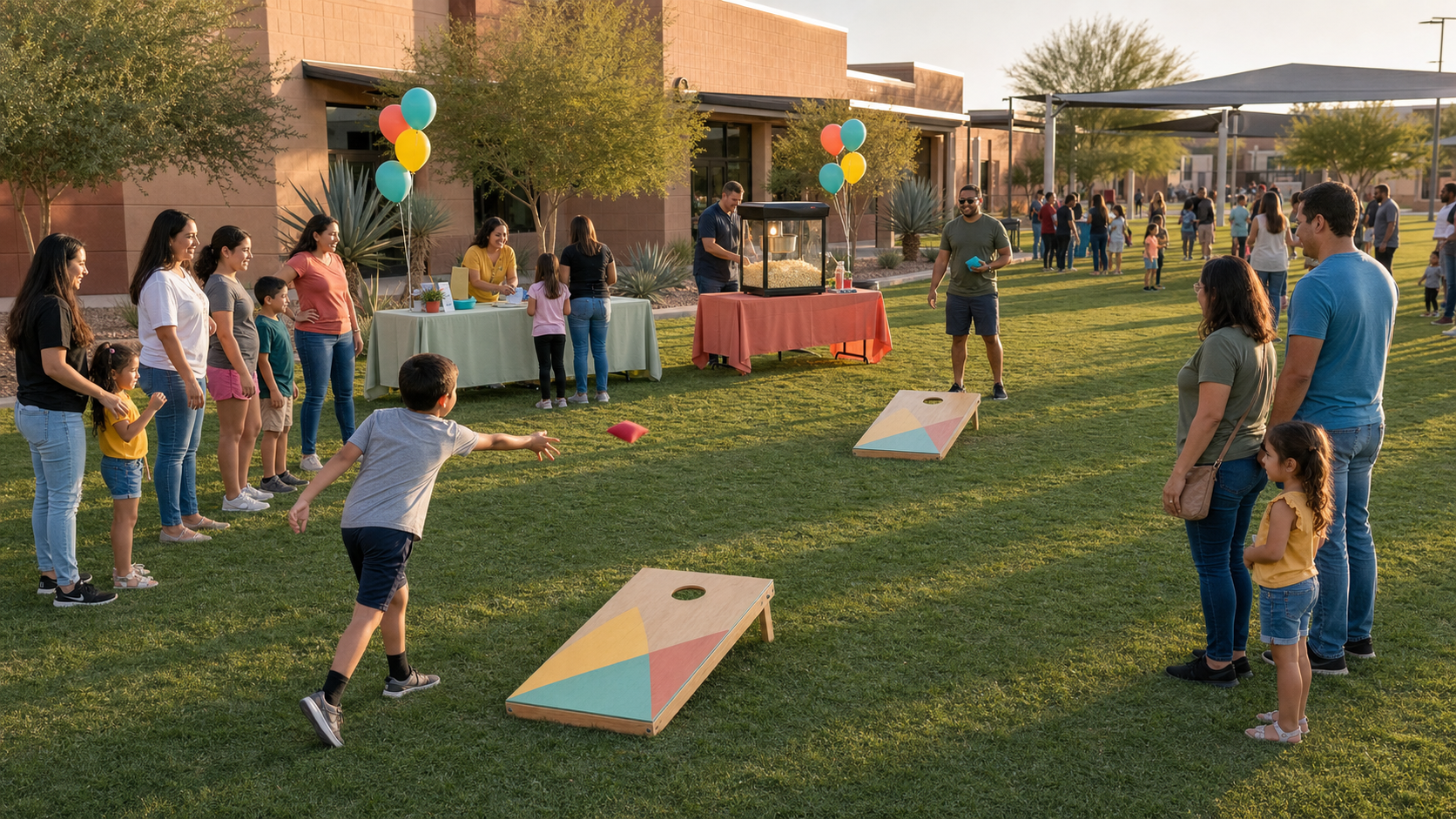
The first school event of the year can sound wonderful on the planning spreadsheet and still feel like one more obligation to a busy family. Parents are learning a new drop-off routine, children are carrying home unfamiliar papers, and everyone is trying to remember which app holds which message.
The best back-to-school event ideas solve one clear family problem in about an hour. Give people an obvious reason to come, an activity they can join without instruction, one useful school connection, and permission to leave when they have what they need. A smaller event with that structure can feel more welcoming than a packed carnival with no clear purpose.
Quick answer
Start with the feeling families should take home: connected, informed, supported, confident, or simply happy to be back. Choose one of the nine formats below, then use the One-Hour Welcome Test and the Welcome, Play, Help layout to make it easy for a family to participate, even if they arrive late.
Use the Real East Valley Back-to-School Window
Back-to-school season is already underway in parts of the East Valley. The Queen Creek Unified calendar lists July 20 as the first day. Higley Unified began July 23, and Gilbert Public Schools began July 28. Mesa Public Schools begins August 6.
That staggered calendar changes the job of the event. Before school starts, families may want a low-pressure chance to see the campus and meet someone familiar. After the first week, they can name the confusing hallway, pickup question, technology problem, or support resource they actually need.
Do not choose a date because it looks like back-to-school season. Choose it because the timing solves a current family need. Confirm the exact campus calendar, approval process, staff availability, communication channels, and facility rules before announcing anything.
Run the One-Hour Welcome Test Before You Pick Activities
An event can have games, food, decorations, volunteers, and a full agenda yet still be difficult to join. The One-Hour Welcome Test keeps the plan centered on the guest experience.
Ask four questions:
- Can a family understand the promise in one sentence? “Meet three families in your grade” is clearer than “Back-to-School Bash.”
- Can someone who arrives 20 minutes late join within three minutes? Avoid one long program that punishes a late arrival.
- Will every family leave with one useful connection or answer? Fun earns attention. A helpful person, resource, or next step makes the night matter.
- Can a family leave without an awkward exit? School nights are busy. A good event lets people stay for the fun or go when their goal is complete.
The Institute of Education Sciences recommends focusing family events on topics families value, using personal invitations, stating what families will gain, considering distinct groups, and pairing high-interest activities with opportunities to build connection. Its six school family-engagement strategies are a useful checkpoint for any format below.
Compare 9 Back-to-School Event Ideas by the Result Families Need
| Event idea | Promise to families | Best-fit setting | Main planning risk |
|---|---|---|---|
| Grade-level popsicles | Meet a few familiar faces | Playground or covered court | Too much unstructured mingling |
| Family yard-game rally | Have fun together without a formal program | Field, gym, or large courtyard | Unsafe spacing or unclear rules |
| New-family campus quest | Learn the campus without a lecture | Campus route with staffed stops | Privacy, access, or confusing clues |
| Back-to-school movie night | Relax together after the first-week rush | Field, courtyard, or multipurpose room | Sound, sightlines, or late ending |
| Resource fair with a fun lane | Find help without a paperwork-only atmosphere | Gym or multipurpose room | Information overload |
| Grade-level picnic | Turn pickup-line faces into real introductions | Covered outdoor area or cafeteria | Food and allergy requirements |
| Clubs and activities sampler | Discover where a child may belong | Gym, field, or classroom loop | Too many announcements |
| Family service night | Do one useful thing together | Cafeteria or multipurpose room | Unclear beneficiary or material rules |
| Curriculum question café | Get answers without a long presentation | Library, cafeteria, or classrooms | Becoming a one-way lecture |
Choose the row whose promise matches the family problem. Do not choose the most impressive setup. If the committee needs to establish a comfortable ceiling before selecting food, decor, games, or equipment, the EventRent AZ party budget calculator can organize the first conversation without turning the event into a math exercise.
Choose the Format That Fits Your Families
1. Grade-Level Popsicles and Playground Meet-Up
Invite one or two grade levels at a time for a short, casual gathering. Children get familiar play, while adults meet people they may see at pickup, performances, and class events all year.
Offer one easy conversation prompt, then confirm food, allergy, supervision, shade, water, and campus rules with staff.
2. Family Yard-Game Rally
Use a small number of recognizable games with generous space instead of squeezing in every option. Cornhole can create a relaxed family challenge, while giant Jenga gives younger and older guests an easy shared moment.
Post one-sentence rules and keep throwing lanes away from walking routes. The PLAY yard-game planning guide helps organizers consider participation and space instead of counting games mechanically.
3. New-Family Campus Quest
Create a short, supervised route to places families genuinely need: the office, health room, library, pickup point, cafeteria, and a place to ask for help. Each stop should offer one useful fact or a friendly person, not a puzzle that makes a new family feel tested.
Keep the route accessible, protect private information, and obtain campus approval for every stop and visitor path.
4. Back-to-School Movie Night
A movie night lets families relax together after the first-week intensity. Open briefly, provide one place for school questions, and let the movie remain the main event.
Protect paths, sightlines, sound, bathroom access, and a realistic ending. The Arizona family movie-night guide offers adaptable ideas for seating, snacks, and guest comfort.
5. Resource Fair With a Family-Fun Lane
Resource fairs can feel like homework when every table has another form. Pair the useful information with an optional family activity lane so children have something welcoming to do and adults can choose the conversations they need.
Group tables by family questions rather than only department names. Provide translation, accessibility, and private-conversation options where required.
6. Grade-Level Picnic or Dinner
Food creates a natural reason to sit down, but the promise is connection, not the menu. Use grade-level or neighborhood seating cues, leave open seats for late arrivals, and give families one light prompt that can start a conversation.
Confirm food, allergy, health, vendor, cleanup, and school-day restrictions. Mesa Public Schools notes that school-affiliated food can be subject to current requirements, so campus review is essential.
7. Clubs and Activities Sampler
Instead of a sequence of speeches, give each club, arts group, sport, or student-support program a short demonstration or question station. Families can explore the options that fit their child and skip those that do not.
The evening should help a child imagine belonging somewhere. Avoid promising placement, schedules, or eligibility staff have not confirmed.
8. Family Service Night
Choose one age-appropriate project the school has approved, such as assembling welcome materials, organizing a permitted supply drive, or preparing thank-you notes. Families talk more easily when their hands have something useful to do.
State who benefits, what materials are allowed, and what happens next. Avoid private information, unapproved donations, unsafe tools, or promises the school cannot fulfill.
9. Curriculum Question Café
Create several small question areas instead of one long presentation. Families might choose among reading support, technology access, homework routines, assessment basics, or how to contact the right person.
Give each table a knowledgeable facilitator, clear scope, and written next step. Families do not need every answer in one night. They need to know where to go next.
Build a Welcome, Play, Help Layout
Once the idea is chosen, map the experience into three lanes. These are functions, not necessarily three literal rows of tables.
Welcome
This is the first visible point from the arrival path. A guest should know where to begin without stopping traffic or searching for a volunteer. Use a greeter, concise sign, and one sentence explaining the first action.
Play
This is the low-pressure reason to stay. It may be yard games, a movie, a service project, a playground, an art activity, or a simple conversation prompt. Participation should be optional and understandable without a long orientation.
Help
This is the useful school connection. It might be a staff table, translated resource, club representative, campus map, technology helper, or clear contact card. Keep it visible without making the whole event feel administrative.
A family should be able to move from Welcome to Play to Help in any order. That flexibility is what allows a caregiver with two children, a family arriving from work, or a nervous new student to use the event in the way that fits them.
Keep entrances, gates, fire routes, pickup areas, accessible paths, restrooms, power, food, games, and sound plans within school requirements. Treat the layout as a planning recommendation until campus staff approve it.
Write an Invitation a Busy Family Can Trust
“Join us for our Back-to-School Bash” names the event but does not explain the payoff. Write the invitation around what a family will gain.
Use this formula:
Come for [clear family result]. Drop in between [arrival window]. Start with [easy first action]. Stay for [optional activity]. Before you leave, get [useful answer or next step].
Example:
Meet a few families in your child’s grade and learn where to get help this year. Drop in between 5:30 and 6:30 p.m. Start at the welcome table, then choose a yard game or conversation area. Before you leave, pick up the school contact card and upcoming family-event calendar.
Use the approved school channels, translate the message where needed, and make transportation, accessibility, food, photography, supervision, and RSVP expectations easy to find. A personal invitation from a trusted teacher or staff member may be more meaningful than another generic reminder.
Take the 15-Minute Opening Check
Fifteen minutes before guests arrive, stop looking at the event like an organizer. Walk it like a family who has never been there.
- Approach: Can you identify the correct entrance from the normal arrival direction?
- Welcome: Can you tell what happens first without asking?
- Late arrival: Could you join now if the event had already been running for 20 minutes?
- Game safety: Are cornhole lanes, giant Jenga, balls, and active children separated from primary walking routes?
- Furniture: Are tables complete, chairs stable, and accessible spaces open?
- Decor: Are balloons, signs, cords, and table decor secure and outside exits and pathways?
- Food: Is the serving area approved, staffed as required, and separated from active play?
- Help: Is there a visible person or place for questions that should not be handled publicly?
- Exit: Can a family collect the useful next step and leave without crossing activity traffic?
If one answer is no, fix that before adding another decoration or announcement.
Frequently Asked Questions About Back-to-School Events
What is the best back-to-school event for families?
The best format matches the problem families need solved. Use a meet-up for connection, a resource fair or question café for clarity, a game night or movie for relaxed community building, and a campus quest for new-family confidence.
Should a back-to-school event happen before or after the first day?
Either can work. A pre-school event reduces first-day uncertainty. An event during the first two to four weeks lets families ask questions based on routines they have actually experienced. Use the campus calendar and one clear family promise to choose.
How long should a school family event last?
Many welcome formats can work within a 60- to 90-minute arrival window, but there is no universal rule. The better test is whether a late-arriving family can participate quickly, get the promised value, and leave comfortably. Confirm the final schedule with the school.
Make the Night Feel Easier Than the Week Around It
Families do not need another event that proves how much the committee planned. They need a clear invitation, an easy first step, a moment of genuine connection, and one useful thing to carry into the school year.
Choose one promise. Build Welcome, Play, and Help around it. Then walk the route like the family most likely to arrive late, feel uncertain, or need to leave early. That is how a simple back-to-school idea becomes a night people are glad they attended.