Tables and Chairs
Does Every Guest Need a Seat at a Party?
Do not guess with a universal seating percentage. Use the All-at-Once Test to decide when every guest needs a chair and when a mixed layout can work.
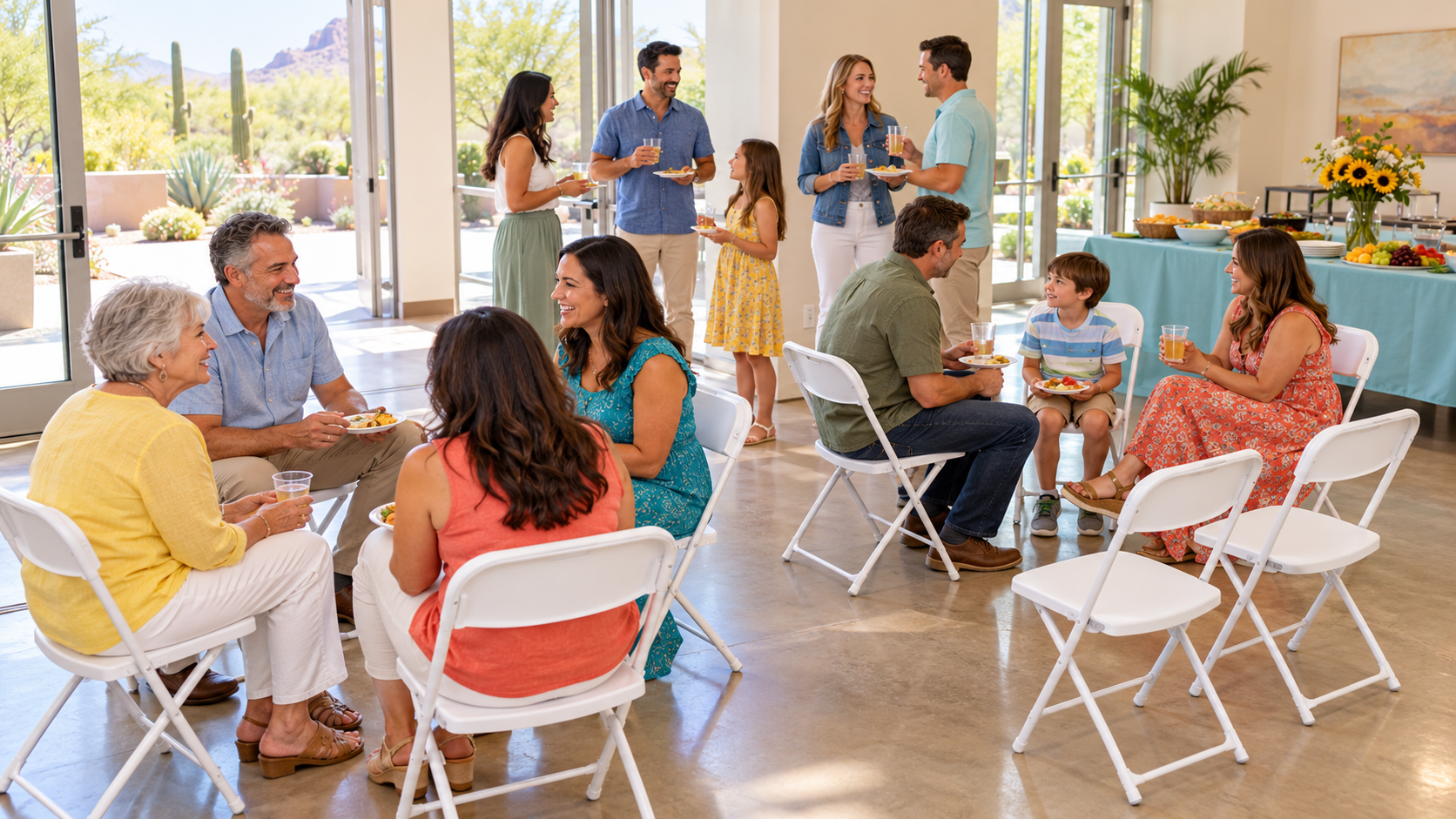
You picture a casual party where people wander, talk, and refill their plates. Then food is served, the birthday song starts, or someone makes a toast, and every guest looks for the same thing at once: somewhere to sit without balancing a plate on one knee.
Every guest needs a dependable seat when the party includes a meal, ceremony, presentation, movie, or other shared moment that asks the whole group to stop and settle. A drop-in open house or short standing reception may use fewer seats, but only when guests still have easy places to rest, eat, and participate without competing for a chair.
Quick answer: Do not start with a universal percentage. Use the All-at-Once Test. Identify the moment when the most guests will eat, watch, listen, or pause together. If that moment works only when everyone is seated, plan one appropriate seat for every expected participant.
Start with the party promise, not a chair percentage
The invitation quietly tells guests what the room should let them do. “Dinner at six” promises a real place to eat. “Cake and gifts” suggests a shared pause. “Drop in for drinks” suggests more movement, although people still need comfortable places to rest.
That is why one seating percentage cannot answer every party. Fifty guests at a seated dinner and fifty guests at a two-hour open house are not doing the same job in the space.
Before counting chairs, write one sentence:
At the busiest shared moment, guests will be __________.
If the answer is eating a full plate, watching a child open gifts, listening to a speech, viewing a movie, attending a ceremony, or completing the same activity, the safest practical plan is a real seat for every person participating. If guests will arrive in waves, stand briefly, and leave at different times, a mixed setup may work.
The EventRent AZ table and chair quantity guide is the next step once you decide which moments require full seating.
Use the EventRent AZ All-at-Once Test
Ask four questions in order:
- What happens all at once? Name the meal, toast, cake, gifts, presentation, ceremony, movie, game, or group photo that brings everyone together.
- What will guests be holding? A full plate and drink need more support than a small appetizer. A child, gift, coat, or mobility device changes the usable space too.
- Who must be able to sit immediately? Include older adults, pregnant guests, disabled guests, anyone who requests an accommodation, and any person who simply cannot comfortably stand through the planned moment. Do not isolate these seats at the edge of the gathering.
- What happens when people stand up? Pulled-out chairs must not close the route to food, doors, restrooms, activities, or the exit.
The test is deliberately qualitative. A confident answer is better than a precise-looking ratio built on the wrong event format.
Match the seat count to what guests will actually do
| Party format | Biggest all-at-once moment | Practical seating implication |
|---|---|---|
| Sit-down meal | Everyone eats together | Provide one dining seat and usable table place for every expected eater. |
| Buffet meal | Most guests fill plates within one serving window | Give every expected eater access to a stable seat and plate surface, even if seats are spread across more than one table. |
| Birthday with cake and gifts | Children and adults pause to watch, eat, and take photos | Seat the people who will participate in the shared moment, then keep a clear viewing route for anyone standing. |
| Shower or family celebration | Food, gifts, and conversation overlap | Plan full seating when the event includes a meal or long gift-opening segment. A lighter open-house format may use mixed seating if the invitation makes that clear. |
| Short open house | Guests arrive and leave in waves | Mixed seating can work when there are enough easy, integrated seats for anyone who wants or needs one, plus stable places for food and drinks. |
| Standing reception | Conversation and small bites are the main activity | Full seating may not be necessary, but a standing label is not permission to make guests compete for the few useful chairs. Protect real rest seats and keep them inside the social space. |
If the room feels tight, do not solve the problem by removing the seats guests need. Adjust the format, shorten the seated program, serve food that is easier to handle, use a second room intentionally, reduce bulky furniture, or change the guest count.
For a compact yard or patio, the small-backyard party layout guide helps protect the door, food route, and social space before chairs fill the edges.
Make mixed seating look intentional, not scarce
Fewer than one seat per guest works only when the party truly moves. The layout should make choice obvious rather than make the last chair feel like a prize.
Create small, connected places to pause:
- a regular-height table with chairs for eating;
- a few conversation seats inside the main gathering, not behind it;
- standing-height surfaces for guests who are mingling;
- a clear spot for a wheelchair or mobility device without removing someone from the group; and
- an empty path between the entrance, food, seating, restroom, and exit.
Avoid lining every chair against the wall like a waiting room. Turn seats toward one another or toward the shared moment. Leave enough room to pull a chair out without making everyone else squeeze past.
Table shape can help or hurt that plan. The round versus rectangular table guide compares the job each shape performs. If the question is chair type rather than count, use the white folding chair versus white resin chair guide to compare the longest seated moment, the visual role, and room transitions.
Keep access and comfort inside the main party
Do not make guests request a “special chair” after the party starts. Ask about access or seating needs privately before the event, then build useful choices into the main layout.
At a public, workplace, HOA, school, or community event, temporary furniture does not remove accessibility responsibilities. The U.S. Department of Justice guide for small towns notes that temporary events should plan accessible parking, routes, seating, food service, and other features early. The event owner and a qualified reviewer should confirm the requirements for the actual site and event.
For a home party, the same hospitality principle still helps: keep sturdy seating easy to reach, do not hide it behind steps or soft ground, and avoid placing all comfortable seats far from the conversation. Ask rather than guess what a guest needs.
If rentals or extra furniture change the budget, enter real quotes in the free EventRent AZ party budget calculator. Treat it as a planning tool, not a price quote.
Run the occupied-space walkthrough before the party
An empty setup is misleading. Chairs are tucked in, tabletops are bare, and nobody is carrying food.
Run this six-question check with chairs pulled out and a sample plate and drink in hand:
- Can everyone required to sit during the shared moment find an appropriate seat?
- Can a guest set down both a plate and drink without borrowing someone else's place?
- Can a person using a mobility device join the same conversation or table without becoming the aisle?
- Can guests reach food, the restroom, and the exit after the chairs are occupied?
- Can the host move through the room without asking several people to stand?
- If more guests sit than expected, is the backup a real seat in the party, not a chair pulled from a bedroom after someone asks?
If the walkthrough fails, change the layout before adding decor. One useful seat with a clear path helps more than a pretty chair nobody can reach.
You do not need to make every casual party look like a banquet. You do need to understand what the invitation asks guests to do.
Use the All-at-Once Test, seat every person who will share the seated moment, and make mixed seating deliberate when the party truly stays in motion. The right answer is not a percentage. It is a room where nobody has to wonder whether there is a place for them.