Tables and Chairs
How to Set Up Party Tables and Chairs on Gravel, Pavers, or Turf Without the Wobble
Give the best ground to the hardest party job. Compare gravel, pavers, turf, and lawn, then use a quick real-furniture test before decorating.
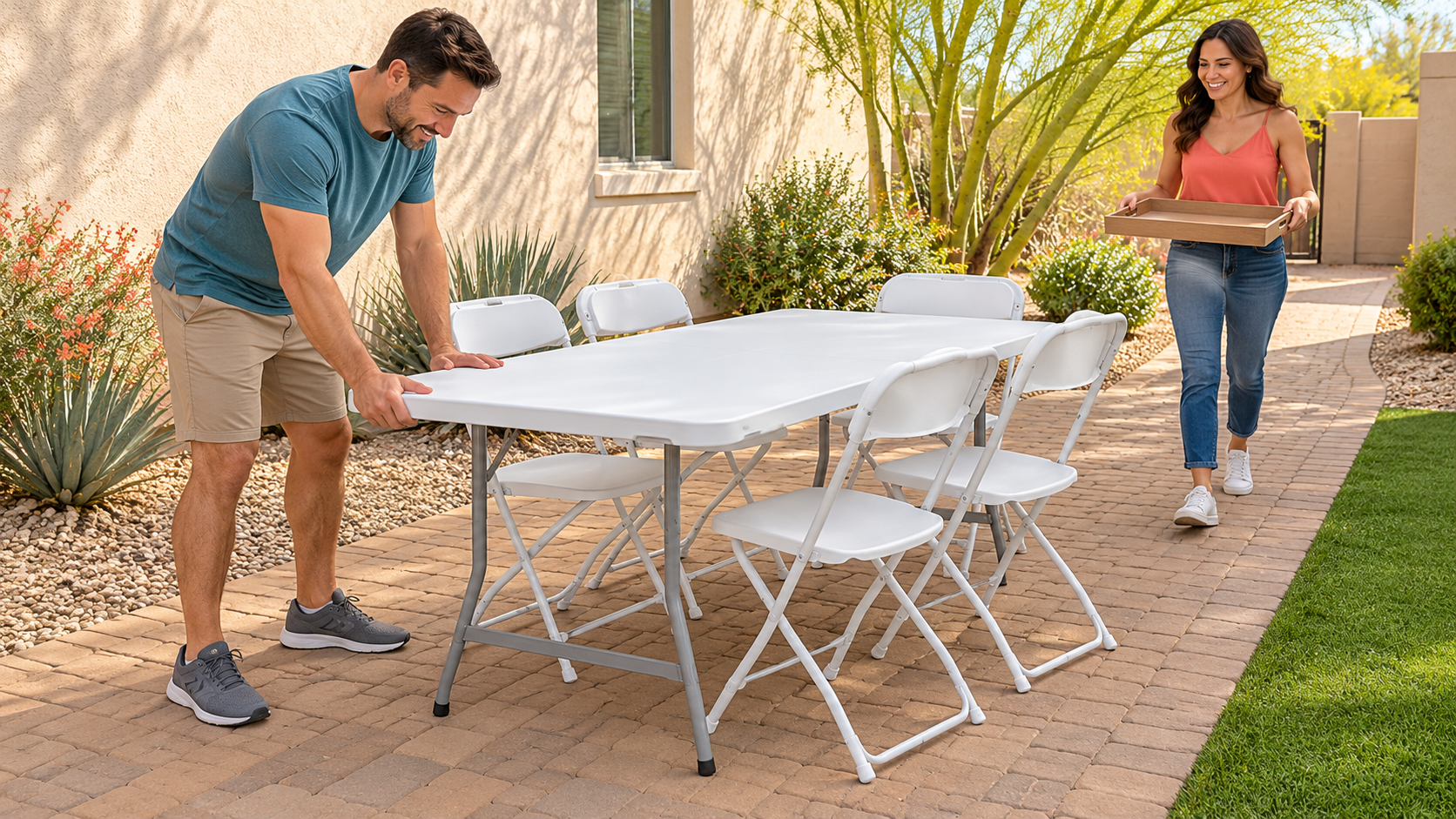
You can have the guest list, menu, and table plan finished, then discover the yard itself has opinions. One chair sinks into turf. A table rocks across a paver joint. The route from the gate crosses loose gravel.
Put the hardest party job on the best ground. Dining, serving, and any seat that must feel dependable belong on the flattest, firmest surface available. Use turf, lawn, or gravel only after you test the actual furniture there. If a table rocks, a chair sinks, or the main route feels difficult, move the setup instead of hiding the problem with decor.
Quick answer: Walk the yard before setup. Rank each area by firmness, levelness, and ease of travel. Give the best surface to seated dining or food service, keep one continuous guest route, then perform the Press, Sit, Carry Test with real furniture. Rugs and tablecloths can improve appearance, but they do not make unstable ground stable.
Table of contents
- Give the best ground the hardest job
- Match each surface to a realistic party job
- Set up on pavers without fighting every joint
- Treat turf and lawn as surfaces that still need testing
- Use gravel carefully and protect the guest route
- Do the Press, Sit, Carry Test
- Set up in the right order
- Answer the common surface questions
Give the best ground the hardest job
A mixed yard does not need one perfect surface. It needs an honest job for each usable area.
Start with the moment that would be most frustrating if the furniture moved. For a sit-down meal, that is the dining table. For an open house, it may be the food and drink station. For a birthday, it may be the cake table and stable seats for grandparents or caregivers.
That priority gets the flattest, firmest part of the yard. Everything else follows.
Use the EventRent AZ Best Ground Gets the Hardest Job Plan:
- Name the hardest job. Choose dining, food service, a seated program, check-in, or another moment that needs dependable furniture.
- Find the best ground. Look for a surface that feels firm underfoot, does not shift, and lets all four table legs make steady contact.
- Protect the route. Connect the entrance, priority zone, restroom, and exit without sending guests through loose or narrow ground.
- Move flexible activities outward. Conversation, decor, gifts, and casual standing zones can use the remaining space if the surface suits them.
If the yard is small as well as mixed, use the EventRent AZ door-first small-backyard layout to protect the entrance before adding furniture.
Match each surface to a realistic party job
The table below is an editorial planning guide, not an engineering approval. Surface installation, condition, weather, furniture design, venue rules, and guest needs can change the answer.
| Surface | Strong starting use | What to test | A reason to relocate the job |
|---|---|---|---|
| Level concrete or even pavers | Dining, serving, seated activities, dependable guest seats | Paver joints, slopes for drainage, chair pullback, route edges | A table rocks, a leg lands in a joint, or chairs cross a sharp transition |
| Artificial turf over a firm base | Casual seating, conversation, light activities, some dining after a real test | Soft spots, seams, heat, edge transitions, chair-leg movement | Legs sink, catch, tilt, or leave the chair unstable |
| Dry, even lawn | Flexible seating or a casual activity after testing | Soft soil, irrigation, holes, roots, chair movement | Ground compresses, a leg sinks, or the surface changes after watering |
| Compacted, stabilized landscape material | Limited standing or furniture use only after property and stability checks | Loose top layer, slope, wheel movement, repeated traffic | Particles shift, the route deforms, or a guest cannot travel comfortably |
| Loose decorative gravel | Visual edge, planters, or a low-traffic area | Depth, movement, hidden edging, transitions, shoes and mobility needs | Dining, food service, or the main route depends on it |
Do not assign furniture by appearance alone. Artificial turf can look perfectly smooth while hiding a slope. Pavers can look solid while a table spans two slightly different planes. Loose gravel can look tidy while moving under a chair leg.
The U.S. Access Board explains that accessible floor and ground surfaces must be stable, firm, and slip resistant. It also notes that most loose gravel does not meet those characteristics unless it is properly treated. For public, commercial, or HOA facilities, review the U.S. Access Board guide to floor and ground surfaces, then confirm the site's obligations and rules with the responsible venue or qualified professional. For a home party, ask guests what route and seating will work for them instead of guessing.
Set up on pavers without fighting every joint
Pavers are often the easiest-looking part of the yard, but the furniture still needs a real test.
Place the table, then press down near each corner. If the top rocks, rotate or shift the entire table so the legs land more evenly. Do not hide a moving table under a linen and hope plates will steady it.
Next, open every chair. Pull the tightest chair out as a guest would, sit, stand, and push it back. A chair leg that catches in a wide joint or slips off the paver edge can make a good-looking dining area irritating to use.
Watch the transition from pavers to turf or gravel. Keep chair pullback on one surface when possible. A seat with two legs on pavers and two on softer ground may feel level while empty and change when someone sits.
Finally, follow the drainage slope with your eyes and feet. Outdoor hardscape may not be perfectly level. If the dining table still rocks after a reasonable repositioning, give that spot a less demanding job and move the meal.
Treat turf and lawn as surfaces that still need testing
Artificial turf and lawn can make a party feel relaxed, but a smooth green view is not proof of a stable chair.
On artificial turf, check seams, edges, dips, and any place the base feels softer. Keep chair legs away from a transition strip when possible. If the property owner has restrictions on furniture, coverings, stakes, or heavy equipment, follow them.
On natural lawn, walk the area after the most recent irrigation and at the same time of day the party will happen. Look for soft soil, holes, roots, sprinkler heads, and places where the ground changes under pressure.
A rug is decoration, not a leveling system. It may hide a dip, add a curled edge, or make it harder to see where one surface becomes another. Use a rug only when it is rated for the intended setting, lies flat, and does not create a new route problem. Never use it to disguise furniture that already rocks or sinks.
If everyone will eat at once, estimate the furniture first with the EventRent AZ table-and-chair quantity guide. Then reduce or change the layout if the tested surface cannot hold that plan comfortably.
Use gravel carefully and protect the guest route
Gravel is where a surface-first plan matters most. The word can describe compacted fine material, stabilized paths, or loose decorative rock. Those surfaces do not perform the same way.
Start with the main route. If guests can enter, reach seating, use the restroom, and leave on a firm hardscape path, keep that route clear. Do not force everyone across loose gravel just because it is the shortest line on a sketch.
Then decide whether any furniture truly belongs on the gravel. Set up one real table and one real chair before moving the full order. Press the table corners, sit, stand, and move the chair. If legs settle, slide, twist, or rock, stop. Move the job to pavers, concrete, or another proven area.
Avoid quick fixes made from loose rocks, folded cardboard, stacked scraps, or other improvised supports. They can shift, hide under linens, or create a new failure point. A temporary flooring system, stabilized route, or surface modification needs property approval and a product or professional solution designed for that use.
If the whole outdoor area is loose gravel and the event requires dependable dining or accessible travel, the honest answer may be to move the main gathering to a patio, garage, indoor room, clubhouse, or different venue.
Do the Press, Sit, Carry Test before decorating
This EventRent AZ test takes one table, one chair, an empty tray, and an honest helper.
1. Press
Place the real table where it is planned. Press near every corner and along the serving side. The table should not rock, twist, or settle deeper into the surface. Repeat after the chair layout is added, because moving the table a few inches can change where every leg lands.
2. Sit
Open the exact chair type. Sit fully, place both feet naturally, stand, and pull the chair back. Repeat at the end seat and wherever the surface changes. Give the most dependable positions to guests who need stable seating.
3. Carry
Carry an empty tray or lightweight box from the entrance to seating, food, drinks, trash, and the restroom route. Ask your helper to sit in the tightest chair while you pass. If you must step into loose gravel, turn sideways, or brush an occupied chair, change the layout.
Test the busiest version of the party, not the prettiest empty version. A stable table means little if the serving side blocks the only dependable route.
When table shape is still flexible, compare how each footprint behaves in the tested area with the EventRent AZ round-versus-rectangular table guide.
Set up in the right order
Use this day-of order so linens, centerpieces, and coolers do not make you reluctant to fix the foundation:
- Clear the route. Move hoses, tools, toys, loose planters, and decor away from the entrance and restroom path.
- Inspect the ground. Check paver joints, turf edges, wet lawn, gravel depth, holes, and abrupt transitions.
- Place the priority table. Give dining or food service the best proven surface.
- Open every priority chair. Pull back, sit, stand, and check the edge seats.
- Walk the live route. Carry an empty tray while one helper occupies the tightest chair.
- Add support tables. Give food, drinks, cake, gifts, and equipment separate jobs only when the surface and space support them.
- Add linens and decor last. Keep them from hiding legs, edges, cords, or problems that still need attention.
- Recheck before guests arrive. Furniture can move during loading, cleaning, or decorating.
If the tested plan changes the quantities or exposes a missing support table, review the current EventRent AZ rental inventory and confirm dimensions, inventory, availability, delivery, pickup, setup, and surface requirements directly with the business. If the revised plan affects several spending categories, use the free EventRent AZ party budget calculator to keep the whole event visible.
Answer the common surface questions
Can you put party tables and chairs on gravel?
Sometimes, but the word gravel is not specific enough to answer by itself. Test the actual surface with the actual furniture. If the table rocks, chair legs settle or slide, or the guest route crosses loose material, relocate the setup or use an approved purpose-built surface solution.
Will an outdoor rug make uneven ground safe for a party table?
Not by itself. A rug can hide depressions, shift, or create an edge. Use it for appearance only after the table, chairs, and walking route are already stable and the rug is suitable for the location.
Can folding chairs sit on artificial turf or lawn?
They can work when the surface is firm, even, and compatible with the chair legs, but test them under a seated person. Check soft soil, seams, edges, sprinkler heads, dips, and property rules before placing the full row.
What is the best outdoor surface for party tables?
A firm, stable, even area where all table legs make dependable contact and guests can approach without a difficult transition is the strongest starting point. In many yards that is concrete or well-laid pavers, but the condition of the real surface matters more than its label.
A comfortable outdoor party starts at ground level
Your yard does not need to look like a ballroom. It needs one dependable place for the party's hardest job and a route guests can use without negotiating the furniture.
Give the best ground to the hardest job. Press the table, sit in the chair, and carry the tray before you decorate. That small rehearsal is what turns gravel, pavers, turf, and lawn from a guessing game into a party plan.