Seasonal Event Planning
Thanksgiving Kids' Table Ideas That Keep the Whole Meal Moving
Build a Thanksgiving kids' table around three jobs: Eat, Make, and Move. This practical guide covers seating, low-mess activities, adult help, and the post-meal transition.
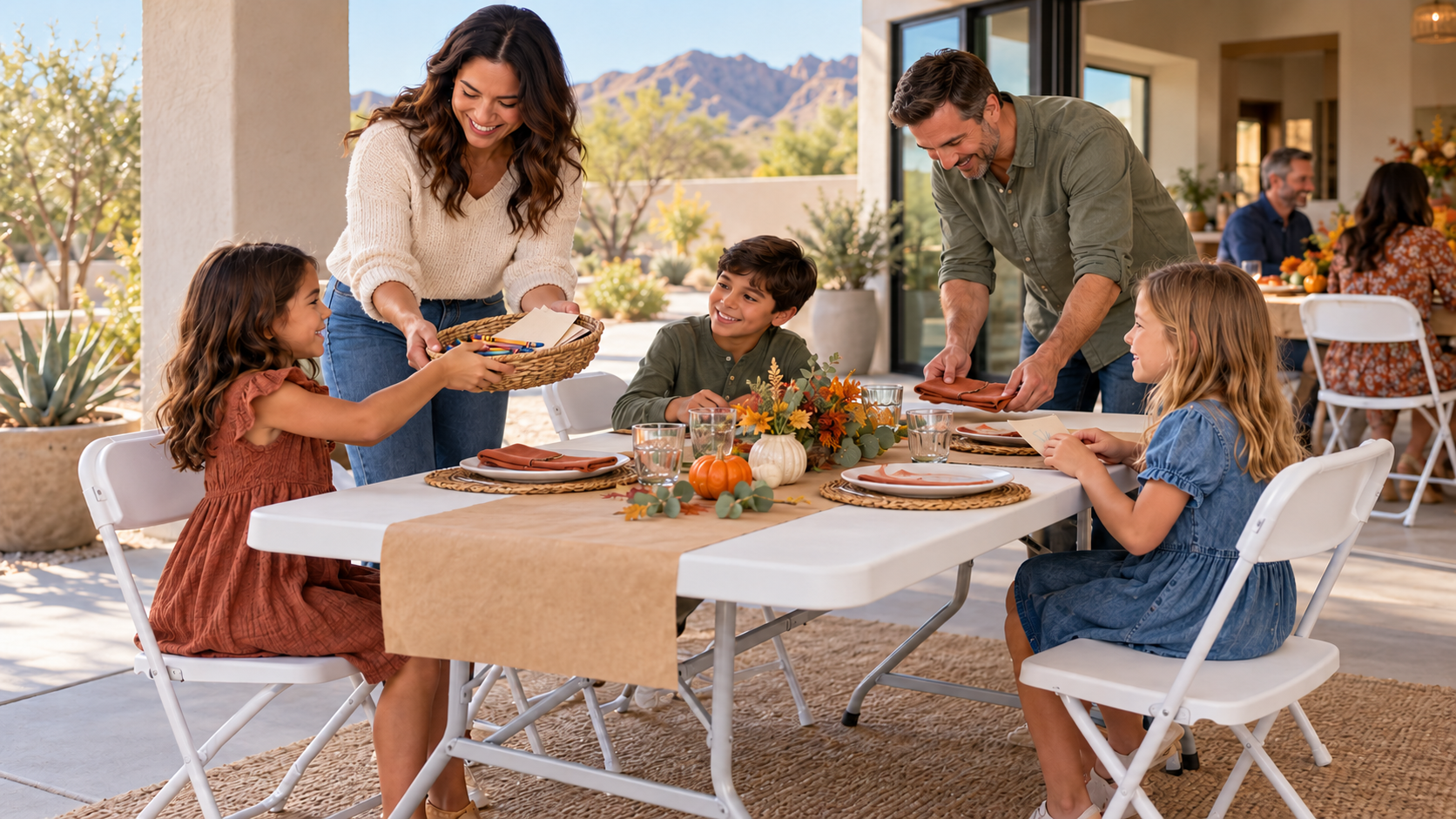
The kids' table often begins as a sweet idea and ends as three events stacked on one surface. Children color while the adults finish cooking. Then the crayons have to disappear, hot plates arrive, someone needs help cutting food, and the host is still finding missing forks.
The best Thanksgiving kids' table has three clear jobs: Eat, Make, and Move. Give each child a stable meal place, offer one low-mess activity that can pause quickly, and decide where children may go when they finish. Keep the table near enough for real adult help. Clear activity supplies before food arrives. Treat the next activity as part of the plan, not an escape from the table.
Quick answer: Build the kids' table around the children who are actually coming. Seat by help needed, not by a label such as “little kids.” Put a responsible adult beside the child who needs the most assistance. Use one simple activity, one supply basket, and one cleanup container. When dinner ends, send children to one ready, supervised next place while the table resets for dessert.
In this guide
- Decide whether a separate table helps
- Use the Eat, Make, Move Plan
- Run the Seat-Ready Check
- Set the table for a real meal
- Choose one low-mess activity
- Prepare the next place
- Use the 20-minute rehearsal card
- Answer common kids' table questions
Decide whether a separate kids' table actually helps
A children's table is useful when it gives children a comfortable place to eat together and keeps adult help close. It is not useful when it becomes overflow seating in another room, a craft station that cannot be cleared, or the only place left after adults claim the usable chairs.
Ask four questions before creating one:
- Can every child use the seat and table safely for the full meal?
- Can a responsible adult see and reach anyone who may need help?
- Can the table hold a plate and drink after the activity supplies are removed?
- Can children leave the table without crossing the kitchen work path or squeezing behind several guests?
If any answer is no, keep some or all children at the family tables. A separate table is an option, not a Thanksgiving requirement.
If the whole room is tight, use the EventRent AZ Thanksgiving seating guide for small spaces to plan real plate places and a clear route first. This guide begins after the room has a workable seating plan.
Use the EventRent AZ Eat, Make, Move Plan
The table does not need to do everything at once. Give it one job at each moment.
| Moment | Table job | What should be present | What should be gone |
|---|---|---|---|
| Make | Give children an easy landing activity while the meal finishes | One activity, one shared supply basket, names or seat cues if useful, water away from paper | Hot dishes, sharp tools, fragile decor, sticky craft materials |
| Eat | Become a complete dining table | Stable place setting, drink, napkin, child-specific utensils or supports, reachable adult help | Crayons, scissors, loose pieces, tall centerpieces, activity directions |
| Move | Release children into one ready next place and reset for dessert | Cleanup container, named next activity or room, responsible adult coverage | Abandoned plates mixed with craft supplies, an unplanned free-for-all |
The important transition is Make to Eat. Put the activity in one tray or basket so a helper can lift it away in one move. Do not scatter supplies across the table because they look festive.
The Move moment matters just as much. Children who finish first should know whether they may visit the playroom, join a yard activity, sit with a book, or remain at the table. The answer depends on the children, property, supervision, and family rules. Decide it before the first plate arrives.
Seat by help needed, not by age alone
Two children the same age may need completely different setups. One may eat independently and enjoy a cousin table. Another may need help with food, reminders, a quieter seat, or a familiar adult nearby.
Use the Seat-Ready Check for each child:
- Seat: Is the chair, high chair, booster, or other support appropriate for this specific child and used according to its instructions?
- Reach: Can the child reach the meal without leaning across hot dishes or another place setting?
- Exit: Can the child leave safely without climbing over furniture or asking an entire row to stand?
- Adult: Which responsible adult is close enough to help, and do they know that responsibility?
- Next: Where may the child go after eating, and who remains responsible there?
For a high chair, follow the product instructions and current safety guidance. The U.S. Consumer Product Safety Commission says to use the safety straps, keep the child within view, and not allow a child to climb into or stand on the chair. Read the CPSC high-chair safety tips and check current recall information for the product being used.
Do not move a child away from the family conversation simply because the adult table is full. If the kids' table works, make it feel intentional. Put it in the same room or connected gathering area, give it complete place settings, and include it in the same welcome, toast, or gratitude moment.
Set the kids' table for a real Thanksgiving meal
Decor comes after function. Start with the plate, cup, napkin, utensils, and the child's actual seating support. Then add only what leaves the meal easier.
Useful choices may include:
- a wipeable table covering or plain paper runner;
- low, soft, or unbreakable decor that does not steal plate space;
- cups that suit the individual children and family preferences;
- a water refill plan that does not send children through the serving line;
- serving portions and utensils chosen by the responsible adults;
- one obvious place for used napkins and cleared dishes.
Skip open flames, tall centerpieces, fragile place settings, tiny decorative pieces, and any material that becomes unsafe or difficult around the children who will attend. Treat allergy, choking, medical, and food decisions as child-specific responsibilities for parents or caregivers, not as problems the table design can solve.
Young children are at higher risk from foodborne illness. FoodSafety.gov advises clean hands, separate raw foods from ready-to-eat foods, safe cooking, and prompt chilling. Review its food-safety guidance for children under five when relevant, and follow recipes, labels, caregiver instructions, and professional guidance for the children attending.
For the broader Thanksgiving meal, the USDA says perishable food should be refrigerated within two hours, or within one hour when food is exposed to temperatures above 90 degrees Fahrenheit. Its current Thanksgiving food-safety guidance covers serving and leftovers. Assign a responsible adult to food safety rather than turning the children into the buffet monitor.
Choose one low-mess activity that can stop cleanly
The activity should help children settle, not create a second party that needs an emcee.
Choose one format from the table below. Match it to the individual children, caregiver preferences, available supervision, and the host's real setup time.
| Activity format | Why it can work | Prepare before guests arrive | Stop before the meal by |
|---|---|---|---|
| Paper runner drawing | Several children can join at once without completing a project | Tape down plain paper, limit supplies to approved washable drawing tools | Rolling or folding the paper and lifting one supply basket |
| Place-card decorating | The activity contributes to the shared table | Prepare sturdy blank cards and a small set of approved supplies | Moving finished cards to place settings and removing every loose piece |
| Conversation picture cards | Children can point, draw, or answer in their own way | Use simple family-approved prompts with no pressure to share private feelings | Stacking the cards in one envelope |
| One tabletop puzzle or matching activity | A small group can join without a formal start | Confirm pieces and complexity suit the children attending | Sliding all pieces into a lidded container |
Avoid glitter, wet paint, open glue, sharp tools, hard-to-count tiny pieces, and food-shaped craft materials around the meal unless a responsible adult has explicitly approved and is supervising them. Do not promise that any activity will occupy every child for a certain number of minutes.
If guests span several ages, offer one activity with more than one way to join. A younger child might draw a picture while an older child writes a place card. Participation should remain optional. Thanksgiving is not improved by forcing a shy child to perform gratitude for the room.
Prepare one next place before dinner begins
The children who finish first need a clear next move. “Go play” is not a plan if the play area is across a parking lot, beside a pool, through the kitchen, or outside adult view.
Pick one next place and make it ready:
- a nearby living-room floor with books, a simple game, or a familiar movie;
- a patio conversation area where a responsible adult is already seated;
- a safe yard activity with defined boundaries and confirmed supervision;
- a quiet corner for a child who needs a break from the group.
Name the boundary in plain language: “After your plate is cleared, you may choose a book in the living room. Aunt Maya will be there.” The example is only a structure. Use the real adult, room, and family rules.
For an optional shared activity after dinner, the EventRent AZ backyard game-night guide explains how to let players, spectators, and conversation-first guests join without forcing a tournament. Keep every activity clear of serving routes and supervise children according to the actual setting.
If Thanksgiving is outdoors, use the EventRent AZ outdoor Thanksgiving plan for Arizona to confirm the patio, lighting, furniture, food handling, temperature response, and indoor fallback. “November in Arizona” is not a complete plan.
Use this 20-minute kids' table rehearsal card
Run the rehearsal several days before Thanksgiving with the actual table and chairs when possible.
EventRent AZ Kids' Table Rehearsal
Minute 0 to 5: Place every chair or child-specific seating support. Sit in the nearest adult seat. Check sightlines, reach, exits, and the route to the restroom.
Minute 5 to 10: Set one complete meal place for every child. Add only the activity basket and low decor. Confirm the table still has real plate space.
Minute 10 to 15: Remove the activity as if hot food is arriving. One helper should be able to clear it in one trip without sorting.
Minute 15 to 20: Walk from the table to the approved next place. Remove cords, hot items, unstable furniture, fragile decor, and anything that blocks the responsible adult's view or route.
If the table fails, remove decor first. Then simplify the activity. Then reconsider whether every child should sit there. Do not solve a supervision or seating problem by asking the children to be more careful around a setup that does not fit them.
If unfamiliar relatives or family friends will attend, the EventRent AZ guide for guests who do not know one another can help the host plan a warm arrival and one thoughtful introduction without forced icebreakers.
Thanksgiving kids' table questions
Should every child sit at the kids' table?
No. Use the table only for children who can use it comfortably with the available adult help. Keep a child at a family table when their seating, feeding, sensory, medical, supervision, or personal needs make that the better plan.
What age is best for a separate Thanksgiving table?
There is no universal age. Readiness depends on the individual child, seating support, meal, location, distance from adults, family preferences, and supervision. Ask the parent or caregiver rather than using one age cutoff.
How do I keep the kids' table from getting messy?
Use one activity, one supply basket, one cleanup container, and a covering appropriate for the real table. Remove every activity item before the meal. Keep drinks and hot dishes away from paper supplies during the Make moment.
Should the kids' table be in another room?
Usually, the easiest setup keeps it in the same room or a directly connected area where responsible adults can see, hear, and help. A separate room may work for the next activity when the property and supervision plan genuinely support it.
Make the children's table part of Thanksgiving, not overflow
The goal is not a perfect tiny tablescape. It is a place where children can arrive, join the meal, and move into the next part of the day without disappearing from the family or turning the host into a full-time activity director.
Plan Eat, Make, and Move. Seat by help needed. Clear the activity before food arrives. Prepare one next place. When those pieces work, the kids' table feels less like a side project and more like what it should be: another welcoming part of Thanksgiving.