Seasonal Event Planning
Thanksgiving Seating Ideas for a Small Space: Fit Everyone Without Squeezing the Room
Use the Three-Scene Thanksgiving Room Plan to create real dinner seats, protect the walking route, and make a small home feel welcoming.
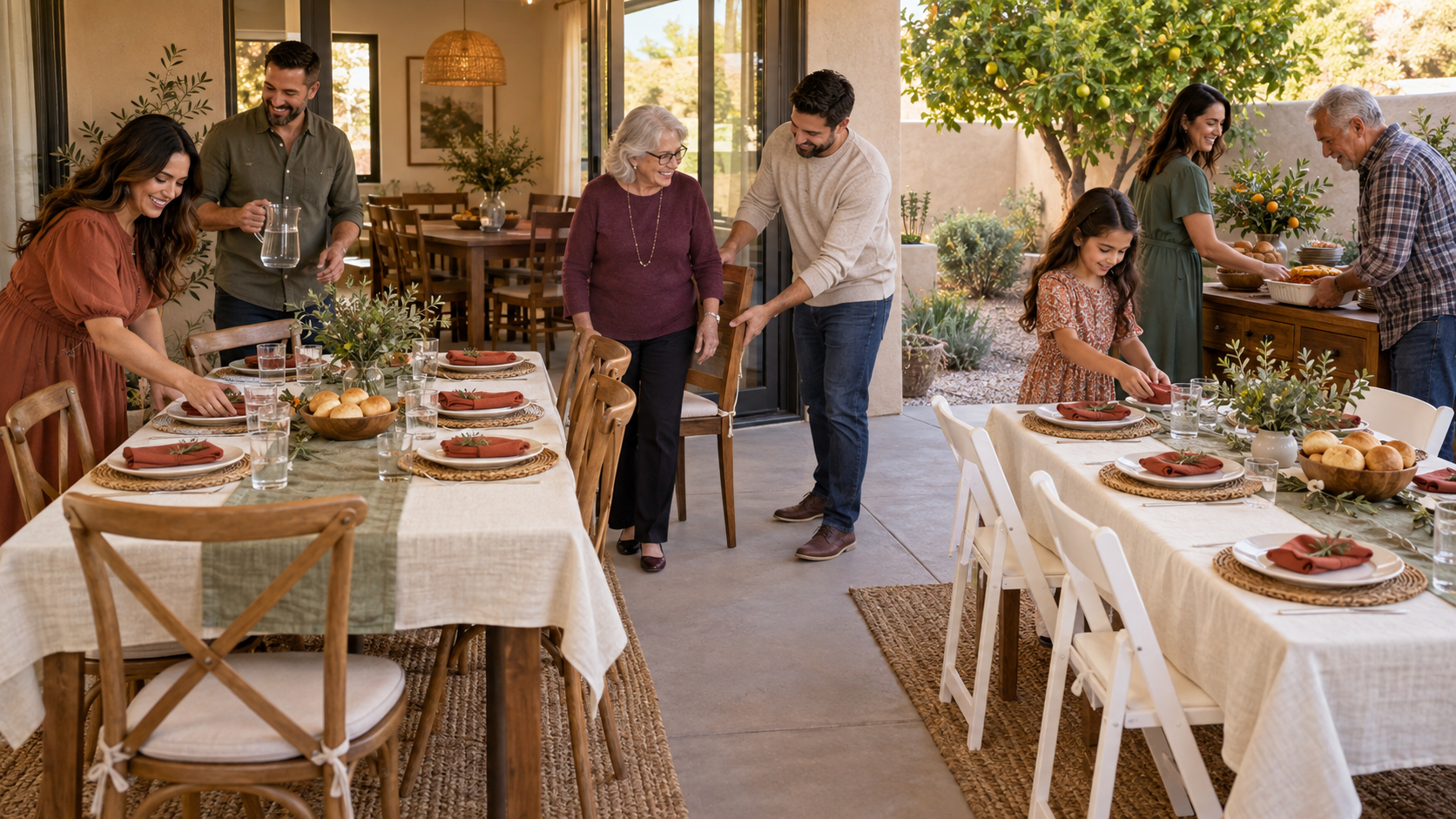
The guest list grows quietly. One cousin brings a partner, the college kids come home, and suddenly the dining table that works all year is short by six seats.
The best small-space Thanksgiving setup gives every guest a stable place to sit and eat, moves serving dishes off the dining surface, and lets the room change between arrival, dinner, and pie. You do not need one enormous table. You need enough real plate places, one clear route, and a plan for what each surface is doing at each part of the day.
Quick answer
Use the Three-Scene Thanksgiving Room Plan:
- Arrival: Keep coats, drinks, and snacks away from the dinner seats and kitchen work path.
- Dinner: Give every guest a stable chair and usable plate surface. Put the main food on a separate buffet, counter, or support table.
- Pie: Clear the hot-food zone, reset drinks and dessert, and let chairs regroup for conversation.
Plan the dinner seats first, the walking route second, and the decorations last. If a centerpiece costs someone elbow room or blocks the only path, it is not helping the holiday.
In this guide
- Choose the meal format before the furniture
- Use the Three-Scene Thanksgiving Room Plan
- Choose a seating arrangement that fits the room
- Move serving off the dinner table
- Place people before decorations
- Run a 20-minute room rehearsal
- Treat the Arizona patio as a plan, not a promise
- Thanksgiving seating questions
Choose the meal format before the furniture
Start with one decision: will everyone eat the main meal at the same time?
For a traditional seated dinner, the honest answer is usually yes. That means every expected guest needs a chair with back support and a stable surface for a full plate, drink, napkin, and utensils. A sofa can be comfortable for conversation, but it is rarely a good substitute for a dining place when gravy and hot dishes are involved.
A relaxed buffet changes how food reaches the table, not whether people need somewhere comfortable to eat. A true open house can use staggered seating only when arrival times, food, guest ages, and mobility needs genuinely support it.
Do not solve a seated-meal problem with cocktail-party seating. Choose the format that matches the meal people were invited to enjoy.
If the guest count is still moving, use the EventRent AZ table-and-chair planning guide for quantities and real-space fit. Keep this Thanksgiving guide focused on how the room should work.
Use the Three-Scene Thanksgiving Room Plan
A small room struggles when the host asks it to be an entry, bar, buffet, dining room, dessert station, and lounge at the same time. Give it one main job at a time.
| Scene | The room's main job | What should be ready | What can wait |
|---|---|---|---|
| Arrival | Welcome people without blocking dinner or cooking | Coat landing spot, water, one simple drink area, a small ready snack, clear restroom route | Dinner chairs pulled fully into position, pie and coffee setup |
| Dinner | Seat every guest and move food safely | Complete place settings, clear chair backs, serving zone, water, one open path | Dessert, coffee extras, games, gift exchange, bulky decor |
| Pie | Shift from meal service to relaxed conversation | Cleared hot-food area, dessert plates, coffee or tea, flexible chair clusters | A perfect dining-table reset or a second formal place setting |
The furniture does not need to disappear between scenes. Its job can change. An entry console can hold drinks during arrival and desserts later. An auxiliary table can hold appetizers, then become the buffet, then hold pies after the meal.
The win is not more furniture. It is fewer jobs happening on the same surface at the same time.
Thanksgiving falls on Thursday, November 26 in 2026, according to the U.S. Office of Personnel Management 2026 holiday schedule. Test the room well before the week of the holiday so borrowed or rental furniture is a considered choice, not a rescue purchase.
Choose a seating arrangement that fits the room
One long table is not automatically warmer, and two tables are not automatically less connected. The best arrangement is the one that lets people sit, hear one another, and move without a chain reaction.
| Arrangement | Works well when | Watch for | Make it feel intentional |
|---|---|---|---|
| One extended table | The room is long and an added table can align safely with the everyday table | Mismatched heights, blocked doors, a narrow chair-back route | Use related linens and one low visual detail across both surfaces |
| Two nearby tables | One room is wide enough for two complete dining groups | One table feeling like overflow, trapped inside seats | Mix generations and hosts across both tables, then share one welcome or toast |
| Dining room plus covered patio | The indoor room cannot fit the group and outdoor conditions truly work | Wind, temperature change, lighting, door traffic, uneven ground | Give both areas complete place settings and the same level of care |
An L-shaped table can work in the right room, but the inside corner often creates seats that are hard to enter or use. Test it with actual chairs before choosing it for the photograph.
If table shape is still undecided, compare the jobs, conversation pattern, and real footprint in the round versus rectangular party table guide. A narrow room often favors rectangles, while a wider room may support separate round conversation groups. The actual chair pull-back and route still decide whether the plan works.
Move serving off the dinner table
A table can technically seat everyone and still feel cramped when every casserole, platter, basket, candle, and centerpiece arrives.
Decide whether the meal will be buffet-style, passed family-style, or a mix. In a small room, a separate buffet or kitchen-counter route often protects the dining surface for people. Keep only the items guests will use throughout the meal on the table, such as water, salt, or a small bread basket if there is room.
Give serving its own sequence:
- Plates begin where the line begins.
- Hot and cold dishes follow in an order guests understand.
- Each dish has its own utensil.
- Drinks sit away from the food line when possible.
- Dessert remains covered or stored until dinner service ends.
- Dirty dishes have a landing place that is not the active buffet.
The buffet setup guide for keeping guests moving gives the full one-way serving plan.
Thanksgiving food needs a real safety plan. The USDA advises keeping perishable food out of the 40°F to 140°F danger zone and refrigerating it within two hours, or within one hour when the temperature is above 90°F. Review the current USDA Thanksgiving food-safety guidance, follow recipes and labels, and assign a responsible adult to manage holding and leftovers.
Place people before decorations
The seating plan is really a people plan. Names matter more than matching chairs.
Before assigning or informally suggesting places, ask what guests need. Avoid announcing personal health or mobility information to the group. A private question such as, “Is there a seat or route that would make dinner easier for you?” gives the guest control.
Protect these needs where they apply:
- a firm chair with back support;
- room for a mobility device without removing the guest from conversation;
- a clear and short restroom route;
- a highchair or booster used according to its instructions;
- a quieter seat for someone who struggles to hear in a busy room;
- distance from swinging doors, hot serving dishes, cords, candles, or pets;
- an easy exit from the table without asking several people to stand.
Children do not have to be separated into a “kids table” by default. A children’s table can be fun when the children are ready for it and a responsible adult can still supervise. It should not become the only place left after adults claim the usable chairs.
Seat the people with the least flexible needs first. Build the rest of the arrangement around them.
Run a 20-minute room rehearsal
Do this before buying decorations or promising that one more guest will “fit somewhere.”
- Remove the everyday clutter. Move only furniture and objects that can be relocated safely and returned later.
- Set every planned table and chair. Use the actual furniture when possible. If something is not available yet, mark its complete footprint accurately.
- Place one real dinner plate at every seat. Add a water glass and napkin. This exposes tight elbows and unusable corners quickly.
- Pull out the hardest chair. Sit down, stand up, and repeat without moving the table or asking another guest to stand.
- Carry a plate through the route. Walk from serving to every seating area, then from the table to the restroom and exit.
- Open every important door. Check the oven, refrigerator, patio door, restroom door, and main entry against chair backs and waiting guests.
- Photograph the working layout. Use the photo to reset the room after cleaning, not as proof that more furniture should be added.
If the room fails, remove decoration and duplicate serving jobs first. Then change the table arrangement. Do not solve a blocked route by asking guests to squeeze harder.
When borrowing still leaves a real gap, review the current EventRent AZ table and chair inventory. Confirm dimensions, quantities, availability, delivery or pickup details, and the final layout before treating any item as part of the plan.
If costs are moving across food, seating, serving pieces, and decor, put real estimates into the free EventRent AZ party budget calculator. Protect guest comfort and a usable room before buying details that appear only in photos.
Treat the Arizona patio as a plan, not a promise
A covered patio can make an East Valley Thanksgiving feel generous, but “Arizona in November” is not a weather guarantee.
Plan the patio only when it has stable, level flooring, safe lighting, a clear route, comfortable seating, and a realistic response to wind and temperature changes. Check the current forecast close to the event. Follow property rules and equipment instructions. Never place heaters, open flames, cords, or hot serving equipment where guests, children, pets, linens, or decorations can contact them.
Keep an indoor fallback that can work without panic. That may mean two indoor tables, a slightly smaller seated plan, or moving the meal time. Tell guests what to expect only after the plan is settled enough to be honest.
Outdoor overflow should feel like part of Thanksgiving, not a place the extra people were sent. Give it complete place settings, the same food access, and hosts or family members who will genuinely sit there.
Thanksgiving seating questions
Does everyone need a seat at Thanksgiving dinner?
For a seated Thanksgiving meal, plan a stable chair and usable plate surface for every expected guest. Sofas and standing counters can support arrival or dessert conversation, but they should not quietly replace dinner seating for guests who were invited to a shared meal.
Is it okay to use two tables for Thanksgiving?
Yes. Two comfortable tables are better than one table that traps chairs and crowds plates. Make both feel intentional with complete place settings, thoughtful guest placement, and one shared welcome, toast, or other moment that connects the room.
Should children have a separate Thanksgiving table?
Use a children’s table only when it suits the children’s ages, supervision needs, and family preferences. Give it stable age-appropriate seating, a safe location, and the same care as the adult tables. Do not use it merely to solve an adult seating shortage.
How early should I test the Thanksgiving seating layout?
Test it as soon as the likely guest count and usable rooms are known. An early rehearsal gives you time to change the arrangement, borrow or rent missing furniture, and communicate honestly. Repeat a quick final check after the room is cleaned and before decorations are added.
Make room for the people, not the picture
Thanksgiving does not become more meaningful because every chair fits one perfect table. It becomes meaningful when every guest can settle in, eat comfortably, and stay in the conversation.
Plan arrival, dinner, and pie as three scenes. Give every guest a plate place. Move the serving dishes out of the dining squeeze. Then set the table with only the details that leave the room easier, warmer, and ready for the people coming through the door.